Pro-western but populist: how Nikol Pashinyan retained power in Armenia
For most candidates, campaigning on the loss of an ancestral homeland and advocating reconciliation with a longtime enemy would amount to political suicide. Not in Armenia.On Sunday, the prime minister, Nikol...
For most candidates, campaigning on the loss of an ancestral homeland and advocating reconciliation with a longtime enemy would amount to political suicide. Not in Armenia.
On Sunday, the prime minister, Nikol Pashinyan, secured re-election in the Caucasus nation of 3 million people, despite having led Armenia through a devastating military defeat to Azerbaijan just three years ago.
Pashinyan’s victory came against a field dominated by pro-Russian opponents, chief among them Samvel Karapetyan, a billionaire businessman who made much of his fortune in Russia and emerged as the prime minister’s most prominent challenger.
Central to Pashinyan’s election vision was a future peace deal with Azerbaijan, with which Armenia has fought a series of bloody wars since the final years of the Soviet Union, and the normalisation of ties with Turkey, whose border with Armenia has remained closed for more than three decades.
Reopening those routes, he argued, would create new trade opportunities and bring Armenia closer to Europe and the US, helping to loosen Moscow’s longstanding grip on the country’s economy.
To get there, however, Pashinyan has had to persuade Armenians to draw a line under the loss of Nagorno-Karabakh, the disputed territory that Armenian forces controlled for nearly three decades before Azerbaijan retook it by force in 2023, triggering an exodus of more than 100,000 ethnic Armenians.
Days before the election, Pashinyan described his decision not to continue the struggle to reclaim Nagorno-Karabakh as one of his greatest achievements. “The most important thing that has happened is that the Republic of Armenia has been freed from the conflict trap,” he told supporters.
In taking that position, Pashinyan was betting that many Armenians were more concerned with the future than the past, said Richard Giragosian, the director of the Regional Studies Centre, a thinktank based in the Armenian capital, Yerevan.
“Armenia wants to cut its losses and move on,” said Giragosian. “The taboo around normalising relations with Turkey largely disappeared years ago. As for Azerbaijan, many Armenians have come to accept the reality that they lost the war and have few alternatives.”
Not everyone agreed.
The loss of Karabakh remains an open wound, and emotions repeatedly spilt into the campaign. On several occasions, Pashinyan was filmed in heated confrontations with refugees from the region who scolded him for abandoning Armenia’s historic claims in pursuit of peace.
Karapetyan’s campaign frequently circulated AI-generated videos depicting buses picking up vast numbers of Azerbaijanis to settle in Armenia under a future peace agreement.
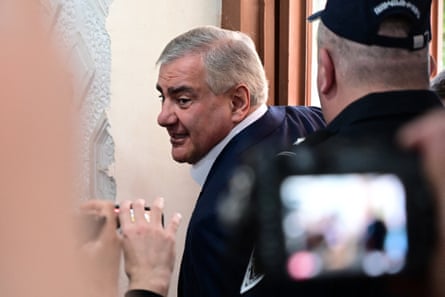
These messages were amplified by Moscow. In the run-up to the election, Russia unleashed what researchers described as an unusually intense barrage of overt and covert influence operations.
Alongside this, Moscow has simultaneously increased economic pressure on Armenia, imposing restrictions on key imports and warning that future subsidised gas supplies could be at risk.
A divisive reformer
Born in the small northern town of Ijevan, Pashinyan began his career as a journalist before emerging as one of Armenia’s leading opposition figures in the 2000s. He swept to power in 2018 after mass street protests ousted the country’s entrenched political elite, campaigning on an anti-corruption and anti-oligarchy platform.
A firebrand campaigner, Pashinyan possesses a rare combination in a region dominated by strongmen and oligarchs: a strongly pro-western outlook coupled with a populist and at times divisive style that has resonated with many Armenians.
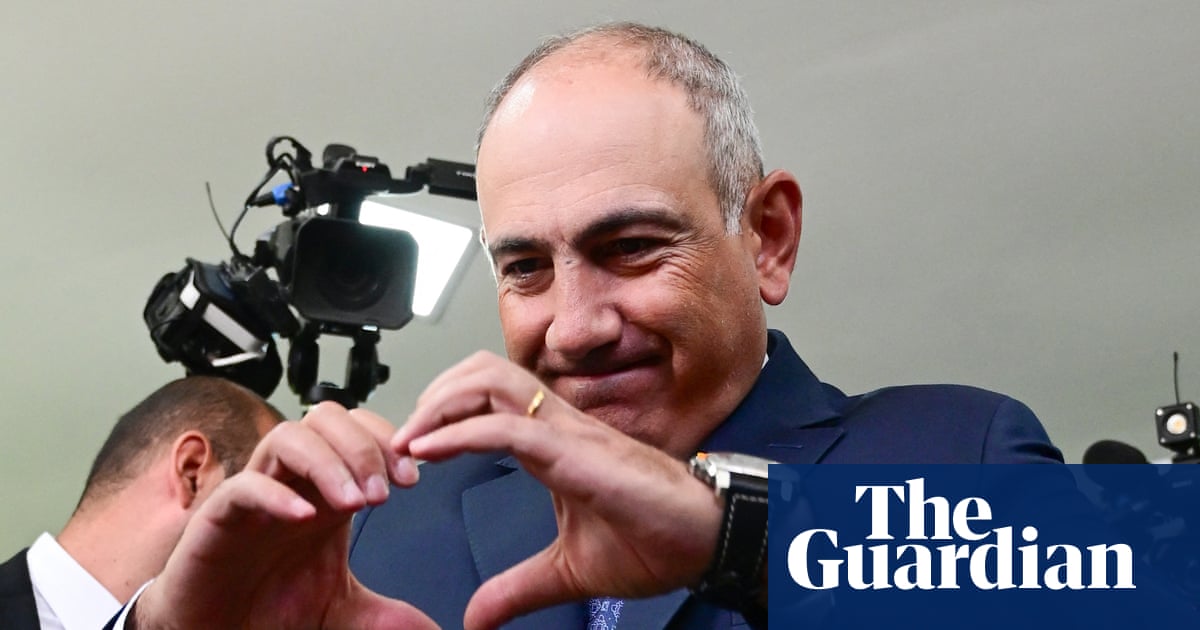
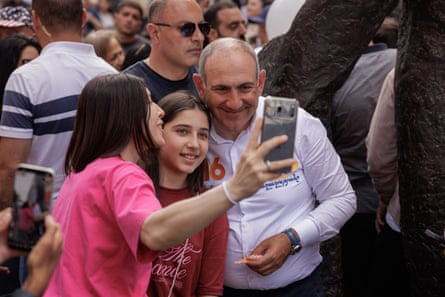
He filmed TikTok and Instagram videos of himself wearing hats stoically grooving to music – from Adele to Kendrick Lamar – staring directly into the camera before breaking into a smile and a hand-heart gesture that has become the symbol of his movement.
At his headquarters on Sunday night, Pashinyan opened his victory address with a passage from the Bible, a nod to the deeply held religious beliefs of many Armenians in a country that prides itself on being the world’s first Christian nation.
Those who know Pashinyan say his appeal lies in his ability to connect with ordinary Armenians. “He’s a guy from the street, and he knows what people on the street want to hear from him,” said Tatul Hakobyan, an Armenian political commentator who studied with Pashinyan and has known him for more than three decades. “That’s why his rhetoric speaks to the hearts of many Armenians,” Hakobyan added.
Yet concerns about Pashinyan’s democratic credentials are growing among observers. In the run-up to the election, authorities arrested a number of opposition figures on charges ranging from vote buying and financial crimes to plotting to overthrow the government.
“His style of government is highly personalised rather than institutionalised,” said Thomas de Waal, a senior fellow with the global analysts Carnegie Europe. “Pashinyan displays a worrying lack of interest in building durable institutions,” De Waal added.
Those worries are likely to intensify after the election. In his first remarks following his victory, Pashinyan suggested that leading opposition figures should be arrested, referring to his main rivals – Karapetyan, Robert Kocharyan and Gagik Tsarukyan – as a “three-headed war party”.
Much of Pashinyan’s success can be explained not only by his own appeal, but also by the weakness of the alternatives. “The biggest problem Armenia has is the absence of a democratic opposition,” said Areg Kochinyan, the president of the Yerevan-based Research Center on Security Policy. “The opposition parties capable of entering parliament are widely viewed as corrupt and closely aligned with Russia. That leaves many voters with few credible alternatives.”
Despite his victory, Pashinyan still faces significant challenges. Russia has threatened economic retaliation if Armenia moves further towards the west, and the prime minister will have to carefully manage relations with a country on which Armenia remains heavily dependent for energy and trade.
Crucially, Pashinyan failed to secure the supermajority required to amend the constitution. That could complicate efforts to conclude a final peace agreement with Azerbaijan, which has demanded the removal of constitutional language that it says implies territorial claims to Nagorno-Karabakh.
Still, Pashinyan struck a triumphant tone on Monday. In a trademark social media video, he gazed into the camera while Queen’s We Are the Champions blared in the background.