Literary sensation 'C'était ça ou mourir' faces AI authorship claims
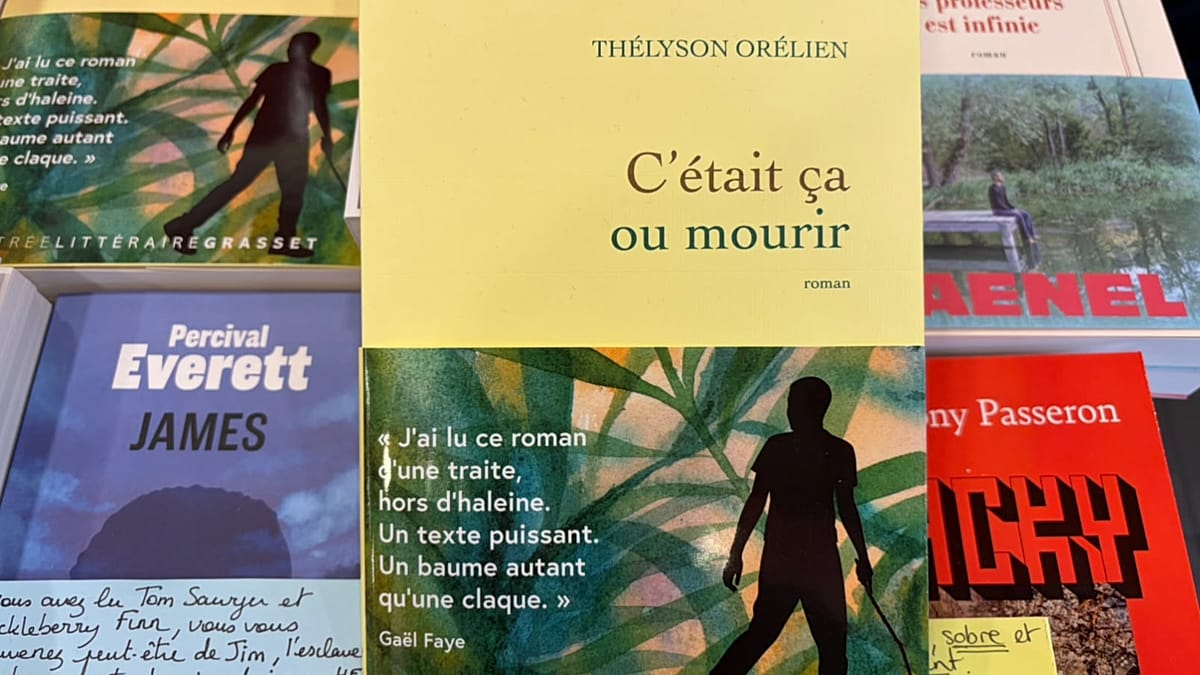
Quebec writer of Haitian origin Thélyson Orélien, longlisted for major prizes, rejects claims by the 'Balance ton Claude' account and says he has suffered racist abuse since arriving in France.
Can an AI detector destabilise a bookshop hit that is in the running for the biggest prizes? In France, the novel "C'était ça ou mourir" by Thélyson Orélien, presented as one of the revelations of the new literary season and already sold in more than 35,000 copies, now stands accused of having been written by artificial intelligence.
The controversy began with a message posted (source in French) on X on Monday 21 September by an anonymous account, "Balance ton Claude". "According to Pangram, this novel is written almost entirely by artificial intelligence," it claims, saying it tested several passages from the "manuscript" and almost always got "the same result: 100% AI".
According to the people behind the account, the US tool Pangram is "by far the most reliable AI detector", with a "false positive rate of 0.0041%".
The accusation is particularly sensitive for the 38-year-old Quebec author of Haitian origin, whose novel is being translated into more than 20 languages and features in the first longlists for the Goncourt, Goncourt des lycéens, Femina, Médicis and Renaudot prizes.
The novel follows the journey across the Americas of Jonas, a young Haitian history and geography teacher forced to flee his country because of violence and insecurity. Before this debut novel, published last winter in Quebec and whose rights for French-speaking Europe were acquired by Grasset, Thélyson Orélien had mainly published poetry.
From "rumours" to "racist attacks"?
Grasset initially insisted it was paying no attention to these "rumours". "We are dealing with fake news. (...) These tools that are supposed to recognise AI are themselves AIs that make up stories about the Bible having been written artificially," the publisher told BFMTV (source in French) on Tuesday morning.
The publisher, known for its yellow covers, also said that dozens of AI-written novels are on offer on Amazon but that "none of them is successful" because "none of them has any individuality". "The complete opposite of Thélyson," Grasset insisted. The house is owned by the Vivendi group, controlled by billionaire Vincent Bolloré.
Early on Tuesday evening, the scale of the affair prompted Grasset to send a statement to several media outlets, including Euronews, giving the author a chance to respond. In it, Thélyson Orélien explains that the "repetitions" criticised as supposedly characteristic of AI-generated text are part of "a Haitian and Caribbean literary tradition", with its own poetics.
He adds that "people are free to discuss my style, but turning its devices into proof of artificial intelligence has nothing to do with literary criticism."
The writer also took the opportunity to thank the readers who "make space in their lives" for his book: "In a world where some people always want to check where you come from before listening to what you say, this welcome moves me deeply."
In the same statement, the Grasset team say they are renewing "their absolute confidence" in the author, "against any machine or attempt to measure, regulate or silence writing that must remain forever free."
Contacted by Euronews, Thélyson Orélien did not wish to respond to our requests. However, he told Libération (source in French) that he has been the target of "numerous racist attacks" since arriving in France.
AI confronted with a "creolised" language
Before the mainstream media picked up the story, it was on X that the affair snowballed. After the first post by "Balance ton Claude", many users relayed the anonymous account's accusations as established fact – including in English – some even going so far as to mock (source in French) the literary world of critics who had "fallen for a style not only written by AI, but fundamentally mediocre and repetitive."
Others amused themselves by feeding Thélyson Orélien's press statement into Pangram, claiming (source in French) that it too was "100% AI".
The accusations also prompted sceptical reactions.
"I don't understand what would be problematic about using AI to write a book in 2026. It would be stupid not to use it," wrote (source in French) journalist Jérôme Colombain. "Ghostwriters have always existed. What matters, in the end, is the author's responsibility," he added in the same post.
For his part, François Negroni (source in French), an author who openly uses AI to write books on aeronautics, explains that AI detectors analyse a text "by spotting statistical regularities: the distribution of words, syntactic structure, sentence rhythm, lexical predictability." He goes on to argue that Thélyson Orélien "doesn't fit into the boxes" of standard French on which the software is based.
"He writes in a French that critics unanimously describe as 'creolised', shot through with Haitian Creole, Spanish and Portuguese, with orality, aphorisms and rhythms from elsewhere," he says, while stressing that he "doesn't know" whether the novel was written "entirely or partly with the help of AI".
Author Christophe Boutry (source in French) replies that it is "possible" that Pangram has picked up on Thélyson Orélien's "creolised" style. "The research showing bias against non-native speakers concerns other detectors, other versions and above all English. That is not enough to state that Pangram 4 is confusing Haitian French and generated text here."
It is worth noting that, on social media, readers had already raised suspicions of AI use. That was the case, in particular, of Alphaleer on Babelio (source in French). "It's a shame the whole book is written with... artificial intelligence. It gives the impression of being pretty, but it's empty," this user wrote on 12 September. "The narrator is a kind of shadow, moving from stage to stage, from border to border, without anything precise or explored in depth," she continued, highlighting what she sees as the novel's "huge inconsistencies".
On Facebook (source in French), author Fabrice Colin points to "stylistic tics that are, to put it mildly, off-putting," "end-of-chapter aphorisms" and "charming but distinctly dubious metaphors". While insisting he is not accusing the author of using AI and saying he has no opinion on Pangram, he says he is flagging up "writing tics that undermine the text" and invites everyone to make up their own minds.
"Balance ton Claude" calls for tempers to cool
On Tuesday, the previously little-known "Balance ton Claude" account enjoyed exceptional visibility, and now has more than 6,600 followers.
Late in the evening, the five people who, according to Radio France, are behind the account posted a final message calling on people to "go easy on the attacks against Thélyson Orélien," acknowledging that "there is a non-zero chance (...) that he is acting in good faith."
The collective then tried to explain its approach, saying it had "flagged up this book" because it was "successful", while acknowledging that the author had "a sort of merit in managing to produce a coherent narrative that has satisfied many readers".
In their view, "the Parisian intelligentsia probably still underestimate what AI can do", and "do not use LLMs much, if at all" – for "large language models" – nor do they spend time on LinkedIn. That, they argue, is why the literary press failed to recognise "the stereotyped turns of phrase".
"What is the point for a creator of outsourcing their invention?"
Independent Lyon bookseller Gwilherm Perthuis says he is following the controversy from a distance and is not taking sides.
"Obviously I find it catastrophic to potentially write a book by asking a generative AI to do it," the manager of the bookshop L'oeil cacodylate tells Euronews, adding that this is "the polar opposite of my idea of literary creation, which is a singular, innovative piece of work on language and form."
Whereas, in his view, the machine "will create archetypes based on pre-existing average data," he asks: "How can AI help to invent? And what is the point for a creator of outsourcing their invention?"
The bookseller does, however, qualify his remarks, mentioning authors who "rely on AI to prepare their documentation and speed up their research before they start writing, when they need to access complex data."
"For me that is the only real use for AI, (...) its ability to produce almost instant results from among millions of pieces of data that would take us years to sift through ourselves."
Will the "Balance ton Claude" affair derail "C'était ça ou mourir" in its race for the major literary prizes, or will it, on the contrary, encourage readers who have not yet opened it to make up their own minds?
The consequences for the novel's reputation could, at least, be measured quickly. The Goncourt and Renaudot prizes will be announced on Tuesday 3 November, the day after the Médicis prize. On Wednesday 4 November, it will be the turn of the Femina jury to reveal its winner. Finally, the Renaudot des lycéens and the Goncourt des lycéens will be awarded on Tuesday 17 and Thursday 26 November respectively.