Why is there so much outrage over FIFA’s ‘hydration breaks’ at this year's World Cup?
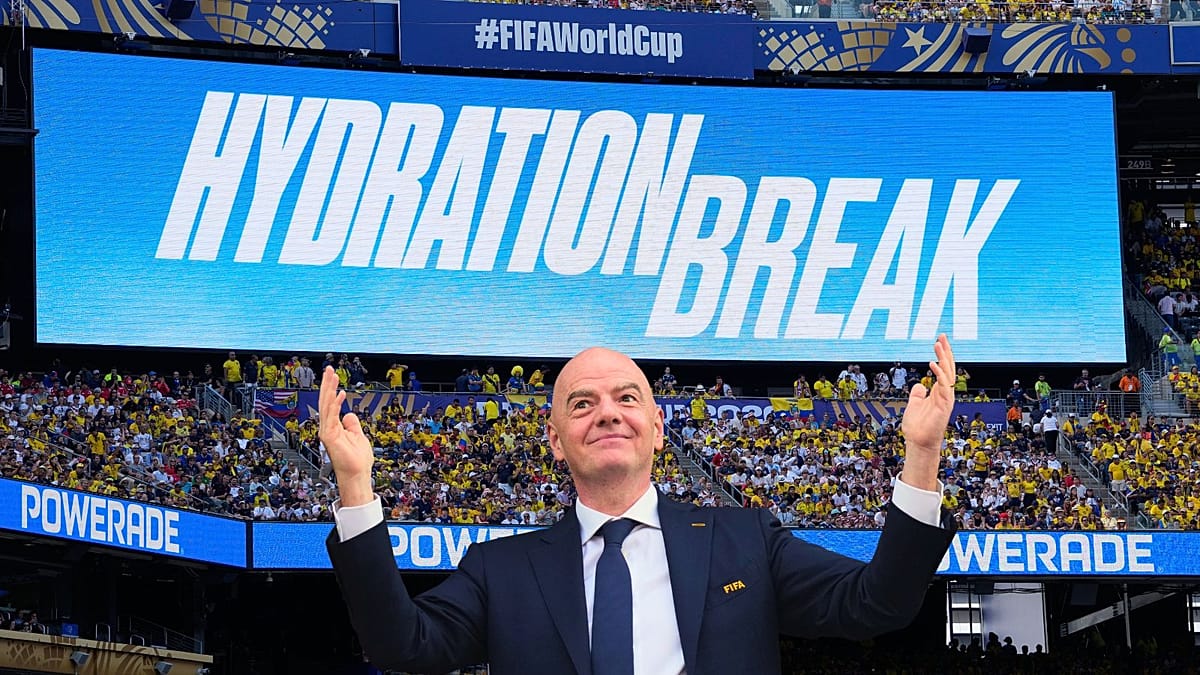
Every World Cup game has been interrupted due to new scheduled "hydration breaks", a move from FIFA which has been met with a chorus of boos. What’s behind the interruptions, and why are they so controversial?
The World Cup has seen plenty of joyous moments already, but also an impressive string of controversies.
From Japanese fans cleaning up stadiums to Scottish food requests and Erling Haaland being a gem of a man, it’s been exciting to see some of the viral moments surrounding the tournament. But at the center of much backlash has been FIFA president Gianni Infantino.
He defended the exorbitant ticket prices which make the tournament look like an elitist shambles; concerns were raised over FIFA’s supposed political neutrality when he awarded FIFA's inaugural Peace Price to Donald Trump; he’s been using a private jet to attend two games per day, thereby adding to what the New Weather Institute has described as “the most polluting event ever”...
Then there was his tone-deaf advice that everyone “should chill” over Somali referee Omar Artan being denied entry to the US, and the recent announcement he made confirming that Donald Trump will hand over the World Cup trophy to the winners at the final on 19 July... The controversies continue, and list goes on.
One grating concern gaining increasing traction are this year's controversial "hydration breaks".
You may have noticed that this year’s matches have seen the jarring introduction of mandatory stoppages midway through each half. The move has been presented as necessary for player welfare, but not everyone is convinced.
Granted, the need to prioritise the health of players in high temperatures is important, but many argue that the four-quarter format more readily associated with American sports are not necessary when so many stadiums already have roofs and air conditioning.
Loud boos have greeted the stoppages and have become a growing trend; but it’s not just the fans who are irked by these interruptions. Players and coaches have spoken out against the way the games are altered by the new structure.
Dutch footballer Virgil van Dijk has criticised their introduction after the Netherlands' 2-2 draw with Japan at the air-conditioned AT&T Stadium in Arlington, Texas, on 14 June.
"Hydration breaks are a bit interesting, because I was obviously watching almost all the games up until today, and every time going to commercial is a bit... Not really that I like it," said van Dijk. "I think for the neutral watchers on TV it's also not great. If it's really hot, obviously it would be good to put them in. But I think you have to look at it in every game, separately, in my opinion. But I think I've said enough already for that."
Uruguay manager Marcelo Bielsa criticised the hydration breaks before Uruguay vs. Cape Verde on 21 June, saying: "According to the general consensus, playing four periods instead of two alters the culturally constructed conception of how to interpret football. In my view, it adds nothing and takes away a lot."
England head coach Thomas Tuchel also admitted he is not a fan of the breaks. "I think that it interrupts and changes the identity of a football match much more than I thought. I had hydration breaks before when it was really, really hot and needed, but they were shorter. It breaks the match almost in four quarters. And I think it changes the characteristic of the match more than I thought."
"Overall, though, I think I like football more when it's played in one go in one half because it builds a momentum,” he added. "It's hard to build momentum, and it's hard to keep the momentum, when there are breaks.”
As for United States women's head coach Emma Hayes, who is working as a pundit for UK broadcaster ITV during the tournament, she said the timing of the hydration breaks can be a double-edged sword.
"It's advantageous for the team losing momentum - that's why I call them momentum breaks," she said. "When you're on top, you don't want it. When you're losing, you do.”
FIFA has argued that its decision to apply drinks breaks across all 104 matches regardless of the local temperature at the time of each match was designed to ensure consistency across the tournament.
However, many have called out Infantino for what they percieve to be the underlying financial motivations behind the drink break imposition. These critics argue that they are a stealth way of inserting advertising.
Indeed, every time the referee's whistle stops the game 22 minutes into each half, viewers watching from home get either a split-screen or a full cut-away to commercials.
So, a shameless money-grabbing scheme?
Infantino insists it isn't, stating that FIFA is making no extra money as a result of networks cutting to commercials.
"There is no additional revenue for FIFA, as all commercial agreements were signed well in advance,” he said. “This is not a financial issue for us. For us, it is purely a sporting matter."
Regardless, the jeers continue, fans aren’t happy, and more people are pointing out how the breaks have opened up additional advertising windows for broadcasters.
“Unnecessary capitalism”, “blatant game disruption for more ad revenue”, “another reason to hate Infantino and the commercialism of football,” are some of the widely shared comments online, with few believing Infantino’s defence when faced with mounting criticism.
Check out some reactions below:
Undeterred, the current head of FIFA has said that the governing body will consider keeping hydration breaks for future World Cups, despite the backlash. And when they do inevitably rule to continue with these interruptions, it’s worth keeping in mind that broadcasters will be chomping at the bit when it comes to live rights...
More heartening for football fans, however, has been UEFA’s reaction.
The governing body of European football has ruled out hydration breaks, confirming that there are no plans to deviate from the traditional uninterrupted two halves for the Champions League and the 2028 European Championships.
In the meantime, at least some are having fun with it:
The 2026 World Cup (and its advertising breaks) takes place in the US, Canada and Mexico until 19 July.