'Response seems far too timid': what role for climate in presidential race?
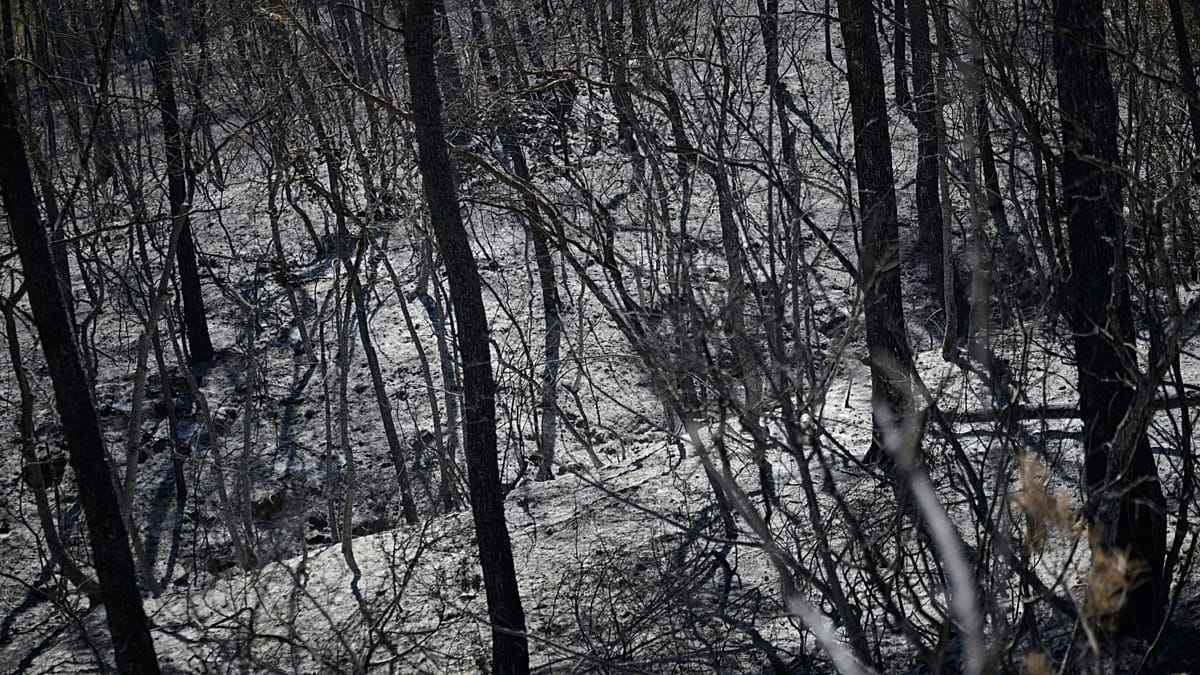
Huge wildfires in Gironde, in the Landes and in the Var. Repeated heatwaves across the country. A severe drought dealing a heavy blow to agriculture. This summer, France has been sorely tested by the...
Huge wildfires in Gironde, in the Landes and in the Var. Repeated heatwaves across the country. A severe drought dealing a heavy blow to agriculture. This summer, France has been sorely tested by the elements.
Last winter, too, the country went through several months marked by a succession of weather fronts and storms (Goretti, Ingrid, Nils, Pedro), causing major flooding across France.
With only a few months to go before the next presidential election, environmental issues are set to take on an unprecedented role in the political debate. Historically carried by the left, the topic has now become unavoidable, forcing the right and the far right to seize upon it.
Because today, "in view of the delays incurred and the seriousness of the situation, France no longer has a choice: it must adapt, and fast", warns the association Réseau Action Climat (Climate Action Network), which challenges the record of successive governments that "have not taken the necessary measures to adapt the country to the effects of climate change".
Yet warnings have been sounding for years. As early as 2013, the IPCC (Intergovernmental Panel on Climate Change) stated that "warming of the climate system is unequivocal and, since the 1950s, many of the observed changes are unprecedented over decades to millennia".
"The years 1983 to 2012 are probably the warmest 30-year period that the Northern Hemisphere has experienced in the last 1,400 years", the report also noted.
Political leaders out of touch
An issue that more and more citizens are taking into account. In a survey published on Monday 24 August (source in French), Ipsos reveals that 64% of French people felt "anxiety or fear" for the health of their loved ones and 48% for their own health during the summer of 2026.
The polling institute also indicates that the French "are looking first and foremost to public authorities for solutions": 79% of respondents want public measures to help the population cope with heatwaves.
For its part, a study by Ademe published last year estimated that 6.3 million French people are moderately eco-anxious, showing early symptoms that should not be allowed to worsen. "2.1 million are highly eco-anxious, with intense and chronic symptoms" and "420,000 of them have mental health that is genuinely at risk", the study (source in French) noted.
The problem is that they are not necessarily being heard by political leaders. "Most parties and presidential candidates seem out of touch with the day-to-day realities of French people who have been severely affected" by these events, says Anne Bringault, programmes director at Réseau Action Climat, speaking to Euronews.
"Faced with an unprecedented challenge for humanity and biodiversity, with the many deaths caused by heatwaves, the economic losses, particularly for farmers, the homes destroyed by wildfires and the parched natural environment, the political response seems very timid and nowhere near matching the expectations of the French public and their perception of the concrete impacts of climate change", she says.
Appearing on France Inter (source in French) on Tuesday, Jean-Marc Jancovici, founder and president of the Shift Project think tank, which works on the climate transition, was even more scathing, arguing that the political class is "in a form of denial" about climate change.
Causes brushed aside
A view shared by Eva Morel, secretary-general of the association QuotaClimat. "The feeling is that elections are really moments when environmental issues struggle to find a way through", she laments to Euronews, before trying to explain this lack of interest. "In fact, they themselves are not encouraged to understand and to put forward ambitious proposals on this issue, because the media reception of their statements is generally quite indulgent on the subject."
She goes even further. "Above all, we cannot hope for a constructive debate on this issue if, when climate-related disasters occur, we talk only about the facts and do not try to understand the underlying factors – both the causes and the structural solutions that would make it possible to address them", stresses Eva Morel.
She points to the example of the events of summer 2026, which triggered discussions focusing "mainly on observations and not necessarily on explanations". "So, for example, we talked more about climate, which is more or less inevitable. But we talked less about fossil energy", she regrets. "From there, we cannot really expect the proposals of the various candidates to be convincing in addressing the root of the problem", the expert continues.
Politicians doing politics
"Which of the candidates places at the centre of their programme the fact that the world is going to change? No one", snaps Jean-Marc Jancovici. In his view, the programmes of declared or potential candidates for the next presidential election are stripped of coherent environmental measures. "You find inconsistencies everywhere", says the president of the Shift Project.
For Eva Morel, this situation is explained in particular by how difficult it is, in "a political system that rewards demagoguery, to ask candidates to address a crisis that profoundly destabilises citizens' ways of life and still come up with a desirable project".
On the right, climate issues struggle to impose themselves over traditionally favoured themes such as immigration or law-and-order questions. "Parties on the right and in the centre are staying in their lane, like Édouard Philippe, who chose to highlight immigration issues during" visit to Mayotte, says Anne Bringault. Eva Morel concurs: "Even when it comes purely to adaptation, the right, as a political family, still does not see it as a political issue."
In his manifesto, Édouard Philippe uses the word "écologie" only once. "We believe that this ambition involves establishing an effective policy to decarbonise our economy, preserving biodiversity and increasing investment in the excellence of French energy and agricultural sectors", he writes, without going into further detail.
For Gabriel Attal, environmental policy for now seems to fall more within a logic of competitiveness and innovation than one of constraint. The Renaissance candidate advocates an energy mix combining nuclear and renewables and wants to make the climate transition a lever for investment and growth.
As for the left, "electoral opportunism, in a context of competition to win green votes, appears to play a significant role", continues Anne Bringault. This competition is all the fiercer as the Greens are struggling to appear united and to impose their line with an eye to 2027, while Jean-Luc Mélenchon is seeking to occupy this space by putting forward proposals such as "eco-regions" or enshrining in the Constitution the principle of the "green rule", under which we do not take more from nature than it is able to regenerate. It is also a way for him to position himself on environmental issues and not leave the Greens alone with a monopoly on this theme.
"What we are seeing is that today the environmental programmes of parties on the left are still more fully developed than those on the right, and that has been the case for several years now", continues Eva Morel. "What we find interesting is the extent to which political discourse mirrors scientific discourse. And today, that seems to be happening more on the left."
RN, king of disinformation
At the other end of the political spectrum, the Rassemblement National strongly rejects so-called punitive environmentalism and opposes wind power, instead making nuclear energy a pillar of decarbonisation.
The party "is hastily trying to throw on a green costume by advocating simplistic solutions that are hardly realistic financially or technically, such as the generalisation of air conditioning", analyses Anne Bringault.
"In fact, they latch onto hot topics. And since climate is now a hot topic, they take an interest in it. It is purely opportunistic", adds Eva Morel, who notes that the RN has rowed back on its previous statements casting doubt on the credibility of the IPCC or the reality of global warming, even if that "is not enough". "The problem is that their political operating system has not taken environmental issues on board at all. They have no proposals that would genuinely protect us from the consequences, let alone address the causes."
She also accuses the party led by Jordan Bardella of relaying, in her view, misleading information. "These are narratives that are deliberately orchestrated because they work with public opinion, instrumentalising moments that generate a lot of attention. [...] It has been shown that this is an obstruction strategy that works. It blocks the implementation of public policies that are supposed to be effective", explains the expert, who cites low-emission zones as an example.
"And what we fear is that, alongside this obstruction, there is an effort to discredit political opponents and environmental defenders by demonising them. And by doing so, they push the solutions away from the problem, even though the problem is very visible", concludes Eva Morel.