Libya launches major security operation in Zawiya after clashes near key oil refinery
Security forces in the city of Zawiya in western Libya announced on Friday the launch of a large-scale security operation following fierce armed clashes that erupted in several parts of the city, with...
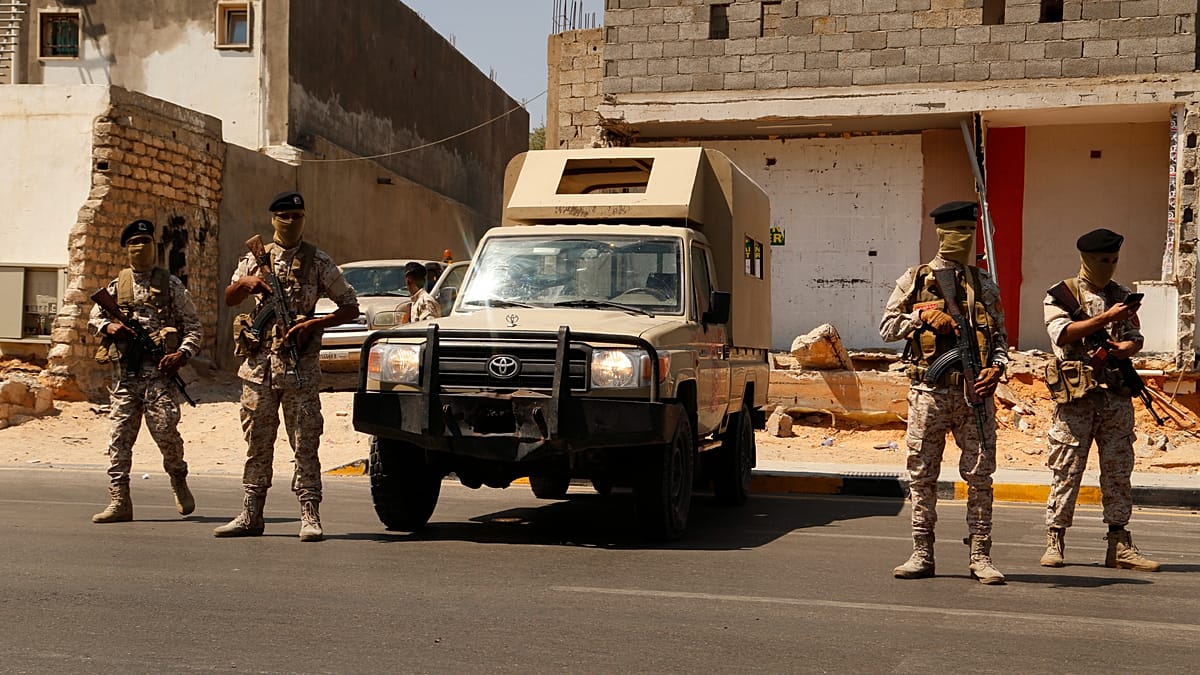
Security forces in the city of Zawiya in western Libya announced on Friday the launch of a large-scale security operation following fierce armed clashes that erupted in several parts of the city, with particular focus on the area around the Zawiya oil complex and refinery, one of the country’s key installations.
The Zawiya Security Directorate and the Joint Security Room said in a statement that the operation was launched on the basis of warrants issued by the competent prosecutor’s office. It covers raids, arrests and searches and the referral of those involved in cases that threaten public security and social peace, including forming criminal gangs, murder, kidnapping and unlawful detention, as well as extortion, drug and psychotropic-substance trafficking, people smuggling and the trade in weapons and ammunition.
Since the early hours of Friday morning, the city has witnessed clashes with heavy weapons between rival armed groups vying for influence. The fighting spread to residential neighbourhoods and areas adjacent to the refinery, causing panic among residents, as bursts of gunfire and explosions were heard intermittently across the city.
Local sources and eyewitnesses said the clashes broke out before dawn and continued sporadically, noting that the area around the refinery was one of the main flashpoints as the fighting expanded to include nearby residential districts.
The Emergency Medicine and Support Centre urged citizens to exercise extreme caution, stay at home and go out only in cases of absolute necessity.
Refinery shuts down
In a related development, the National Oil Corporation and the Zawiya Oil Refining Company announced that they had halted operations at the refinery as a precaution and cleared the port of tankers, after shells landed in operational areas of the oil complex, in a move aimed at protecting lives and infrastructure and limiting potential environmental risks.
The National Oil Corporation stressed that its teams had handled the situation in line with emergency plans, evacuating workers and students from the oil institute except for fire-fighting crews, while monitoring operations continued. It noted that fuel supplies to the capital, Tripoli, and surrounding areas had not been affected despite the refinery shutdown.
For its part, the Zawiya Oil Refining Company said that the shells which fell inside the complex had reached sensitive operational areas, prompting it to shut down the refinery completely and clear the port of tankers as a precaution. It confirmed that its technical teams were working to contain the situation and prevent any further damage.
With no official confirmation of the parties involved in the clashes, local sources reported that the fighting was taking place between armed groups competing for influence inside the city, including local factions vying for control of areas close to the refinery and its surroundings, while no definitive statement has yet been issued by the authorities on their identity.
A strategic city in Libya
Zawiya is considered one of the most sensitive areas in western Libya, hosting one of the country’s largest oil refineries with significant production capacity and connected to vital supply networks that feed the domestic market.
It is also a transit point and hub of intense economic and commercial activity, as well as a crossing used by irregular migrants heading towards Europe’s southern shores.
The city has previously experienced periods of tension and sporadic clashes between armed groups, which have at times led to the closure of major roads, including the coastal highway linking Tripoli to the Tunisian border, further exacerbating the area's fragile security situation.
This latest escalation comes against the backdrop of the complex security and political situation Libya has faced since 2011, with the country still divided between two rival authorities: the internationally recognised Government of National Unity in Tripoli and a parallel government in the east backed by the parliament, while ongoing international efforts to hold elections and unify state institutions remain stalled.
Before the outbreak of the 17 February Revolution in 2011, Libya’s oil sector was going through a period of relative stability, with high production levels that enabled the country to play a prominent role in the global energy market.
During that period, Libya’s crude oil output averaged about 1.6 million barrels per day, with an official target at the time of raising production to around 2 million barrels per day by 2012, capitalising on an improved investment climate after the lifting of international sanctions in the mid-2000s.
Libyan oil exports were directed mainly towards European markets, with countries such as Italy, France and Germany taking the lion’s share, accounting for close to 85% of total exports.
Libya's oil sector rebounded
Despite the political crisis in the country, Libya’s oil sector has seen a marked recovery in production levels this year, approaching the rates recorded before the events of 2011. This points to a relative improvement in conditions at oilfields and installations and greater stability in operations in several key areas.
According to data from the National Oil Corporation, Libya’s average output reached about 1.43 million barrels per day during April and May 2026, the highest level in more than a decade, reflecting a gradual recovery in the energy sector despite the security and economic challenges facing the country.
On the back of this improvement, the Libyan authorities have announced a plan to raise production to around 1.6 million barrels per day by the end of 2026, with the ambition of reaching 2 million barrels per day in the coming years, restoring the country to a leading position in the global oil market.
This increase in production is attributed to several factors, including the agreement on a unified national budget in April 2026, which enabled funding for maintenance and the rehabilitation of oil infrastructure, as well as improved operating conditions at several major fields.
The resumption of full-capacity operations at the Sharara field, the country’s largest oilfield with a capacity of more than 300,000 barrels per day, following pipeline maintenance, has also helped support this rise and reinforce supply stability.
In the same context, geopolitical tensions in some of the world’s key oil shipping lanes, particularly in the Strait of Hormuz, have increased international demand for Libyan crude. Several international players, including the United States, have moved to increase their reliance on Libyan oil to offset potential shortfalls in global supplies.
Libyan crude is distinguished by its high quality, classified as a ‘sweet, light’ crude oil in demand worldwide for its low sulphur content and ease of refining. This makes it well-suited to producing high-grade derivatives such as petrol and diesel.
Libya also holds the largest proven oil reserves on the African continent, making it one of the main players within the Organisation of the Petroleum Exporting Countries (OPEC, with its crude playing a strategic role in balancing the global market.