Nato foreign ministers meet to navigate shifting partnership with the US – Europe live
Key events6m agoOne dead, 'several' injured after reported explosion at industrial complex in Hungary13m agoPoland's Sikorski thanks Trump for last night's announcement on US troops13m agoNato's defence,...
Key events 6m ago One dead, 'several' injured after reported explosion at industrial complex in Hungary 13m ago Poland's Sikorski thanks Trump for last night's announcement on US troops 13m ago Nato's defence, capabilities target and Ukraine among key topics, Rutte says 14m ago Morning opening: Nato meets to take stock ahead of Ankara summit amid tensions with Russia in the Baltics Show key events only Please turn on JavaScript to use this feature
For what it’s worth, we should hear from the US secretary of state, Marco Rubio, soon as he’s expected to arrive at the Nato ministerial any moment now.
Maybe he can offer a bit more clarity on the US deployment to Poland, after the host, Sweden’s Maria Malmer Stenergard, conceded that the US announcements are sometimes “confusing indeed, and not always easy to navigate.”
Italy’s Antonio Tajani stresses the need to have a balanced Nato based on two pillars, the US, and the European allies.
He also declares full support for Ukraine, not just through Nato, but also in terms of giving it a full membership of the European Union down the line – pointedly mentioning the western Balkans in this context, too.
But he also says Nato also needs to have “strong engagement in the south,” and not just look to the risks coming from “the east,” by which he obviously means Russia.
Meanwhile in Sweden, Finland’s Elina Valtonen chooses an interesting phrase to describe her expectations about today’s meeting as she says the ministers “will be hearing secretary Rubio committing the US to Nato.”
She also calls out Russia’s “unacceptable” campaign of “disinformation” against the Baltics, and more broadly talks about Moscow’s responsibility for the state of relations with Nato, which remains a purely defensive alliance.
One dead, 'several' injured after reported explosion at industrial complex in Hungary
Elsewhere, I am keeping an eye on early reports about an explosion at a plant owned by the Hungarian oil company, MOL, in Tiszaújváros in northern Hungary.
Hungarian prime minister Péter Magyar said in a post on Facebook that one person was killed and “several” were seriously injured, with the energy minister on his way to the scene.
Hungarian media outlet 444.hu reported some pictures of the scene after the reported explosion, showing billowing black smoke above the plant.
Poland's Sikorski thanks Trump for last night's announcement on US troops
Poland’s Radosław Sikorski showed up beaming after last night’s US announcement on the deployment of 5,000 US troops to Poland.
He thanks Trump for the decision, saying it means the presence of US troops in Poland “will be maintained more or less at previous levels,” after the Pentagon halted a planned rotation of 4,000 troops.
The exact detail of the proposed deployment is still not clear, but Sikorski is happy with it anyway. “All is well that ends well,” he smiles.
He says last night’s talks focused on Ukraine, where “things are looking up,” and adds that he hopes Russia’s Vladimir Putin will “recalculate” the costs of continuing the war.
Nato's defence, capabilities target and Ukraine among key topics, Rutte says
Outlining his plans for today, Nato’s Rutte said the discussions will focus on “making sure the money is there to deter and defend ourselves against any adversary,” but also turning the money into actual capabilities by ramping up European production.
“We make progress, but still a lot needs to be done. And Ankara will also very much focus on this issue.”
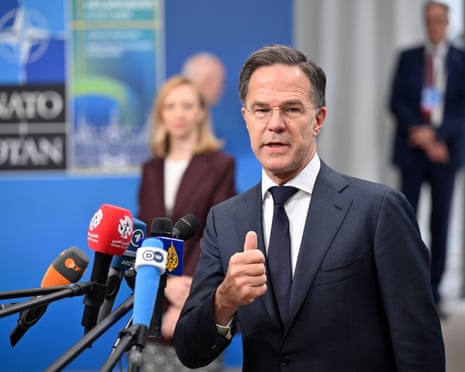
He also specifically mentioned Ukraine, and the need to talk about “how can we keep Ukraine as strong as possible in the fight,” including more funding from European Nato allies.
Earlier this month, Rutte floated this idea of a 0.25% GDP target for spending on Ukraine – a political non-starter, as he himself admitted later (Europe Live, Wednesday) – but expect more pressure on allies in this area.
There will also be some discussion about the reform of Nato in general to move more burden onto European allies, as the US attention gradually turns away from Europe.
“What you will be seeing over the coming time is a step by step process where the Europeans step up more, which is really important – the Americans acknowledge this – and within that process, you will always have, of course, decisions and announcements, which are part of the longer term trajectory. …
Nato is a political military alliance, so that’s the big difference with China or Russia, where one person in the end takes all the decisions. We are a democratic alliance and a military alliance, and that means that decisions will always be informed by military and political considerations, that’s that’s how it works.”
Rutte also pointedly acknowledged Trump’s “disappointment” with Nato’s response to the Iran war, so expect that to come up too.
Morning opening: Nato meets to take stock ahead of Ankara summit amid tensions with Russia in the Baltics

Jakub Krupa
Nato’s foreign ministers are meeting in Helsingborg, Sweden today to discuss the state of the alliance ahead of this July’s major summit in Ankara.

The meeting comes amid growing concerns about Russia’s provocations and accusations against the Baltic states on the eastern flank, with direct threats that even a Nato membership would not save them from Moscow’s anger.
Estonia’s foreign minister Margus Tsakhna said:
“Russia is now using this opportunity to tell the fake news total fake news that Nato allows Ukraine to use our territories or Nato states as Baltic states and also Finland … for attacks against Russia, and this is fake news, because we don’t allow it.”
Latvia’s Baiba Braže added:
“We are grateful for all the allies coming out and denying Russia’s accusations against the Baltic states, Finland, Poland. No, we are not letting Ukraine use our airspace or ground or sea. That’s a fact.”
But there are good news, too, as the US president, Donald Trump, announced plans to deploy 5,000 US troops to Poland, making an apparent U-turn on a previous decision to halt a long-planned rotation of a US brigade.
While Poland’s top leaders were delighted by the news, Nato’s secretary general Mark Rutte struck somewhat more cautious note as he managed expectations about the US presence in Europe, saying:
“Our military commanders are working through all the details, but of course I welcome [the announcement].
But let’s be clear, the trajectory we are on … is a stronger Europe and a stronger Nato, making sure we will over time, step by step, be less reliant on one ally only, as we have been for so long, which is the United States, so that also for them … that they have the possibility and the option to pivot more towards other priorities, which are also in our interests, will continue.”
Let’s more to be discussed behind the closed doors, including Trump’s clear frustration with the way Nato responded to the US requests related to the Iran war.
“You have countries like Spain denying us the use of these bases – well then why are you in Nato? That’s a very fair question,” US secretary of state Marco Rubio told reporters on departure in Miami. “In fairness, other countries in Nato have been very helpful. But we need to discuss that.”
Looks like a busy day ahead. I will bring you all the key lines here.
It’s Friday, 22 May 2026, it’s Jakub Krupa here, and this is Europe Live.
Good morning.