'We need to be more radical' in response to energy crises, EU Climate Commissioner says
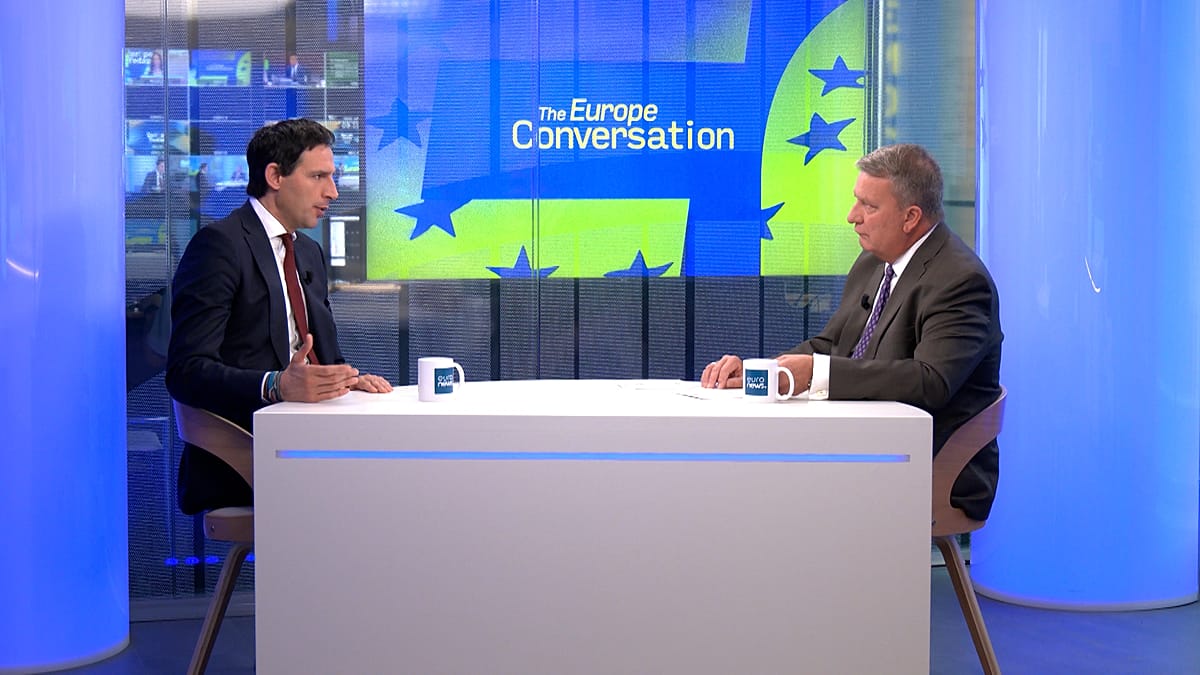
The only way out of energy crises fueled by the wars in Iran and Ukraine is homegrown energy, EU Climate Commissioner Wopke Hoekstra told Euronews. "We owe it to our citizens and our companies."
In light of the worsening energy crises, EU Climate Commissioner Wopke Hoekstra has said the EU must step up its transition to alternative energy sources in the European Union.
"That means more electrification, more renewables, more heat pumps, more interconnectors between our member states, more nuclear," Hoskstra said on Euronews' interview programme The Europe Conversation. "That whole mix is needed."
Starting with the oil crises in the 1970s, Europe has demonstrated its vulnerability given the scarcity of energy sources on the continent, according to Hoekstra.
"The lesson is also that, after every previous crisis, we actually should have been more radical, we should have been more forward-leaning. And that is what we need to do now," the Commissioner said.
"We truly are at the mercy of others. And of course it was smart to get rid of Russian gas. But we replaced that with maybe a bit more renewables, but also by dependency on American LNG, Qatari LNG and LNG from others. Is that a completely safe bet? Well, I guess we have second thoughts about that, right?"
Hoekstra argued that it could well be that this is not the last episode of geopolitical turmoil that Europe will face, and that the bloc "owes it" to its citizens and companies to not burden them with higher prices during the next crisis. "Whether that is in three years or five years or 10 years, no one knows. We have to solve this."
As of early May 2026, Brent crude oil prices have surged above $100 (€around 85) per barrel due to ongoing geopolitical instability in the Middle East.
This surge has created a "third oil shock" for Europe, resulting in significantly higher costs for energy and electricity, which puts businesses under heavy strain.
Rising fuel prices are also causing significant pressure on European households, contributing to higher consumer prices not only for gasoline and heating, but for essentially every agricultural and manufactured product.
In addition, as the European Commission has noted, high energy prices are exacerbating the risk of energy poverty, leading to initiatives aimed at lowering energy bills and protecting vulnerable consumers.
Hoekstra warned that for the time being, Europe will still have to live with current dependencies on fossil fuels.
"Gas will continue to be a transition fuel for years to come, energy demand also, because of what we see in terms of development of AI (Artificial Intelligence), will go up rather than down, even with all the energy efficiency measures that we will probably have up our sleeves," he said.
Billions needed for charging stations and grids
Asked about the slowness of infrastructure modernisation in the EU, Hoekstra conceded that "we have more homework to do".
Billions in investment are still needed, for example, to expand the charging network for electric cars and improve the power grids.
"We're not yet meeting the bar," he said. "So let's be as forward-leaning as we can because every euro invested in this transition is well spent, again, because we are so vulnerable."
Speaking about the current state of affairs of international climate politics, Hoekstra regretted the complete withdrawal of the United States under President Donald Trump from global cooperation.
"The reality is that Americans have checked out on this topic, and that is very unfortunate," he said. "But I have to take the world as it is, not as I would like it to be."
On the other hand, Europe has strengthened its cooperation with like-minded countries from Norway and the United Kingdom, to Canada and Australia, Hoekstra pointed out. The EU also works closely with Latin America, as well as some countries in Africa and in Asia, especially Japan.
At the Climate Conference in Dubai in 2023, Hoekstra said, "we managed to create this supermajority that crossed the north-south divide, and that is, I think, the name of the game going forward."