Burabay National Park in Kazakhstan receives a million and a half tourists
Burabay National Park is undergoing a transformations which should add cultural-historic tours, congresses and gambling to an already much-loved sport and wildlife moments enjoyed by nature lovers.
Three hour drive to the north from Kazakhstan’s capital of Astana there is a place of exceptional beauty. In the middle of the endless steppe, it looks like an oasis. A complex of pristine lakes nestled among the forested hills, with its layered rocks coming out of the lakes and cliffs that look like watch-towers and reflect in the water, it looks like one of the landscapes in the “Lord of the Rings” trilogy.
In winter, when the crew of the Euronews’ “Modern Nomads” series visited it, the lakes are frozen solid, the forests are idyllic under the blanket of snow and the temperature is steady bellow -20 degrees Celsius. Burabay is quieter then as few people decide to brave the cold but that is exactly what gives the place its charm. We enjoyed undisturbed dog-slay rides on the frozen surface of the lake, hike in deep snow, ice-fishing and a relaxing evening in a cozy restaurant looking over the lake.
The summer season is quite different. The park and the adjacent Burabay village team with life, thousands of people spend weekends here and all the restaurants are open, offering great variety of food.
The park offers many more activities over the warmer months – swimming, sunbathing, hiking, cycling, safari with ziplining, rowing, canoeing and taking a boat ride. It has been like that for many years and Burabay, also known as Borovoe in Russian language has been known to everyone in Kazakhstan for decades as a place of beauty and entertainment.
“It is good for family and children tourism, eco tourism, gambling but also active vacation like sport activities,” says Yernar Zharkeshov, Deputy Governor of the Akmola Region where Burabay is.
“We have a special focus on EKO tourism. That is why we have special designated trails for eco-tourists so there is a minimum infrastructure, you can enjoy really wild forests mountain hikes and no one can interfere and you can be in sync with nature,” says Zharkeshov.
Many people are attached to it by childhood memories because since the Soviet times there has been many children’s camps on the shores of Burabay’s lakes. Today there are more than 20.
“On the banks of the nearby lake, there were many pioneer camps during soviet times. They are still there, they were reconstructed, some new ones have been built an dthey receive thousands of children every day. We have prepared the park for this season with more observation platforms, more hiking trails, places for camping. So, whatever the people want, they can find, they can even light a barbecue and have meal in the nature,” says Bauyryhan Makhmetov, one of the senior rangers in the park.
The combination of pine forest and water is believed to be beneficial for the respiratory tract and the park hosts over a dozen sanatoriums and medical institutions. It has been known as a healing spot since Russian imperial times when the first sanatorium for lung patients was built, in 1910.
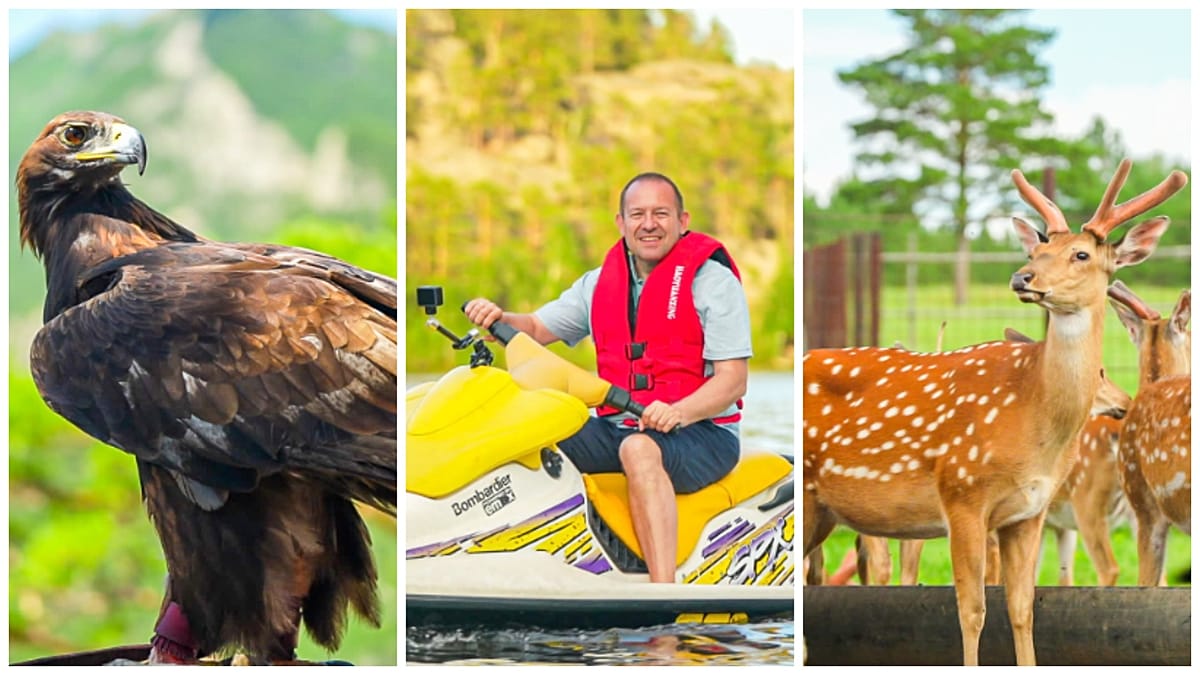
Owing to its 300 species of vertebrae and over 800 species of plants, Burabay National Park was included in the UNESCO’s list of biosphere reserves. Animals that live here include elk, roe deer, wild boar, wolf, Eurasian lynx, fox, ermine, weasel, marten and badger. Tourists also go to local farms of famous maral deer whose antlers, locally called “panty” are used for healing baths.
There is fishing in the summer, too but one has to make sure to obtain permits that are given in limited number in order to preserve the sustainability of the fish fund.
“We issue permits for fishing after careful study of what amount of fishing will not deplete and harm ichtyofauna. It is worth saying that there is a dominant species of fish in each lake and in each lake it is different. For instance lake Borovoe is good for catching pike and perch in winter and Siberian roach and carp in summer. The next lake Schuche is rich in white fish and the one after it in carp. So, fisherman who comes here can have different experience every day, visiting different lakes,” says Sergey Kucherenko, ichthyologist of the Park.
Burabay is currently trying to resolve two seemingly contradictory issues. One is how to make sure that the number of tourists does not endanger the fragile balance of the eko system. The other is how to attract more tourists and improve the economic situation of the region and local population. Local authorities are focused on improving the potential of the winter low season by adding activities that can be done in the freezing winter. Burabay has obtained a very rare permit to organize gambling, which is generally banned in Kazakhstan and is looking into congress tourism that would keep local tourism busy year round.
“There is a special programme of the government which encourages international brand hotela, three, four and five star hotels, to come and construct their hotels here. We already have two hotels but another three of very famous brands are being erected as we speak. At the moment we can organise congresses for 500 people at a time, but we agreed with the government of Astana that they will relocate one of their congress centres to Burabay. In that way we will be able to employ our capacity in all four seasons,” says Deputy Governor Zharkeshov
There is realisation that natural beauties themselves will not attract enough people. Breathtaking as they are, Burabay’s landscapes are not unique in the world and the visitor’s from afar have similar ones closer to home. What is unique in Burabay is its distinctly Kazakh historical and cultural context. It is well known among the Kazakhs who will gladly tell you legends about Burabay. Starting from the one about the name.
There was a magic white camel, called Bura, who came to these lakes and stayed there for a long time, helping the local people and protecting them with its magic. But, one day the poachers came and, after a long chase, wounded Bura with ana arrow. She walked into a lake where, the legend says, she still lives.
Sometimes it seems that every tree and stone in Burabay have legends attached to them. There is a stone that is believed to be the “throne” of a famous Kazakh han, Ablayhan. There is always a steady procession around the stone as people believe that if you walk around it a wish will come true.
The aim of the local government is to offer visitors more cultural content than just legends.
“There is a government programme in which archeologists, our local and nationwide, explore the area. So far, three burial and sacrificial places of an ancient Saka civilization have been discovered and are awaiting further excavations. They will happen in a private-public partnership which will not only unearth the remains but also reconstruct and build those sites as they used to like in the distant past. That will be an attraction that people want to see because for the people of Kazakhstan, this has always been a holy place,” says Zharkeshov.
In one of the burial sites (kurgans) we find a historian and enthusiast who heads the scientific part of the project. He is already showing the place to visitors, members of a book club from Astana who were curious and determined enough to endure the off-road travel to the site.
“The people here always knew this was a sacral place, they just did not advertise it. What we have here are the remains of necropolis, the kurgan of the Scythe civilisiation that lived here 15 centuries BC. It is so-called “kurgan with moustache” because it has a central mound and two curved wall on both sides. In ancient times the people were coming here to ask the spirits for good luck, good health. In less distant times Kazakhs believed a daughter of a khan was buried here and that her spirit is still present. They would come to pray for help to the families, when men, young men, went to wars, their mother would come ere to pray to the spirit of khan’s daughter to save them from harm. People are attracted to such traditions and you see how they come even if it is not easy,” says Zhambyl Artykbayev, Doctor of Historical Sciences.
Last but not least, it should be mentioned that it is becoming easier and easier to get to Burabay from Astana. There has been a good highway for years from Astana. The railroad has been modernised, new carriages bought and just recently, the railway station in the nearby town of Schuchinsk was completely overhauled. From there, it is a short and cheap taxi ride to Burabay which may be a better way to go as parking becomes an increasing problem at the peak of the season.