
Canadian minister stops short of endorsing EU carbon tax as energy alliance deepens
The Canadian climate Minister's reluctance to openly commit to cooperation with the EU on its climate policy stems from the fact that Ottawa is effectively seeking an exemption from the bloc's carbon border tax, according to a December 2025 internal document seen by Euronews.
Canadian Climate and Environment Minister Julia Dabrusin has defended industrial carbon pricing as a tool to cut CO2 emissions and protect businesses from unfair competition, but stopped short of explicitly endorsing the European Union's carbon border tax.
"Industrial carbon pricing is important in a low-carbon economy, which is where the world is going. But these are conversations for us to have (...) those are conversations that are still to be had," Dabrusin told Euronews.
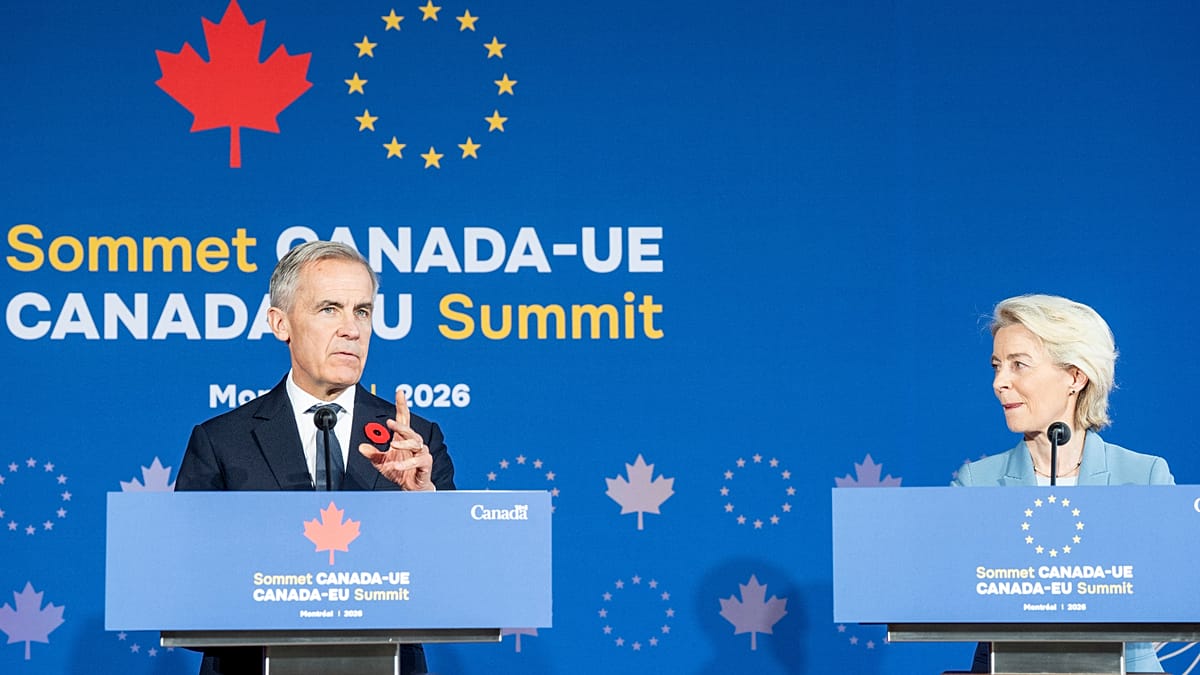
Opposition to the EU's carbon border tax — the Carbon Border Adjustment Mechanism (CBAM) — could expose potential limits to a budding energy alliance between Brussels and Ottawa, as the transatlantic partners embark on a new path of cooperation, hailed at the Montreal summit on 29-30 October.
But when asked whether Canada would back CBAM — which came into effect in January 2026 and imposes a carbon cost on certain imports to protect European producers from competitors operating under weaker climate rules — Minister Dabrusin offered no explicit endorsement.
Dabrusin's reluctance to commit to cooperation with the EU on its climate policy stems from the fact that Ottawa is effectively seeking an exemption from the bloc's carbon border tax, according to a December 2025 internal document seen by Euronews.
"Canada continues to seek a practical agreement with the EU to reduce CBAM's administrative burden for Canadian exporters, and the Prime Minister's Personal Representative to the European Union is fully engaged," the internal document from Canada's trade and foreign affairs ministries reads.
At the closing press conference on 30 October, Canadian Prime Minister Mark Carney said that "a series of trade issues that had been bubbling along" had been discussed, but stopped short of sharing details.
"We are working together to find common solutions (on CBAM and other trade issues)," Carney told reporters on 30 October.
Carney has been attempting to diversify Canadian trade away from its heavy dependence on Washington, making access to the EU market increasingly important.
However, the Canadian document identifies CBAM as a potential obstacle to expanding exports to Europe, particularly in aluminium, steel, critical minerals and hydrogen.
"Canadian exports are not exempt from CBAM and exporters will face carbon charges and complex administrative requirements that could create market access risks and potential competitiveness challenges in the EU market," the document reads.
Lobbying for an exemption
Canada does not qualify for an exemption, despite its existing carbon-pricing policies and close trade relationship with the EU under the Comprehensive Economic and Trade Agreement (CETA), according to the document.
Nonetheless, Ottawa wants Brussels to recognise its domestic carbon-pricing system as sufficiently comparable to the EU's to reduce the administrative and financial burden on Canadian businesses.
Although the legal obligation falls on EU importers, critics argue that such requirements and costs are likely to be passed on to exporters through commercial agreements.
Stephanie Kusie, the Canadian Conservatives' shadow minister for international trade, also raised concerns about how the EU's CBAM could affect businesses.
"Canada is facing an EU carbon tariff in the coming months that could affect $3 billion in Canadian exports. Instead of fixing the issue, the PM has spent months distracting Canadians with talk of the EU," said Kusie.
Between 2021 and 2024, Canadian exports of goods covered by the EU's carbon border mechanism averaged C$28 billion a year, representing 7.4% of Canada's exports to the bloc, according to the document.
Minister Dabrusin said the Canadian government supports industrial carbon pricing, which it has had in place for years and intends to strengthen.
Dabrusin argued that industrial carbon pricing was among the most effective ways to reduce emissions while keeping businesses competitive in a global economy shifting towards lower-carbon production.
However, despite having its own industrial carbon-pricing system, Canada is not exempt from the EU's carbon border levy. Under the bloc's rules, a full exemption is linked to participation in, or a connection with, the EU Emissions Trading System — a condition Canada does not currently meet.
Moreover, the EU's carbon price is significantly higher than Canada's domestic carbon price trajectory.
Battle of semantics over EU-Canada relations
The EU-Canada summit took place as the EU seeks to build a network of trusted economic partners amid souring relations with the United States, which have become more uncertain under Donald Trump's administration.
Canadian Prime Minister Mark Carney told the EU-Canada summit that Ottawa aims to become an associate member by June next year.
However, divergences over the nature of this renewed relationship have been voiced by several member states, led by Germany, particularly over the definition of associate membership. EU leaders agreed to define the concept by the 2027 summit.
Dabrusin told Euronews that, for Canada, delivering on substance rather than semantics was important.
"The main thing for us is deepening the relationship with the EU (...) The conversations we had today underlined how much we have in common in terms of interests and values, and these are things we can build on as we launch the Alliance for the Future," Minister Dabrusin said.