The Big Question: What's stopping Europeans making the most of their money?
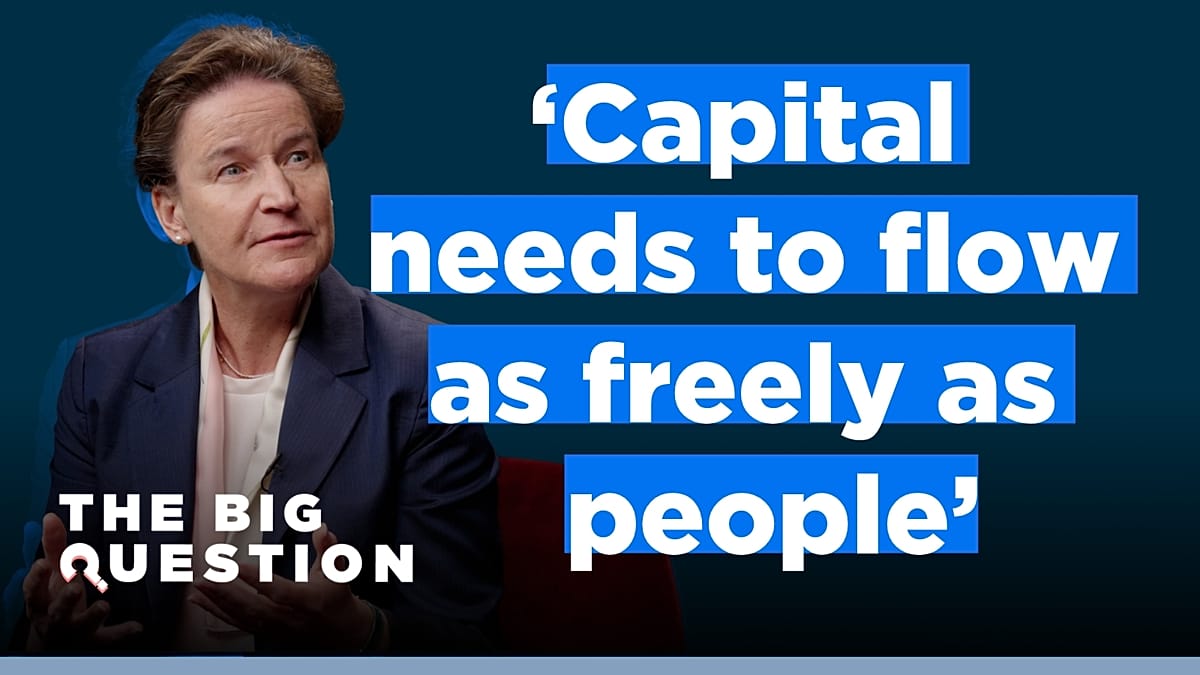
Since its establishment in 2011, Verena Ross has held senior leadership roles at the European Securities and Markets Authority (ESMA), serving first as Executive Director before becoming Chair in 2021. ESMA's...
Since its establishment in 2011, Verena Ross has held senior leadership roles at the European Securities and Markets Authority (ESMA), serving first as Executive Director before becoming Chair in 2021.
ESMA's mission is to enhance investor protection, promote orderly financial markets and safeguard financial stability across Europe.
As Ross prepares to step down as Chair in October 2026, Angela Barnes sat down with her for The Big Question to discuss Europe's investment landscape, the challenges that remain, and the priorities awaiting her successor.
Why do more Americans invest than Europeans?
One of ESMA's key priorities has been helping to implement the Capital Markets Union (CMU), the long-running initiative to deepen Europe's financial markets, recently rebranded as the Savings and Investments Union (SIU).
“We still have, as you say, more often 27 national markets than really a single European capital market,” Verena explained.
The SIU aims to further integrate the EU's fragmented capital markets, reducing European companies' heavy reliance on bank lending while giving investors genuine cross-border opportunities.
"Capital needs to flow as freely as people can within the European Union," she added. Citizens, she argued, should feel equally free to make their money work for them wherever they choose to live and invest.
“So there has been a lot of consideration over the last year. How can we make a real step change here? How can we make sure that we use the extensive savings that we have in Europe and convert it into productive investment that supports growth and works for companies and investors?
"Whenever Europe's capital markets are discussed, comparisons with the US are inevitable. America's markets are deeper, more liquid and supported by a stronger culture of investing," Ross added.
So what is holding Europeans back? Why are we less engaged with our capital markets? Is fragmentation alone to blame?
“In general, in Europe, people are probably slightly less financially literate, but that is not because they don't have the intelligence or the wish to learn about it,” Verena Ross told The Big Question.
“It's more the fact that in America, because you don't have state guaranteed pay-as-you-go pension schemes, anyone who works and who needs to think about his old age needs to directly be engaged in thinking about investing in capital markets.”
To encourage more Europeans to adopt this mindset, Ross argued that people need access to clearer, more accessible information and better tools for comparing investment options, enabling them to "understand the risks, the costs and the opportunities that come with investing in capital markets."
Better pensions, stronger businesses?
How Europeans save their money doesn't just affect their own long-term financial security. It also has wider implications for how businesses raise finance and how the European economy grows.
“At the moment in Europe, still a large proportion of the financing comes through bank credit. But what we need to develop is a more diversified funding source… And in a way, it's a win-win situation when you can bring that together, these savings and the productive investments that they can sponsor,” Ross said.
Europe's reliance on bank credit means businesses can be more exposed when lending conditions tighten, while a significant share of household savings remains in bank deposits rather than being channelled through capital markets.
Verena hopes the Savings and Investments Union will help broaden the range of financing available to businesses, encourage a more integrated capital market and make Europe more attractive to international investors.
“We live in a global world and particularly, capital markets are global by their nature. So we also need to be attractive to overseas investors, whether they are American, Asian or from wherever they come and make sure that Europe is a destination for that investment capital,” she continued.
Ultimately, she believes the challenge is to reduce the barriers created by fragmented national capital markets and build a more integrated market that benefits both European companies and investors.
The future of investing in Europe
While Verena Ross is keen to improve public understanding of capital markets, she also warned about the risks of relying on poor-quality financial information from "finfluencers" and AI.
“AI tools, I think, have a real role to play, but they provide both opportunities and they add risks,” she highlighted while acknowledging that AI is a major source of information for people today.
“At the same time, we need to be clear that AI tools can have certain biases and can actually give you wrong information. So it's also very important that investors don't just trust blindly what is coming out of whatever AI tool that they use,” she said.
As the ESMA Chair looks towards the end of her tenure, and has yet to announce her future plans, she hopes her successor will help realise a more integrated European capital market.
“I really hope in 10-15 years, we have a European capital market, that is deep and liquid, that provides the investment opportunities for investors to invest in European companies, and makes sure that the capital markets are there to support the European economy and its positioning and competitiveness in the world,” she added.
Whether that vision becomes reality will depend on the progress made in overcoming the longstanding barriers to a truly integrated European capital market.
The Big Questionis a series from Euronews Business where we sit down with industry leaders and experts to discuss some of the most important topics on today’s agenda.
Watch the video above to see the full discussion with Verena Ross.