

Denmark’s biggest retailer is training robots for supermarket night shifts. When will they be ready?
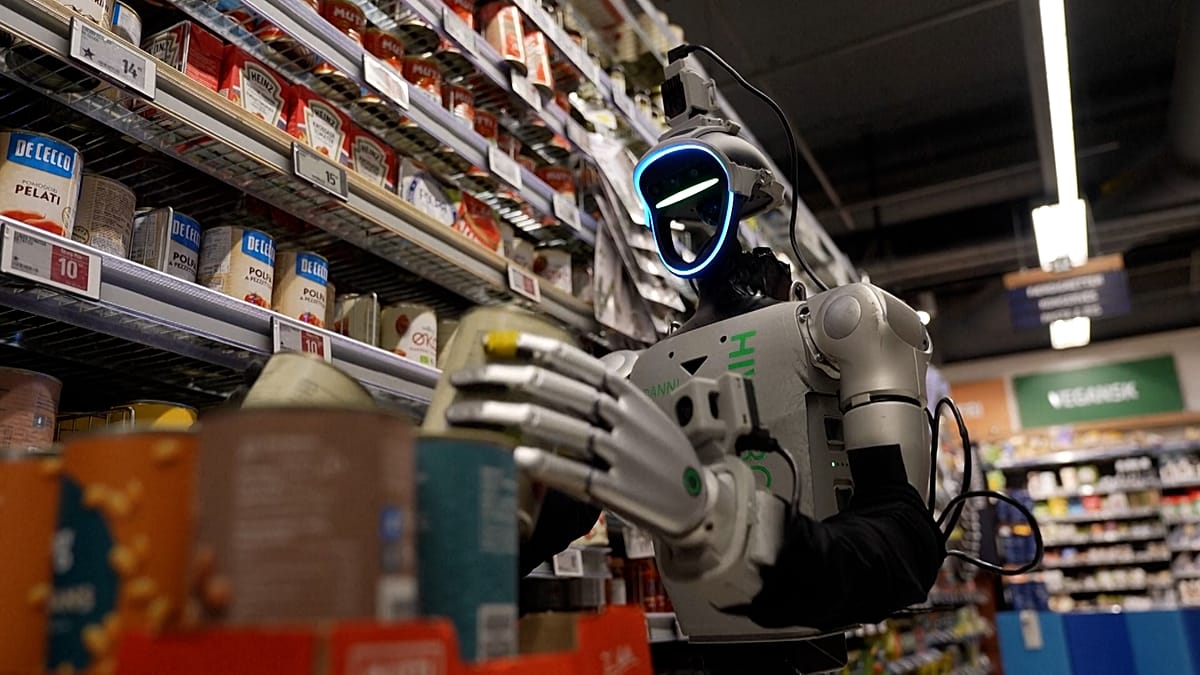
Published on 14/10/2026 - 10:10 GMT+2 In the Danish town of Lyngby, just north of Copenhagen, the supermarket night shift is getting some unusual trainees. Humanoid robots...
Published on 14/10/2026 - 10:10 GMT+2
In the Danish town of Lyngby, just north of Copenhagen, the supermarket night shift is getting some unusual trainees.
Humanoid robots are learning to restock shelves after closing time, part of a multi-year trial to take on routine tasks and free employees to help customers.
With their arms, legs and fingers, the robots can operate in spaces built for people without stores having to change their layouts, according to the Danish start-up, Hive Robots.
For now, they are slower than supermarket workers, though the start-up says advances in AI will help improve their speed and precision.
How do robots learn?
Getting robots to work in real-world settings takes training and data collected on the job.
In a corner of the store, a human operator uses virtual reality glasses and handheld controllers to guide a robot as it picks up pasta bags and places them on shelves.
His demonstrations provide data to teach the machines to perform the tasks independently.
“There are a lot of small things that we as humans don’t think about that basically we need to teach the robot,” said Roger Sala, a robot pilot at Hive Robots.
Training began in June at grocery chain Føtex, owned by Denmark’s largest retailer, Salling Group, which operates more than 2,100 stores across Denmark, Germany, Poland, Latvia, Estonia and Lithuania.
Hive Robots develops the software and trains the machines, which are manufactured by Chinese robotics company Unitree.
The Danish start-up hopes they can independently restock some products at night by early 2027, with stores paying by the hour for the service.
What could it mean for workers?
The deployment of humanoid robots in workplaces adds to the debate over whether AI will ease labour shortages or reduce demand for workers.
AI could change how around 60% of jobs across the EU are done, according to a 2024 report from the International Monetary Fund, helping workers perform some tasks while potentially taking over others.
The technology offers opportunities to improve productivity as well as risks of job displacement, the report said.
Salling Group says the purpose of its trial is to support employees rather than replace them.
The grocery store Føtex estimates that restocking accounts for 40% to 50% of staff time.
Hive Robots says the chain also struggles to recruit young workers for the task.
Føtex operations director Simon Kudsk says it could take up to five years to have robots in every store. Further tasks could include identifying missing or misplaced products, removing empty cardboard boxes and checking best-before dates.
“Our vision or the dream right now is that we eventually could have one or two humanoids in every Føtex store that could support our colleagues to make it more efficient and create more time for value-adding activities focused on customers,” Kudsk said.
Video editor • Roselyne Min