New venomous spider species found in Portugal
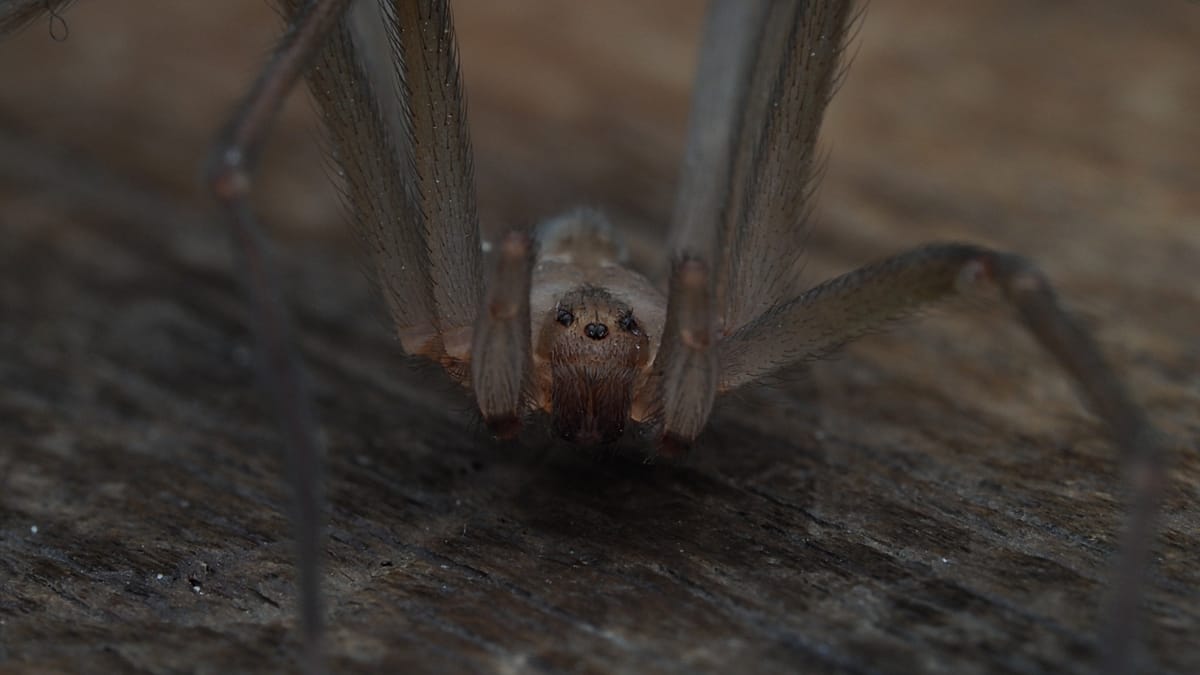
The discovery of the Chilean recluse spider (Loxosceles laeta) in Porto is the first record of this venomous species in Iberia. Researchers say its discreet behaviour means the risk to the public is low.
A new species of venomous spider, the Chilean recluse spider, scientifically known as Loxosceles laeta, has been discovered in the city of Porto in northern Portugal.
Speaking to Euronews, one of the researchers behind the discovery, José Manuel Grosso-Silva, an entomologist at the Natural History and Science Museum of the University of Porto, stressed that, because of the species' shy behaviour and habits, there is no cause for alarm. "The likelihood of people coming across this species or being bitten by it is low," he says.
"It is a shy species, not inclined to bite, but its bite can cause significant damage to the skin, frequently resulting in necrotic skin lesions," the study (source in Portuguese) by biologists Francisco Gil and José Manuel Grosso-Silva on the first record of this species in the Iberian Peninsula explains.
The Chilean recluse spider, Loxosceles laeta, is native to the western region of South America and is usually found in countries such as Brazil and Argentina. However, it has managed to spread to regions far from its original habitat, driven by international trade.
The first specimen was found by chance, the biologist recalls, on 10 September 2025, when a male was spotted on a wall in Campo dos Mártires da Pátria, in Porto. The second, also a male, was found on 10 January 2026; the specimen was collected dead from a sticky trap that had not been set for it.
Despite the discovery of this new species, another venomous spider from the same family has been living in Portugal for several decades and is widely distributed. This is Loxosceles rufescens, or the Mediterranean recluse spider, originally from North America and present in Europe for more than 200 years.
"We do not know whether this new species is confined to Porto or already more widespread. As the Chilean recluse spider can easily be mistaken for the Mediterranean recluse, it is possible that there are photographic records labelled as the latter which in fact show the newly identified species," the biologist notes.
The main difference between the two species lies in the males' pedipalps, jointed appendages located at the front of male spiders' bodies, which have sensory and reproductive functions and are used to transfer sperm to the female during mating.
In terms of morphology and behaviour, they are very similar. "They are uniformly brown, they do not have the colours that allow them to blend into vegetation, and they do not build the kind of webs we usually see on plants for catching insects. They construct webs on walls, in corners and in more hidden, darker places, and are more active at night," José Manuel Grosso-Silva explains.
There are different degrees of severity, from mild cases to severe ones, including some fatalities, as a result of bites by this type of spider. "There is a risk, but it seems low to me, so I try not to fuel panic or excessive alarm," the biologist stresses.
Bite causes necrosis
In 2023, Portugal recorded a case of loxoscelism, a syndrome caused by spider venom, triggered by the bite of Loxosceles rufescens, the Mediterranean recluse spider.
The journal SPMI Case Reports, the digital scientific publication of the Portuguese Society of Internal Medicine, reported the case of a 48-year-old woman who was bitten by this species while she was in an urban park.
After being bitten on the nape of the neck, the woman developed swelling without immediate pain. However, over the following 24 hours the symptoms worsened, with increasing headaches, malaise, feverishness, fatigue and the onset of necrosis with erythema at the site of the lesion. Subsequently, peeling of the skin was observed in other parts of the body, namely around the eyes, in the gluteal region, thighs, lips and oral mucosa.
The patient was discharged from hospital 16 days later with no remaining symptoms.
New species are increasingly common
In Portugal more than 300 species of insects from various regions of the world are now established, many of them introduced by humans through increased goods transport.
"We are increasingly changing the environment around us. We deliberately introduce many plants that often carry insects we did not intend to bring in," he explains.
The biologist recalls the case of the Asian hornet, introduced into Europe via France in a shipment of Chinese bonsais.
Also, "through urban development and monocultures such as eucalypts, which occupy vast areas, as well as extensive crops like maize, natural habitats have been reduced", which contributes to changes in ecosystems and favours the emergence of new species.
Rising temperatures on a global scale, with Europe warming at a particularly rapid pace, may favour the reproduction and spread of these exotic species.
"We do not know how it will evolve here in the Iberian Peninsula; this is a situation to be monitored over the coming years," says José Manuel Grosso-Silva.
Presence of the Chilean recluse spider in Europe
The first European record of this species dates back to 1972, in a building housing the Departments of Zoology and Genetics at the University of Helsinki in Finland.
It is thought that the species was transported by humans and settled inside the building to benefit from the higher temperatures, as it would hardly survive Finland's outdoor climate.
In 2025, Eberhard Karl University of Tübingen in Germany also identified a specimen of this species in the institution's basement.
There are also references to its possible presence in Italy. However, the website where this information was originally published is no longer available and that record therefore remains unconfirmed.