French election 2027: Poll puts Mélenchon in contention for run-off
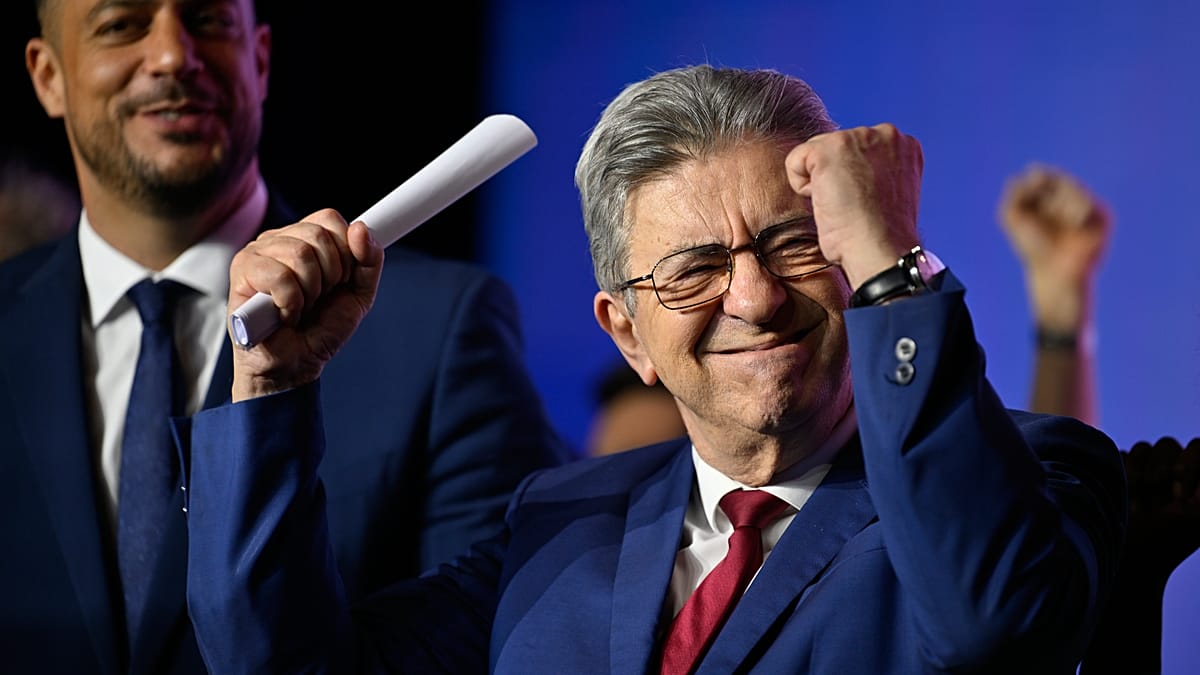
Eight months before the presidential election, Jean-Luc Mélenchon is surging in the polls. The LFI leader could now reach the run-off, while the left is split between his bid and the alternative championed by Raphaël Glucksmann.
Is Jean-Luc Mélenchon's gamble paying off? Eight months before France's presidential election, the La France Insoumise leader appears increasingly well placed to play a leading role.
According to the latest Toluna-Harris Interactive poll for M6 and RTL, Mélenchon would qualify for the second-round run-off in three of the five scenarios tested.
France elects its president in two rounds, with the top two candidates in the first round going head-to-head in a run-off.
However, in a scenario in which former president François Hollande stands, the poll predicts Mélenchon would finish two percentage points behind Édouard Philippe.
The LFI candidate is currently polling at over 16%, up from 12% in the institute's previous survey in April. The rise puts him within reach of Philippe, who has long been seen as the main contender for second place behind Marine Le Pen and her Rassemblement National (RN).
The most favourable scenario for Mélenchon is one in which his rivals are heavily fragmented. When several candidates compete for the centre ground, the LFI leader can move ahead of them.
In a scenario featuring Raphaël Glucksmann, Gabriel Attal, Bruno Retailleau of the conservative Les Républicains (LR) and Philippe - Mélenchon takes 16%, ahead of Philippe on 14% and Glucksmann on 10%.
Momentum comes at just the right time for LFI
The political calendar appears particularly favourable for Mélenchon. On Sunday, addressing several thousand activists at the close of LFI's summer conference in Châteauneuf-sur-Isère, near Valence in southeastern France, he set the tone for the political season ahead.
"Victory is possible," he declared, openly embracing his presidential ambitions.
During a speech lasting almost 45 minutes, the LFI leader sought to show that he was offering more than a campaign of protest, focusing heavily on the economy and the environment.
After a summer marked by heatwaves, wildfires and drought, Mélenchon called for an "ecological state" and a "clear and unequivocal break" with existing policies.
"Climate change is ushering in a completely new era for human civilisation," he said, arguing for fundamental changes to how people live, produce and trade.
The LFI candidate also launched a blistering attack on Emmanuel Macron’s ten-year record, saying that "his departure is now awaited on all sides as a liberation".
He also promised to seek the censure of Sébastien Lecornu’s government if its draft 2027 budget is maintained, judging that it would "worsen all the ills" afflicting the French economy.
Mélenchon–Glucksmann contest is underway
Mélenchon's rise comes as other parties on the French left seek to chart a different course. Raphaël Glucksmann officially announced his presidential bid on Sunday, positioning himself as a social-democratic, pro-European alternative to LFI.
The co-president of Place Publique has called for the left to turn the page on "Mélenchonism" and urged the Socialist Party not to renew its alliance with La France Insoumise.
The parties previously joined forces as part of the Nupes left-wing alliance formed ahead of the 2022 parliamentary elections, and again under the New Popular Front (NFP) after Macron dissolved parliament in June 2024.
Glucksmann is polling at around 10% in the latest survey.
For the Greens, the choice is more difficult. Party leader Marine Tondelier wants to keep channels open with LFI, while others in the party favour closer ties with Glucksmann, the Socialist Party and Place Publique.
Green MP Jérémie Iordanoff has called for a joint structure bringing these forces together, while Yannick Jadot, the Greens' presidential candidate in 2022, announced on Monday that he was joining Glucksmann's camp. Jadot argues that Mélenchon's politics are incompatible with Green values.
'The number of voters is what matters'
The divisions could prove significant. Although Mélenchon is currently benefiting from the fragmentation of his rivals, the left faces a familiar problem: multiple candidates risk splitting the vote in the first round.
Mélenchon dismissed the suggestion that a crowded field would work against him. On Sunday, he summed up his strategy in a single sentence: "What matters is not the number of candidates, but the number of voters."
There is, however, a major weakness in Mélenchon's apparent path to the Élysée. While the poll suggests he is increasingly competitive in the first round, the second remains far more challenging.
In a head-to-head contest with Le Pen, she would take around 68% of the vote against 32% for the LFI leader. Le Pen also beats all the other candidates tested, although her lead is much narrower against Édouard Philippe.
There is still a long way to go before the first round on 18 April 2027. Candidates could withdraw or enter the race, new alliances could emerge and the political balance could shift significantly.
For now, however, the poll represents a significant boost for Mélenchon. Since launching his campaign in the spring, he has not previously appeared so well placed to reach the second round. In several of the scenarios tested, he either overtakes his main rivals or comes close to doing so.
That brings Mélenchon back to the gamble at the heart of his campaign: that a fragmented field can provide him with a route into the run-off.
On the current numbers, reaching the final two is one thing but winning the election is quite another.