Underground fire: Blaze in German lignite mine cannot be extinguished
When a forest fire broke out at the end of June 2026 between Meuselwitz, Mumsdorf and Falkenhain in Thuringia, the fire crews did not yet suspect that the blaze would continue to burn for months. What...
When a forest fire broke out at the end of June 2026 between Meuselwitz, Mumsdorf and Falkenhain in Thuringia, the fire crews did not yet suspect that the blaze would continue to burn for months.
What started as a forest fire has developed into an underground smouldering blaze.
On a former lignite mining site in Thuringia, coal-bearing deposits are still glowing. Experts now assume that it could take years before the fire is completely extinguished.
The reason lies in the nature of the area itself. In the past there was an open-cast mine here for extracting lignite.
That legacy is now proving disastrous for the ground: the remains of the former mine are making firefighting operations considerably more difficult.
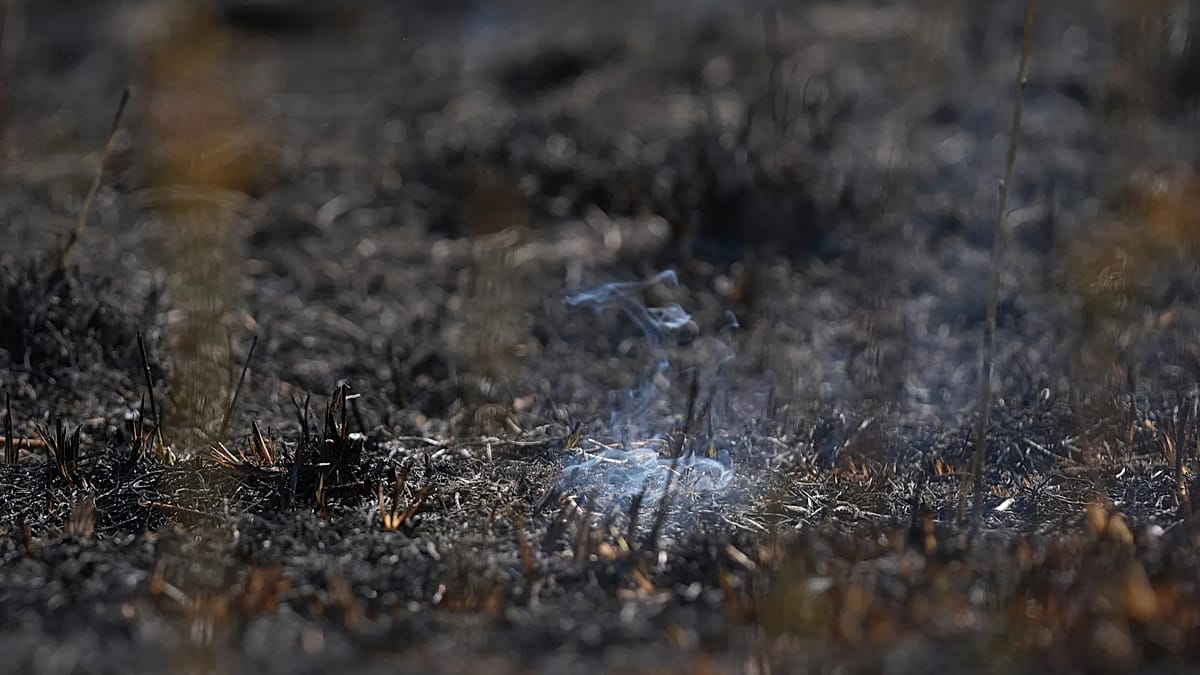
Hardly any flames can still be seen above ground, but smoke continues to rise from the soil. The underground coal-rich deposits keep on smouldering.
What exactly is a smouldering fire?
In a smouldering fire the material does not burn with open flames, but glows slowly under low oxygen supply.
That makes such fires particularly difficult to extinguish: the blaze can spread underground and continue unnoticed over a long period.
An underground smouldering fire is far harder to extinguish than a surface forest fire. Efforts to contain the fire have already been under way for three months, since the outbreak on 27 June.
According to the Lausitzer und Mitteldeutsche Bergbau-Verwaltungsgesellschaft, only limited amounts of water are available in the area for firefighting. In addition, the fire zone may not be entered for safety reasons.
For the moment the emergency services are focusing on preventing the fire from spreading further to adjacent woodland and meadow areas.
To achieve this, the firebreak around the seat of the fire has been widened by up to 50 metres. Sprinkler systems are used to irrigate the perimeter. Drones fly over the area every day for monitoring.
Water-bombing helicopters are of little use here, as they can reach only the surface. The authorities have therefore drawn up a multi-month extinguishing and safety plan.
The first aim is to minimise smoke and odour nuisance. For this reason the smouldering coal slurry basin is being dampened at the surface.
Coal slurry is a mixture of water, coal dust and coal particles that was flushed into the basin over decades, where the solids settled over many years.
According to the LMBV, this fire zone is then to be covered with a two-metre-thick layer that will cut off the oxygen supply. This involves covering the seat of the fire with a thick layer of soil, which is intended to block the oxygen.
Measures against the smouldering fire
To do this, the emergency services will need several hundred thousand cubic metres of water, which is currently being taken from the Zipsendorf residual pit.
This process cannot begin for several weeks, because two pipelines first have to be built over a distance of four kilometres. The construction of a well is also planned. Both projects are to be completed by November.
The flooding of the fire site is then planned by January 2027 at the latest, as Bernd Sablotny, spokesperson for the LMBV management, explained at an event in Meuselwitz.
"We are working flat out to implement the measures as quickly as possible," Sablotny assured.
He also stressed that there should be no delays caused by lengthy approval procedures. Representatives of the competent authorities confirmed this. They were responding to the concerns of numerous residents expressed at a citizens' dialogue.
According to the responsible authorities, no impact on groundwater is expected. The planned construction of the four-kilometre pipeline is also possible in a protected nature area, as it is intended to safeguard the population, the municipality of Elsteraue emphasised in a statement.
To combat the underground fire, the coal slurry basin is first to be deliberately dampened at the surface. Until the long-term safety measures are implemented, work to fight the fire will continue without interruption.
Consequences for local residents
Regular air measurements are now being carried out in the vicinity of the smouldering fire and in the nearest towns. Residents have already complained of respiratory irritation and bad smells; depending on wind strength and direction, different communities are affected.
The town of Meuselwitz is now obliged to hire external experts to carry out a measurement programme, as the Burgenland district explained.
The aim is to determine whether the population is at risk. Among other things, concentrations of carbon monoxide, oxygen, carbon dioxide, methane and hydrogen sulphide in the air are being measured. The LMBV currently speaks of "unremarkable" results.
Air quality is also being monitored in other municipalities, such as Elsteraue.
So far, according to the Burgenland district, no abnormalities have been detected. The municipality itself has confirmed in a statement that it is working closely with neighbouring towns.
Why did the forest fire break out in the first place?
The suspected cause of the forest fire on 27 June is contact between a high-voltage power line and a tree. Late June was just one of several heatwaves that hit Germany this summer. In a number of regions temperatures of more than 40C were recorded.
According to initial findings, the power line may have sagged more than usual because of the high temperatures and come into contact with the tree. That contact could have sparked the fire.
The blaze then spread to the coal slurry basin and ignited coal-bearing deposits just below the surface. Underground they have now been smouldering for around three months.
However, the exact cause of the fire is still being investigated and a final confirmation is still pending.
Lignite mining in the Altenburger Land
In the former Phönix open-cast mine, lignite was mined. The lignite field was divided into six open-cast operations that went into service shortly after 1900 and were worked out by the 1960s.
After mining ceased, Rusendorfer See and Prößdorfer See as well as the Zipsendorf residual pit were created. In technical jargon these are also known as residual pits.
Lignite extraction in the Altenburger Land was discontinued in the 1970s. Briquette plants and power stations at several locations, however, remained in operation until 1990/91.
The present coal slurry basin was largely created during the operation of the Phönix briquette plant. Large quantities of coal slurry were produced during wet briquette production, according to an LMBV statement.