‘Ghost farms’ have been polluting Greece’s waters for years. Now, things are changing
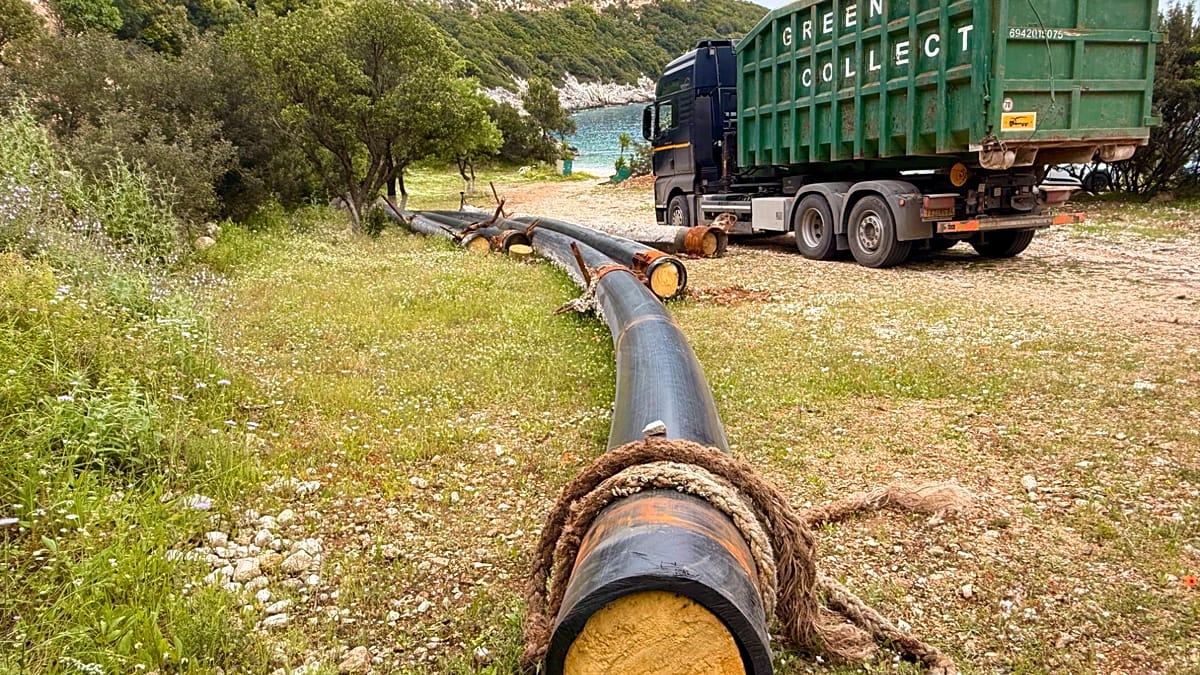
Abandoned farms have left the Ionian Sea filled with fishing nets, tiles, plastics and timber - but media coverage and pressure from the authorities has triggered a momentous 'shift'.
Over the past five years, Euronews Greece has carried out three missions to Ithaca to tackle so-called “ghost nets”.
These are fish farms that have been completely abandoned by their owners. When they left the island, many fishermen failed to remove their nets from the sea, leading to extensive pollution and the death of large numbers of fish.
The owners also abandoned the buildings that housed their businesses. Before long, tiles, plastics and timber also ended up polluting nearby waters.
Although this situation has been going on for years, action by environmental organisation Healthy Seas and the spotlight thrown on the issue by the media, including Euronews**,** appears to have sparked change.
Fish farmers clear up their abandoned nets
Abandoned aquaculture structures that had been recorded near Modi in western Greece have recently been removed by the operator and are reported to have been sent for recycling.
“For Healthy Seas, the case marks an important shift in the way abandoned aquaculture infrastructure in Greece can be dealt with: not only through direct clean-up operations carried out by NGOs, but also through strategic pressure, institutional accountability and coordinated cooperation that will prompt the operators themselves to take action”, the organisation says.
Healthy Seas had identified the abandoned state of the Modi site several years earlier, through surveys carried out jointly with Ghost Diving Greece and in cooperation with the Greek NGO OZON. During these surveys, four aquaculture rings had been recorded at the site, which had already been regarded as inactive and effectively abandoned.
The situation escalated in February 2026, when a large fish-farming ring was spotted drifting in the Ionian Sea before finally ending up near Ithaca, after entering a lane used by passenger ships passing through the area.
Due to concerns about safety at sea, the structure was intercepted by the Coast Guard and towed to shore.
Euronews was on Ithaca in April 2026 and filmed the operation to remove the ring.
Following the incident, Healthy Seas moved to investigate the possible origin of the drifting structure. Drawing on previous surveys, the organisation identified a possible link with the abandoned Modi site.
The type of ring was extremely unusual in the area, making the possible connection hard to ignore. Alongside the removal and facilitation of the recycling of the ring recovered on Ithaca, the organisation stepped up its efforts through ongoing cooperation with the authorities, greater public exposure and formal correspondence with all the competent authorities, informing them of the situation and calling for institutional action.
Shortly afterwards, the Coast Guard carried out a fresh inspection at the Modi site and confirmed that the structures previously recorded there, including during the period when the drifting-ring incident occurred, had by then been removed.
According to the authorities, the operator informed the Coast Guard that the structures had ultimately been transferred to a recycling company.
Although the operator is said to have refused to accept that the drifting ring came from its facility, the abandoned structures previously recorded at the Modi site were removed and are reported to have been sent for recycling.
At the same time, regardless of the origin of the drifting ring itself, the outcome remains the same: one more ghost farm has now been removed from Greek waters.
“For years our work has focused mainly on the physical removal of abandoned aquaculture infrastructure from the sea,” says Veronika Mikos, Director of Healthy Seas.
“What makes this case important is that it points to another possible path: strategic engagement, institutional pressure and coordinated action that can encourage operators to assume responsibility themselves before these structures become even more serious environmental or maritime hazards.”
The case also highlights a broader reality that is becoming increasingly visible in parts of the Mediterranean: aquaculture infrastructure can remain inactive in practice for years while still being considered operational on paper.
Over time, abandoned structures can break loose and pose a risk to shipping, tourism and marine ecosystems.
“This is not just a question of marine litter,” Mikos adds. “The drifting ring near Ithaca showed that abandoned aquaculture infrastructure can become dangerous in busy waters. Preventing such situations requires monitoring, accountability and timely decommissioning before the structures fall apart."