‘Proxy for Trump’ Milei tours Latin America to meet far-right leaders
Argentina’s president, Javier Milei, is not particularly fond of travelling to multilateral forums – it is not unusual for him to skip Mercosur summits, as he did a few weeks ago.But on Saturday he begins a...
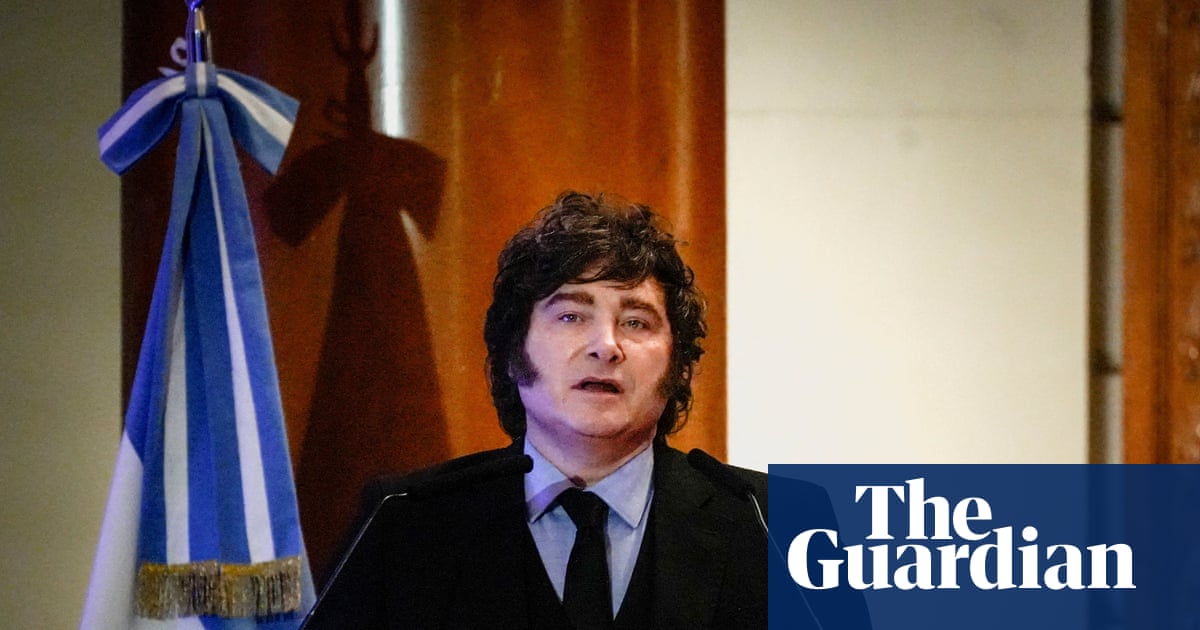
Argentina’s president, Javier Milei, is not particularly fond of travelling to multilateral forums – it is not unusual for him to skip Mercosur summits, as he did a few weeks ago.
But on Saturday he begins a tour of Latin America to meet far-right leaders, starting in Brazil with the launch of Senator Flávio Bolsonaro’s presidential campaign against the leftwing incumbent, Luiz Inácio Lula da Silva, ahead of October’s election.
Milei will then attend Keiko Fujimori’s inauguration in Peru on Tuesday, followed by Abelardo de la Espriella’s inauguration in Colombia on 7 August, from where he will travel to Ecuador to meet president Daniel Noboa.
The self-styled libertarian has justified the trips as those of “a president willing to open up to the world, seeking to triple the country’s trade”.
But analysts point to the timing: amid his declining popularity at home, the tour comes in the wake of a wave of far-right victories in presidential elections across Latin America.
“As someone who has been in power for a little longer, Milei is trying to establish himself as a leader of that group,” said Cristóbal Rovira Kaltwasser, a researcher and professor at the Pontificia Universidad Católica de Chile.
“I’ve never seen Milei take much interest in official visits to other countries,” said Juan Gabriel Tokatlian, a sociologist and professor at Universidad Torcuato Di Tella in Buenos Aires. “What interests him are figures from the world of big tech and the far right, but in neither case is there any real interest in opening trade negotiations,” he added.
Benjamin Gedan, a senior fellow and director of the Stimson Center’s Latin America programme, said a constant in Milei’s trips has been his effort to remain “deferential to the US president, Donald Trump, and never trying to upstage him”.
When Trump took office in January 2025, Milei faced relatively little competition for his affection in Latin America, where fewer than a dozen other far-right presidents were in office, most notably El Salvador’s Nayib Bukele. Trump described Milei as his “favourite president”.
Since then, however, rightwing or far-right candidates have won all seven presidential elections held in the region, with the US president accused of attempting to influence some of them.
Almost all of the winners also interacted with Milei during their campaigns through public exchanges of praise or video calls but, according to Tokatlian, there is no doubt about whom they were really trying to please.
“All these rightwing leaders see Milei as a kind of proxy for Trump, who is the one who is really in charge. They don’t want to be under any kind of Argentine leadership. It’s Milei who’s trying, but there’s no great eagerness for him,” he said.
Tokatlian believes that any contest for Trump’s favour, if one exists at all, will be decided by “whoever gives the US the most on drug trafficking, migration, military cooperation and containing China’s influence”.
The US has signed a series of military cooperation agreements with countries across the region. In March, Trump launched the Shield of the Americas, a “counter-cartel coalition” made up exclusively of far-right leaders aligned with him. Notably absent were key countries for drug production and trafficking in the region – Mexico, Brazil and Colombia – all of which are governed by leftwing administrations.
After being elected, De la Espriella said that Colombia would join the initiative and establish a local Shield of the Americas office in Medellín.
Ariel Goldstein, a researcher and professor at the University of Buenos Aires, believes Milei nonetheless remains ahead of the others in the race for Trump’s attention.
“He has already spent the past two or three years building an intense relationship of friendship and subordination with the US,” he said.
When Trump was re-elected, Milei travelled to Palm Beach to become the first foreign leader to meet him after his victory.
The Argentinian president has also emulated a number of policies from his US counterpart, including withdrawing from the World Health Organization and tightening immigration policies.
Last year, Trump offered a $40bn US bailout that was widely seen as crucial to the libertarian party’s victory in Argentina’s midterm elections.
However, Milei’s path to re-election next year is far from looking smooth: although inflation has fallen, purchasing power has also declined, while unemployment and informality have risen and his administration has been hit by corruption scandals.
Meanwhile, Goldstein believes that Milei and Trump are now heavily invested in winning the next major prize on the electoral calendar: Latin America’s largest country, Brazil.
Besides attending the launch of Flávio Bolsonaro’s campaign, the Argentinian president had hoped to visit the senator’s father, former president Jair Bolsonaro, who is under house arrest after being convicted over an attempted coup, but the request was denied by a justice. Milei has never held a bilateral meeting with Lula.
“A Bolsonaro victory would be hugely important to Milei and Trump because it would allow them to reorganise the whole region around an axis of subordination to the US,” said Goldstein.