Edgar Morin, France's intellectual 'grandfather', dies aged 104
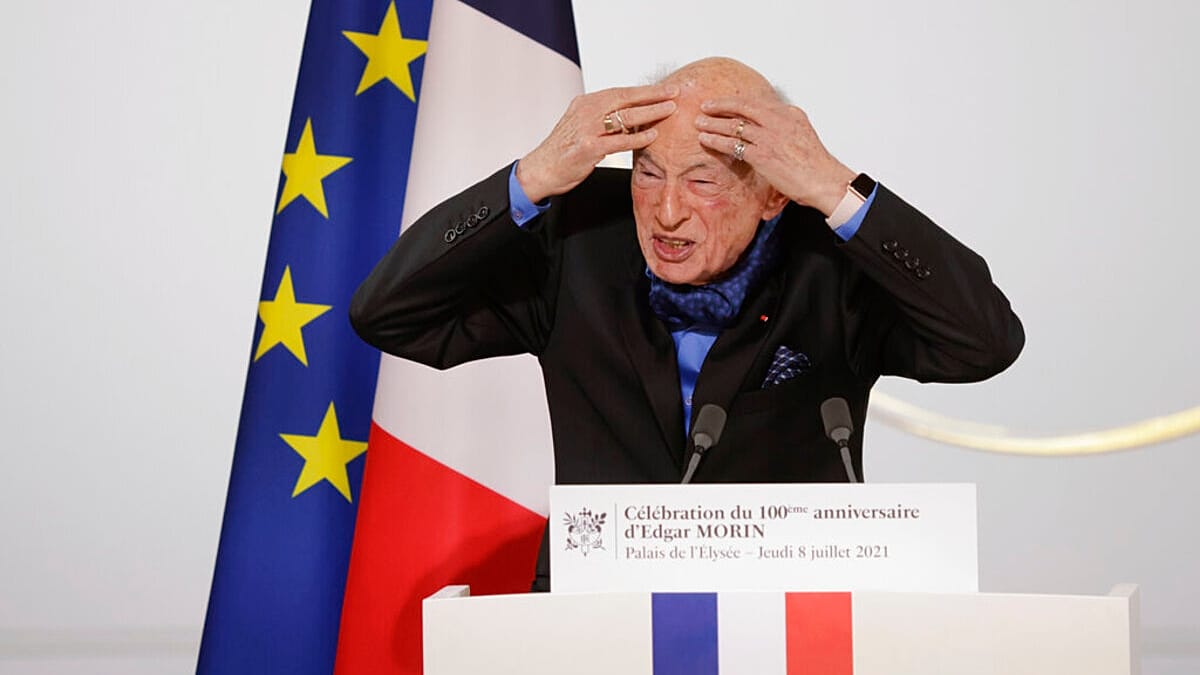
For French people, Morin was above all an intellectual guide, developing a holistic, transdisciplinary approach to the major issues of our time. Outside France, he was best known as the pioneer of 'cinéma vérité' with his film 'Chronicle of a Summer' (1961).
Edgar Morin, one of France's most emblematic public intellectuals, a former member of the Resistance during the Second World War who devoted his life to promoting critical thinking and fighting intolerance, has died at the age of 104, his wife announced on Saturday.
"He is the grandfather of all French people and the memory of the 20th century," wrote the left-wing daily Libération in a 2021 profile of this elegant philosopher, a lover of hats and silk ties.
On Saturday morning, French President Emmanuel Macron paid tribute on X to the memory of this "universal spirit", "humanism personified".
For former Élysée tenant François Hollande, Morin "chose, throughout his long life, the paths of intellectual freedom. Stumbling at times, always correcting himself."
A sign of his undeniable intellectual reach, tributes to Morin were pouring in on Saturday morning, from the right and the far left alike.
The leading figure of France Unbowed (La France insoumise), Jean-Luc Mélenchon, recalled that Morin "at 102 [had] done his part in the protest against the massacre of Palestinians in Gaza", concluding: "An example never dies."
Former French foreign minister Dominique de Villepin said that "his thinking opens the way for us. His voice, so friendly and fraternal, will be with us for a long time."
A similar tone was struck by Enrico Letta, former secretary of Italy's Democratic Party and ex-prime minister, now president of the Jacques Delors Institute:
Finally, UNESCO paid tribute "to the memory and immense philosophical legacy of Edgar Morin, a major figure of thought", adding that "Edgar Morin's intellectual journey is a method for the future".
« What does it mean to be human? »
The son of secular Jewish immigrants, he trained as a sociologist but saw himself rather as a "humanist", blending philosophy, psychology, ethnography and biology in an effort to understand human nature.
Abroad, he is best known as the inventor of "cinéma vérité" thanks to his 1961 documentary made with filmmaker Jean Rouch, "Chronicle of a Summer", which recounts the daily lives of ordinary young Parisians.
The spontaneous discussions about social class, race, colonialism and other major issues, sparked by the simple question " Are you happy?", revolutionised the documentary genre.
" It is one of the greatest, boldest and most original documentaries ever made, " enthused the New Yorker magazine in 2013.
For the French, Morin was above all an intellectual guide, who developed a holistic, transdisciplinary approach to the big questions of our time.
" What does it mean to be human? What is globalisation? What is life? These questions require us to connect forms of knowledge that are currently scattered across different fields of research, " he explained to TV5 Monde in 2020.
Long after his hundredth birthday, he continued to comment on current affairs, sharing his thoughts with his 220 000 followers on X, from the 2022 heatwave, when he posted: " Paris, 6 pm, 40°C: Rise, long-awaited storm! " to the war in Ukraine, when he wrote: " War is a lesson in hatred. "
" Until his final days, Edgar Morin remained attentive to the world, to others and to the great human questions that nourished his thinking, " his wife, Sabah Abouessalam Morin, said in a statement sent to AFP on Saturday.
" Today, the void he leaves is immense. But his courage, his loyalty to people and ideas, his moral rigour and his hope continue to accompany us."
Rejected by the communists
Morin, born Edgar Nahoum on 8 July 1921 in Paris, was the son of Jewish parents who had emigrated from Greece. He always refused to be defined by his Jewish identity, insisting that he was also " French, Mediterranean and a citizen of the world ".
At the age of 10, he lost his adored mother, a fact his family tried to hide from him for weeks and which he would later describe, decades on, as his " personal Hiroshima ".
He took refuge first in his studies, then in left-wing activism, and joined the Communist Party.
After initially advocating non-violent resistance to the Nazis – one of two major errors of judgement he later acknowledged, along with his initial post-war support for Soviet leader Joseph Stalin – he joined the Resistance under the pseudonym Edgar Morin.
With degrees in history, geography and law, he went on to head propaganda for the French military government in post-war Germany, then worked as a journalist before joining the CNRS.
A restless spirit, he incurred the wrath of his communist comrades for writing in a newspaper deemed pro-American.
Expelled from the party, Morin developed a deep distrust of indoctrination, which he expressed in his book " Autocritique ", insisting on the need to question one's beliefs continually.
He nevertheless remained an influential voice on the left.
His analyses of issues as varied as the antisemitism that fuelled the wildest rumours of Jewish customers being abducted from clothes shops in Orléans in the 1960s – a bout of collective hysteria on which Morin wrote a book – and globalisation reached a wide audience.
A French oracle
From the 1970s onwards, he began warning of the environmental dangers of unbridled economic growth – one of the many themes on which he proved remarkably prescient.
He was also fiercely critical of Israel's treatment of the Palestinians, writing in a 2002 article that "the Jews of Israel, descendants of an apartheid called the ghetto, are ghettoising the Palestinians" and that "Jews who were humiliated, scorned and persecuted humiliate, scorn and persecute the Palestinians".
He was convicted of antisemitism over the article, but acquitted by the Court of Cassation. The case, during which Jewish extremists accused him of being a "self-hating Jew", won him broad sympathy among his academic peers.
As a sign of the universal respect he commanded, on his hundredth birthday in 2021 Morin was invited to dinner by President Emmanuel Macron.
A prolific writer – he authored dozens of books, the latest published in 2025 – his warnings about the climate emergency and the excesses of unfettered capitalism made a lasting impression.
Edgar Morin in 5 dates:
1921 Born on 8 July
1941 Joined the French Communist Party (until 1951)
1950 : Researcher at the CNRS, where he was promoted to director of research in 1970
1982 Publication of Science avec conscience (Fayard), the work in which he set out for the first time his theory of the "complex human"
2024 Publication of La méthode de la méthode, volume 3 (Actes Sud)