
Is von der Leyen’s ‘associate membership’ for Canada already dead?
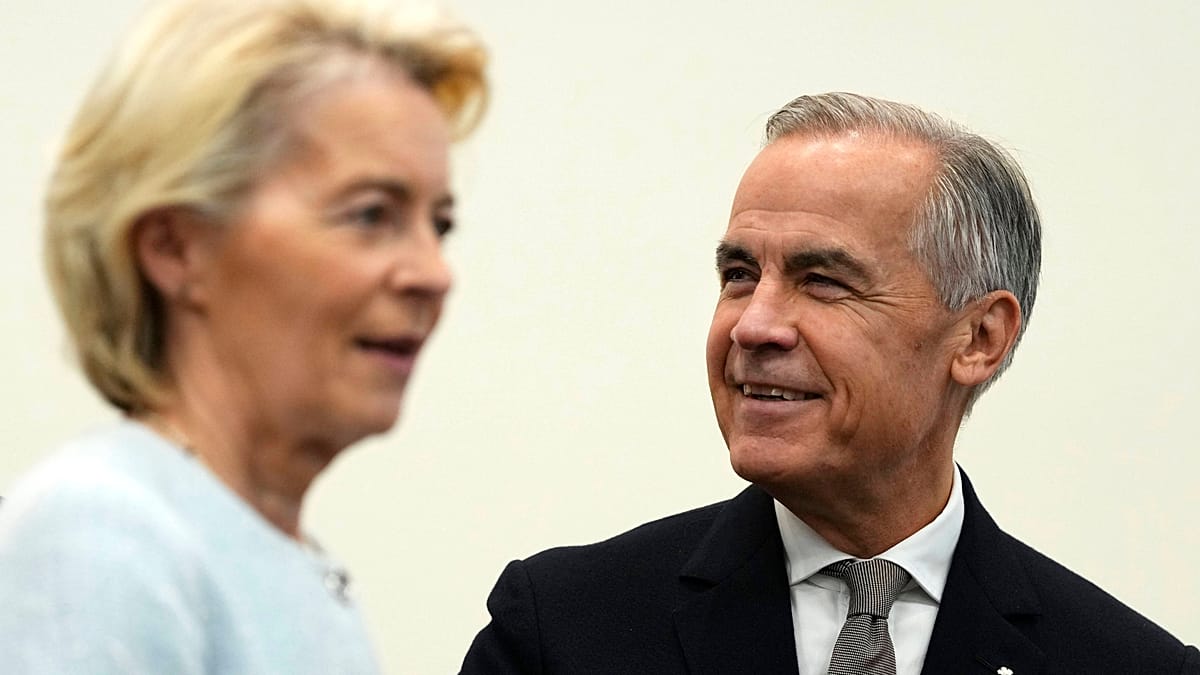
The term ‘associate membership’ was dropped from the EU-Canada summit text after German pushback, in a major blow to Commission President von der Leyen. Nonetheless, the two sides are still keen to boost their partnership.
Just weeks after European Commission President Ursula von der Leyen unveiled a bold new blueprint for relations with third countries, starting with Canada, the idea of “associate membership” has been quietly buried. Has her grand vision already run aground?
On Wednesday, all references to associate membership were scrubbed from the joint statement due to be adopted at this week's EU-Canada summit, following objections from several member states, led by Germany.
Instead, the text agreed by member states speaks of developing an “ever closer association” between the EU and Canada, stopping short of full membership.
"It would have been much better to have unity from member states on the initial wording, but we have a strong basis that is agreed. And we are fleshing out the details. But most importantly, we have a common approach in terms of what the objective is that we want to pursue," Commission chief spokesperson Paula Pinho said on Thursday.
It may look like a semantic distinction, but it amounts to an embarrassing political setback for von der Leyen, who floated the idea of Canada becoming the EU's first associate member with great fanfare in September.
Arriving in Montreal for the summit, von der Leyen appeared determined to press ahead regardless.
“We have a new ambition: bringing Canada closer to us than ever before, as associate member of the EU. And we want to take our unique partnership even further,” she wrote on X.
Yet despite the wordplay, the final text leaves little doubt that the much-hyped format failed to win the support of European governments, whom von der Leyen did not consult before making her grand pitch to Canada.
Her own country, Germany, led the charge to remove the term, arguing that the substance of the new partnership should be defined before attaching a label with potential legal implications, rather than the other way round.
There is an irony here. Associate membership was proposed last May by German Chancellor Friedrich Merz as a way of offering Ukraine security guarantees while it worked towards full EU membership.
Ukrainian President Volodymyr Zelenskyy rejected the proposal, which was never properly discussed among EU countries. Berlin, of course, denies that this is the real reason it so vehemently opposed Canada's associate membership.
“What the EU can do is technical, is a sector-by-sector approach. The ‘associate membership’ provided a package for it; it put a label on the partnership,” an EU diplomat told Euronews, speaking on condition of anonymity.
Perhaps even more telling, Canadian Prime Minister Mark Carney never fully bought into von der Leyen’s idea, preferring the notion of an 'Alliance for the Future'.
“The President used both terms. The precise nomenclature is a question for Europe,” Carney said at a press conference after von der Leyen’s speech, when asked whether he was comfortable with “associate membership”.
Again, the semantics hide different worldviews. For Carney, the Alliance for the Future is an open concept: a group of middle powers he championed in his landmark Davos speech in January as a new framework to safeguard global stability and the rules-based order.
The EU, by contrast, does not regard itself as a middle power, as officials in Brussels are fond of reminding anyone who will listen. Associate membership was intended to place the bloc at the centre of a new international coalition of democracies – not merely as one partner among equals, but as its leader.
That is why whatever arrangement the EU strikes with Canada matters beyond bilateral relations. Other like-minded countries, such as Australia, South Korea and Japan, are watching closely for a potential blueprint for how Brussels engages with third countries.
“In the world we are living in today, which is not the easiest, this is the right response: have the courage to think out of the box, have the courage to do something new, and have the courage to set out a vision,” said an EU official, also speaking on condition of anonymity.
Von der Leyen may have overplayed her hand, promising a partnership she could not deliver because she moved too far ahead of the member states. Still, it is hard to dismiss that EU-Canada ties have never been stronger in the past few months.
From joint exploitation of critical raw materials and common stockpiling to mutual market access in strategic sectors like AI and cloud, via systematic integration in EU defence programmes and early consultation on major policy areas, the relationship is on steroids.
Bernd Lange, the German MEP who chairs the European Parliament's Committee on International Trade, said that the disagreement over terminology should not overshadow the EU's growing ties with Canada.
“Getting caught up in debate over the partnership’s name only distracts from what really matters. So call it how you want, but what matters is concrete action, not words. The momentum is there,” he wrote on X.