Naples ring road is Italy's first smart road: reshaping future mobility
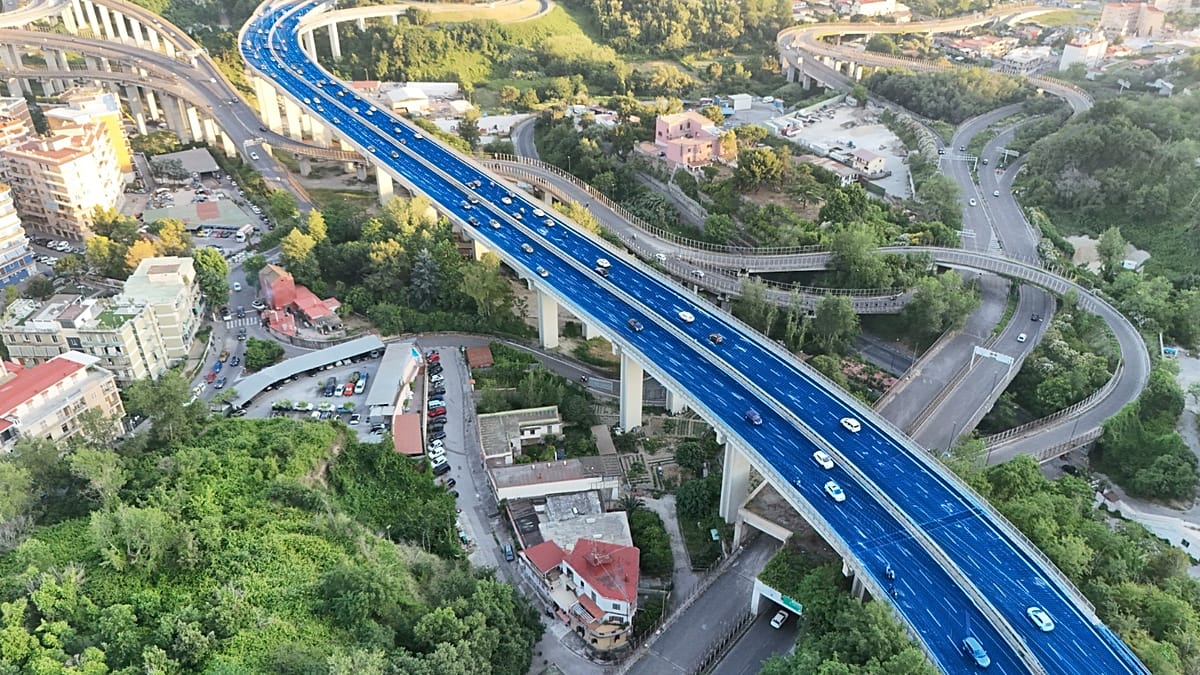
Naples' ring road has been certified by Italy's transport ministry as the country's first Smart Road. Sensors, traffic monitoring and car-to-road communication herald the mobility of tomorrow.
By Euronews
Published on 11/06/2026 - 15:33 GMT+2
Italy's smart mobility revolution starts in Naples. Tangenziale di Napoli is in fact the first road infrastructure in the country to have obtained official Smart Road certification from the Ministry of Infrastructure and Transport.
The recognition confirms the adoption of advanced technologies for infrastructure monitoring, intelligent traffic management and real-time communication between the road and connected vehicles, including self-driving ones.
It is a milestone that projects Italy into a new era of mobility, turning one of the main urban arteries in the South into a national model of innovation.
The project that transformed Tangenziale di Napoli
The initiative is the result of collaboration between Tangenziale di Napoli, a company of the Autostrade per l'Italia Group, the Ministry of Infrastructure and Transport, the National Centre for Sustainable Mobility (MOST) and Movyon, the technology hub of the Aspi Group.
The aim was clear: to make the infrastructure capable of collecting, processing and sharing real-time information to improve the safety, efficiency and sustainability of traffic flows.
Today Tangenziale di Napoli is one of the most advanced Italian laboratories dedicated to connected and cooperative mobility.
The three features that define a Smart Road
To obtain certification, Tangenziale di Napoli had to meet three key requirements laid down by the regulations.
Intelligent traffic monitoring
Sensors capable of collecting continuous data on traffic have been installed along the entire network. The information is processed by advanced traffic models that support operators in the control centre in their decisions on how to manage traffic.
This approach makes it possible to intervene in a preventive way, reducing congestion and critical issues before they turn into emergencies.
Real-time weather monitoring and hydrogeological risk
Another key element concerns the monitoring of environmental conditions.
Weather stations and dedicated sensors detect data on rainfall, road surface conditions, water levels and the state of the surrounding area. The system is designed to promptly identify risk situations such as floods, landslides or other potentially dangerous phenomena, alerting operators when certain safety thresholds are exceeded.
Communication between infrastructure and vehicles
The real innovation lies in the two-way communication between the road and the car.
Thanks to Vehicle-to-Infrastructure (V2I) technologies, connected vehicles can receive directly on board information on accidents, roadworks, obstacles, weather conditions, road surface conditions and recommended speed.
At the same time, vehicles also transmit data to the infrastructure, providing a much more precise and immediate picture of traffic conditions.
This means that the operator no longer simply reacts to events but can anticipate them and manage mobility proactively.
More than 200 cameras and 40 antennas along 22 kilometres
The new Naples Smart Road is based on a dense technological network.
Along the 22 kilometres of Tangenziale di Napoli the following are being installed:
- 217 smart cameras;
- 15 traffic detection gantries;
- 8 weather stations;
- 40 communication antennas with ITS-G5 and Cellular V2X technology.
All the data collected flows into the Movyon C-ITS central platform, which integrates information coming from the infrastructure with other external sources and uses it to provide continuous monitoring of traffic conditions.
The systems can detect the position, speed and direction of vehicles, providing drivers with up-to-date information and helping to improve both road safety and the quality of journeys.
Connected cars and self-driving vehicles: the test between Vomero and Fuorigrotta
One of the most innovative aspects of the project concerns the testing of self-driving vehicles.
On the stretch between Vomero and Fuorigrotta, the first Italian test was carried out in which a self-driving vehicle changed its speed in real time, following the instructions received directly from the road infrastructure.
At present, 30 connected vehicles are operating on Tangenziale di Napoli and are able to communicate constantly with the network.
The system is already able to warn drivers of dangerous situations such as roadworks, broken-down vehicles, adverse weather events or other critical issues, also suggesting the optimal speed to limit the build-up of queues.
“The goal achieved today by the Autostrade per l'Italia Group is a very important result,” said Arrigo Giana, chief executive of Autostrade per l’Italia.
One of the pillars of this process is technology. From this point of view, Giana concluded, thanks to the synergies developed within our Group we have shown that we can be a trailblazer and a testing ground for the mobility of the future.