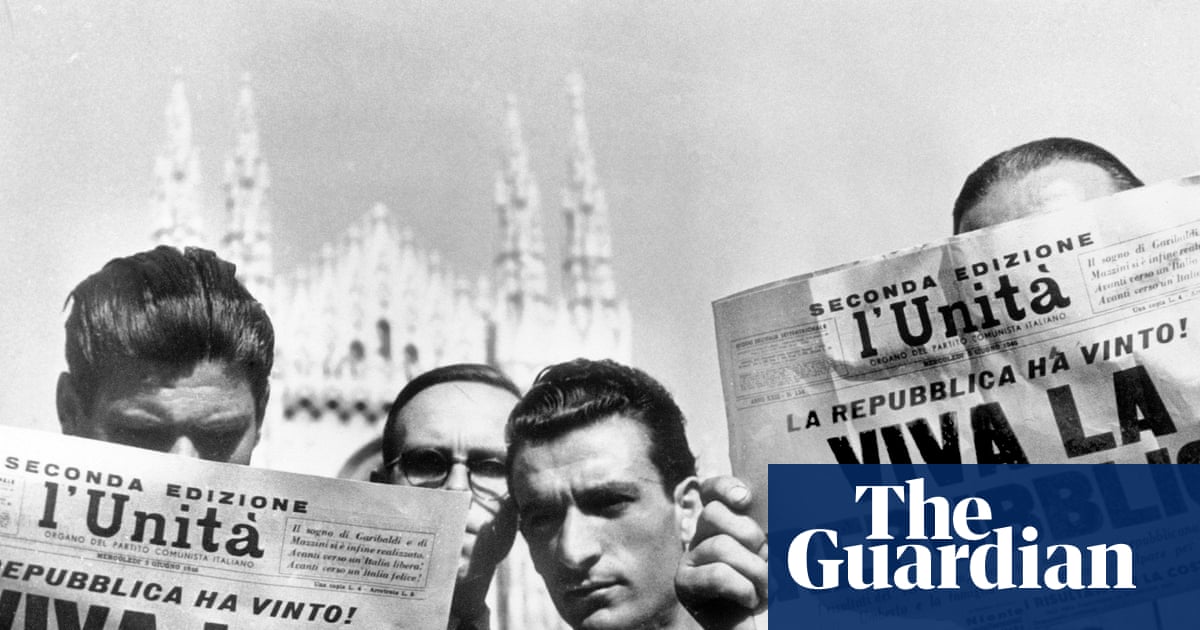
Italy votes to become a republic – archive, 1946
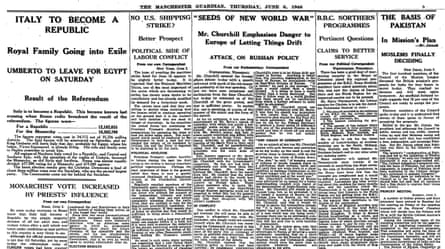
Italy to become a republic: royal family going into exile6 June 1946Italy is to become a Republic. This became known last evening when Rome radio broadcast the result of the referendum. The figures were:For a...
Italy to become a republic: royal family going into exile
6 June 1946
Italy is to become a Republic. This became known last evening when Rome radio broadcast the result of the referendum. The figures were:
For a republic …….… 12,182,855
For the monarchy .… 10,362,709
The figures represent votes cast in 34,112 out of 35,236 polling districts. The figures will be announced on Sunday, and ex-King Umberto will leave Italy that day, probably for Egypt, where his father, Victor Emmanuel, is already living. His wife and family went to Naples yesterday to await him.
All regions of northern Italy voted for a republic and central and southern Italy, with the exception of the region of Umbria, favoured the monarchy, as did Sicily and Sardinia. Rome was equally divided, 677,000 voting for a monarchy, and 619,000 against.
The latest election results give the Christian Democrats a lead of about three million votes over the Socialists and, who are the second largest party. The Communists came not far behind the Socialists.
Editorial: the new republic
6 June 1946
Seventy-four years after his death one half of Mazzini’s dream has been realised: Italy is for the first time in her history united as a republic. Even those who value the monarchy most highly in this country will not be inclined to question the wisdom of this choice. The best traditions of modern Italy are republican traditions. The Savoy monarchy was no natural growth. Those Italians who had long dreamed of national unity never dreamt that it would come in the shape of a dynasty from Piedmont, and they accepted it – if they did accept it – only because it seemed the easiest way to achieve their aim. Francesco Crispi, Mazzini’s ablest follower, expressed this well when he finally broke from his leader with the declaration “The republic would divide us, the monarchy unites us.” To-day many Italians must wonder whether the reverse will hold good. Though the referendum has given the republic a clear majority it is not a decisive majority – 12,182,855 against 10,362,709, – and it is remarkable that even after Victor Emmanuel’s collaboration with fascism nearly half the country was ready to give its allegiance to the House of Savoy.
It is not impossible that if the allies had accepted Croce’s proposal of a regency on behalf of the boy Prince of Naples, who, unlike King Victor Emmanuel and King Humbert, bore no stigma of fascism, Italy would still be a monarchy to-day. Moreover, in spite of attempts to conceal it, it is known that whereas the north was strong for the republic the south was loyal to the monarchy. This is not surprising in view of the rival historical traditions, but it may help to accentuate one of the most persistent and fatal rifts in Italian politics. Great wisdom and restraint will be necessary if the new republic is not to be haunted by royalist ghosts.
If one half of Mazzini’s dream has been realised in the referendum for the republic the results of the election show how remote was his other aim – the destruction of the papacy. The Christian Democrats, who are very much the party of the Roman Catholic church, have won a resounding victory.
Continue reading.
The birth of the republic
From our own correspondent
11 June 1946
Rome
To-day the Italian supreme court in a simple but historic ceremony in the parliament building announced the all but complete returns for the referendum on the monarchy. And so, somewhat hesitantly, the Italian Republic came into being.
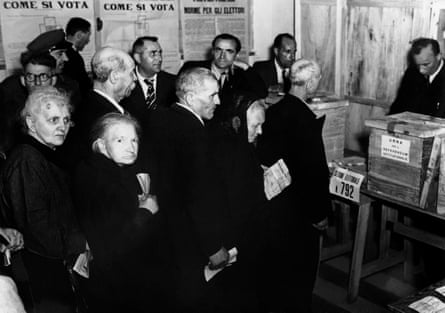
Since early in the morning there had been a queue outside parliament for the few seats available for the public at this evening’s ceremony.
The president of the High Court of Cassation, with six sectional presidents, all black-robed, stood at one end of the hall, with the Italian government, while the president solemnly announced the almost complete figures of the voting.
The court had announced that some objections had still to be investigated and that some results were missing, and so the question arose whether the Republic had been officially proclaimed. Signor de Gasperi, the premier, thought it had: it was not necessary that it should be proclaimed from a balcony, he said. “If the court has felt authorised to communicate figures showing a majority for the republic we take that to mean that the court is satisfied that further adjustments cannot materially modify the result.”
Signor de Gasperi added that if Umberto leaves to-night or tomorrow, he leaves still as “King” of Italy. There was no reason on personal grounds why the king should leave at all as he had behaved very well.
Thus from to-night Signor de Gasperi becomes not only prime minister but also head of the Italian state. This is a temporary measure until the first meeting of the new Constituent Assembly, which must elect Italy’s first president.
Continue reading
Umberto gives up the fight and goes: flight into exile in Portugal
From our own correspondent
14 June 1946
The people of Rome, who have got into the habit these last few days of looking at the Quirinal from time to time, saw the royal standard come slowly down at 10 minutes to six to-night.
At 2.30 Umberto II was seen to drive into the Quirinal, from which all cordons had been removed. At quarter past three his car, followed by another, drove swiftly out towards the Ciampino airport before anyone except a few waiting journalists knew what had happened. At the airport the passengers of the two cars, who included Umberto, two Italian generals, and two ladies-in-waiting, as well as Duke Gallarati Scotti, Italy’s Ambassador in Madrid, who is on his way back to his post, entered the Italian plane which had been waiting since Monday to take the king to Portugal.
Continue reading.
Voting by symbol
5 June 1946
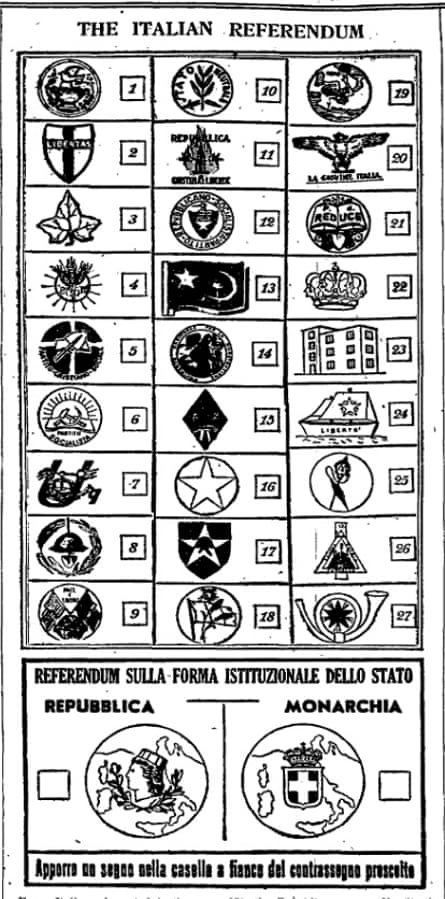
Today we reproduce some of the symbols by which the parties are represented on the voting paper and the simpler but more prosaic designs which stand for the republic and the monarchy. The use of symbols is presumably to help the section of the electorate which is illiterate.
The chief parties are the Christian Democrats (2), the Socialists (6), the Communists (13), the Republican party (3), the Royalist National Block (16), and the Liberals (18). No 9, which shows the Stars and Stripes as well as the tricolour of Italy, is the symbol of the party which wants Italy to be the 44th state of the United States.