Volkswagen unveils four-year plan as questions remain over jobs and plants
Volkswagen said on Thursday it would reduce production capacity as part of a sweeping overhaul aimed at making the group leaner and more competitive in a rapidly changing global car market. However, uncertainty remains over the scale of potential job cuts and factory closures.
Volkswagen has unveiled its strategy through to 2030, including plans to halve the number of models it offers and reduce the number of vehicle variants by as much as 75% in an effort to cut costs and complexity.
The announcement followed a closely watched meeting of the German carmaker's supervisory board, which reportedly discussed one of the largest restructuring programmes in the history of the global automotive industry.
Europe's biggest carmaker is under pressure from US tariffs, weaker profit margins on electric vehicles and, above all, fierce competition in China, the world's largest car market.
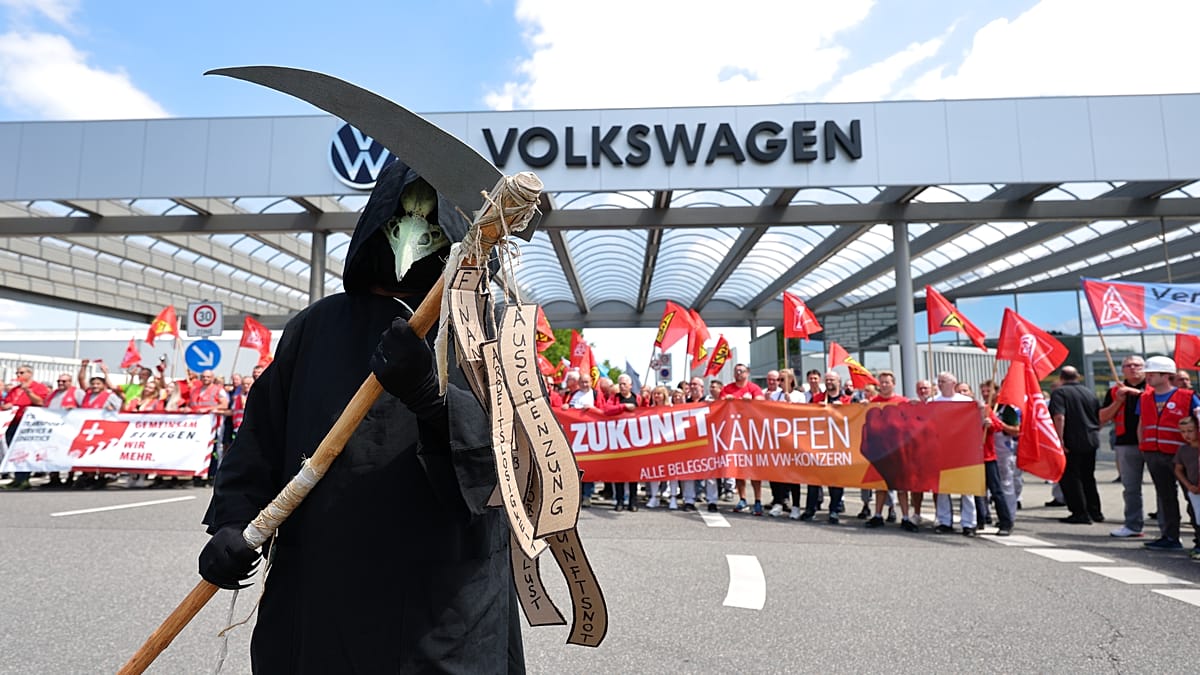
As the board met at Volkswagen’s headquarters in Wolfsburg on Thursday, IG Metall, one of Germany’s largest trade unions, organised coordinated protests across the country. One demonstration was held outside the headquarters, while further action took place at around 20 Volkswagen, Audi, Porsche, MAN and Cariad sites.
Union representatives warned that management risked a "major conflict" with workers. Volkswagen is reportedly considering cutting 100,000 jobs worldwide — more than 15% of its workforce — and closing four plants in Germany: Volkswagen factories in Hanover, Emden and Zwickau, as well as Audi's Neckarsulm plant.
If confirmed, these measures would go well beyond Volkswagen's 2024 agreement with unions, which already included more than 35,000 job cuts in Germany by 2030.
However, the new plan released after the board meeting did not directly address reports of job cuts or plant closures.
Instead, Volkswagen said it would reduce annual production capacity to around nine million vehicles to respond to “sharply intensified competition”. That compares with capacity of around 12 million vehicles before the Covid-19 pandemic and about 10 million today.
Other measures include tailoring products and technology more closely to regional markets, cutting production capacity to match demand, and simplifying the group’s corporate structure and investment portfolio.
Volkswagen chief executive Oliver Blume said in a video statement that “the global situation has deteriorated over the past 12 months”, pointing to geopolitical tensions, tariffs, high costs, increasing regulation and intensifying global competition.
He also said Volkswagen needed to “get rid of excess capacity”, potentially leaving the door open to factory closures. Blume added that “digitalisation, artificial intelligence and shared services will help increase productivity and speed”.
Arno Antlitz, Volkswagen Group’s chief financial officer, said the cost reductions already agreed were “not sufficient in the current economic and geopolitical environment”.
He said the company planned to improve vehicle cost structures, “significantly reduce overhead costs”, increase plant efficiency and accelerate technology development and decision-making.
Volkswagen employs about 657,000 people worldwide, but the company has not said how the planned reduction in production capacity would affect its workforce.
Volkswagen has repeatedly argued that deeper restructuring is necessary after the group's net profit fell 28% to €1.56bn while revenue declined 2% to €75.7bn in the quarter to March 2026.
“The next few years will decide who will play a decisive role in the automotive industry in the future,” Blume said.