Revealed: the internal BHP memo that slammed the brakes on world’s biggest miner’s climate push
In the middle of 2019, London was sweltering through a heatwave.Temperature records tumbled. Frail, ill and elderly people died in their hundreds.In a city not built for heat, trains were brought to a halt....
In the middle of 2019, London was sweltering through a heatwave.
Temperature records tumbled. Frail, ill and elderly people died in their hundreds.
In a city not built for heat, trains were brought to a halt. Railway lines threatened to buckle and sagging power lines caused spot fires along the tracks.
Across the channel, Belgium, the Netherlands and Germany also hit record temperatures.
During the hottest week in late July, the then global chief executive of one of the world’s worst polluters was preparing to take the stage at a high-profile London event.
BHP’s Andrew Mackenzie stood before a collection of Britain’s most powerful – lords, MPs and diplomats – and gave a climate speech that made the world take notice.
Mackenzie warned that the world’s dependence on fossil fuels was causing risks that “could be existential”.
Global heating was indisputable, he said, and would have catastrophic consequences.
“The planet will survive,” he said. “Many species may not.”
Here was one of the most powerful corporate leaders in the world making an impassioned call to arms on the problem his company helped cause. Mackenzie said global warming required the “biggest global mobilisation since World War II”.
The company later pledged to reduce emissions from its operations, largely from energy and diesel use at its mines, by 30% by 2030 and had already set a goal to reach net zero emissions by 2050. It also sought to curtail indirect emissions – from the use of its iron ore and coal by others – which at that stage were the equivalent of pollution from roughly 126m cars.
Six years after Mackenzie’s speech, long after he had left the company, senior BHP executives were presented with an internal memo dated May 2025.
The memo was about the company’s plans to decarbonise a significant contributor to its global emissions: the vast network of Pilbara mines, power plants, trains and diesel truck fleets that make up its Western Australian iron ore division.
The urgency for BHP to source renewables had “diminished”, it said. BHP was now claiming the plan it had devised to hit net zero in the Pilbara by 2050 had a “low probability of success”.
“To preserve optionality … alternate pathway decisions have been preserved and will continue to be assessed.”
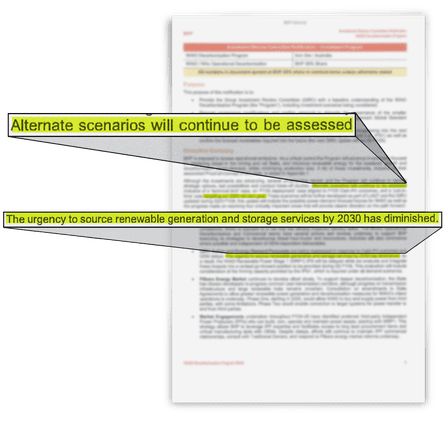
The memo canvassed options that would massively delay key decarbonisation projects.
A huge wind and solar project, big enough to power roughly 150,000 homes, would be delayed, the memo said.
BHP then contemplated three “scenarios” that would put off the electrification of its highly polluting truck and rail fleets.
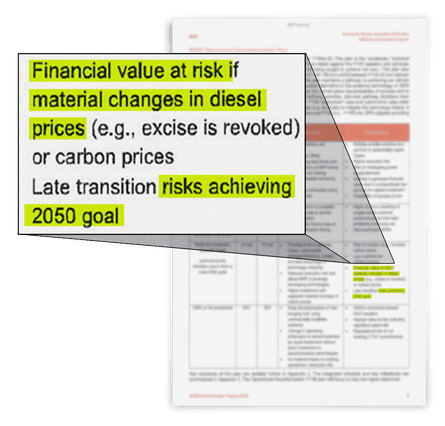
The first option, described as the “central” or “FY35 deployment” case, would push the rollout of battery-electric trucks and trains as far back as 2035 – a seven-year delay to plans initially outlined to investors and regulators. That delay, it said, might require a “resetting of targets and/or external communications that relax ambitions previously set”.
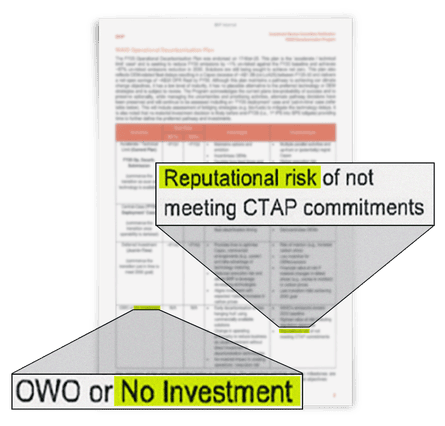
The second option was described as the “deferred investment” or “just-in-time” case, and proposed a transition starting in 2040. This option, the memo warned, “risks achieving 2050 goal” and posed a “financial” risk if there was a material change in carbon pricing or the Australian government revoked the generous diesel tax break it now hands BHP.
The third option offered up to BHP executives was simply to do nothing. It was an option that carried “reputational risk”, the memo said, given that it would mean breaking BHP’s commitments in its climate transition action plan, a plan shareholders had voted overwhelmingly to support.

The memo is part of a major leak of internal documents, dubbed the BHP files, that show how the mining giant has hit the brakes on decarbonisation.
An exclusive investigation based on documents leaked to the Guardian and the ABC’s Four Corners can reveal the company has cancelled a project that could have significantly reduced emissions, delayed vast renewables initiatives – one big enough to power a small city – and continued to make major purchases of polluting diesel trucks despite initial plans to fully electrify its fleet from 2027 onwards.
In a statement to the Guardian, BHP said it has already made huge strides in reducing emissions by 36% from 2020 levels by 2025, and pointed to analysis suggesting it is the second best performer on emission reductions among Australia’s largest listed industrial companies.
It blamed the slowdown on progress towards its net zero goal on the lack of availability of battery-electric trucks, something it says no Australian miner is currently using because “the technology is not advanced enough to scale to an operational fleet”.
Environmentalists and climate policy experts say BHP’s slowdown exposes the failings of one of the Australian government’s flagship climate policies, the safeguard mechanism.
What is the safeguard mechanism?
ShowAustralia’s safeguard mechanism requires the country's largest polluting industrial facilities to cut their greenhouse gas emissions intensity year on year.
It applies to about 200 facilities that each year emit more than 100,000 tonnes of carbon dioxide, or the equivalent in other greenhouse gases. These include mines, gas facilities, processing plants, smelters and manufacturers.
Facility owners can make cuts onsite or by buying carbon offsets.
The policy was introduced in 2016 by the rightwing Coalition government with a promise it would stop industrial emissions increasing. But it was not applied as promised and total pollution from the sites continued to rise.
The Albanese Labor government revamped the scheme in 2023, setting new emissions limits, known as baselines, for each facility.
Under the changes, facilities are required to reduce emissions intensity – the amount of pollution per unit of production – by up to 4.9% a year. Companies can choose whether they make direct cuts or buy carbon offsets to meet their reduction obligations.
They have access to two different types of carbon credits to offset their pollution. They can buy Australian carbon credit units, which are created through government-approved projects said to draw CO2 from the atmosphere or prevent its release.
Or they can also use "safeguard credits", which are created when a facility emits less than its safeguard baseline. The owner gets one safeguard credit for every tonne of CO2 they are below their baseline. These within-scheme credits can be sold to other polluting facilities that emit more than their baseline and need offsets.
New polluting facilities, including gasfields and coalmines, are allowed to open and enter the scheme with baselines set at “international best practice”. For new gasfields, that means offsetting all CO2 pollution so they are net zero.
A deal between Labor and the Greens introduced an absolute "cap" so that total emissions under the scheme need to come down over time. The pace of reduction was not stipulated under the deal and is set by the climate change minister.
A climate policy expert at the Australian National University, Prof Andrew Macintosh, says the fundamental weakness of the safeguard mechanism means no “rational operator”, including BHP, will be taking steps to decarbonise rapidly.
BHP and other big emitters face limited repercussions for excess emissions, he says.
“We are miles away from where we need to be... We’re literally wasting time. If anyone was mildly serious about climate change, they would be hitting the panic button.”
‘Reputational risks’
The scale of BHP’s emissions can be hard to fathom.
Since BHP’s creation as the Broken Hill Proprietary Company in 1885, its trade in iron ore, coal and copper has made it an extraordinary global success, and one of the biggest contributors to the climate crisis. It ranks 10th for historic climate pollution among investor-owned companies, according to the thinktank InfluenceMap.
According to its annual report, it pumped 8.7m tonnes of CO2 into the atmosphere last financial year – more than about 80 individual countries. Its scope-three emissions – those released when its products are used by customers – continue to increase, rising 7% from 2020 to 2025.
BHP data shows emissions across its Australian operations were 7.22m tonnes last financial year, while its international emissions were 1.44m tonnes.
Emissions from its iron ore division in WA were 2.62m tonnes, more than every bus on Australian roads.
It also consumed 1.23bn litres of diesel and received $622m in fuel tax credits in 2024-25, according to analysis of data from the fuel tax credit scheme. It is the biggest recipient of the Australian government’s fuel subsidy.
BHP was keenly aware of the importance of decarbonisation. It made bold public pronouncements, telling shareholders and governments – federal and state – of the importance of its decarbonisation plan.
The BHP files show it was talking a big game internally, too.
“Slow emissions reduction progress by WAIO [Western Australia Iron Ore] would have reputational impacts, particularly in the context of rapid action by other Pilbara iron ore miners,” one internal memo in 2023 noted, adding: “Urgent decarbonisation in line with BHP’s public commitments effectively underpins WAIO’s licence to operate, sustain and grow.”
In inland Western Australia, BHP uses its own power grid to feed its energy-intensive operations, using mainly gas and diesel generation.
Transforming that power grid with solar, wind and battery projects was crucial to BHP’s plans to lower its emissions and hit its decarbonisation goals, alongside the plans to electrify the highly polluting diesel truck fleet, which accounts for the majority of its emissions.
The first step was a relatively modest one.
BHP’s board had signed off on $390m for a 50-megawatt solar plant and 20MW battery near its Jimblebar mine, enough to power roughly 20,000 homes. Internally, it was rated as “an excellent opportunity to improve BHP’s social value”.
“The project is the first investment step in WAIO’s decarbonisation plan and is also critical in the context of BHP’s public commitments and the [Western Australian] state government’s environmental requirements,” the 2023 memo said.
The enthusiasm was short-lived.
In mid-2023, documents show, the inland solar project was closed and amalgamated with another, broader renewables project. That project has no capital funding slated for years and has itself been delayed.
The decision shocked staff. Some questioned how BHP could break with such a clear direction from its board.
A memo in April 2024 shows BHP was aware the decision would cause “delay to WAIO’s first solar power generation” and could complicate its attempts to win regulatory approval for other, unrelated projects.
It warned of “reputational risks to BHP as communities, government and shareholders expect near term action by [Western Australian Iron Ore] on emissions reduction”.
Technology ‘simply does not exist’
The fate of the Jimblebar solar project foreshadowed what was to come.
The company’s central project in its decarbonisation strategy was dubbed the WA iron ore renewable power stage one, or WRP1, which was to be completed by December 2028.
The project was to include almost 500MW of solar, wind, and battery storage – enough to power 150,000 homes.
A windfarm would be built at Jimblebar, a solar installation would be built near the company’s Mining Area C operation, and batteries would be installed at Yarnima power station and at a planned electrical substation near Mining Area C. A second stage was to add even more renewable generation.
The combined renewable power would be enough, BHP believed, to support the electrification of its truck and rail fleets.
But the BHP files show the company has put the project on ice.
One document says it will “not progress in its current form”. Another shows no capital expenditure on the project until 2031 at the earliest. A third document, dated May 2025, shows early studies for the project have been delayed.
The company said internally that delays in developing battery-electric trucks by equipment manufacturers had reduced the demand for renewable electricity.
The transition to electrified haulage is key to BHP’s decarbonisation strategy but industry groups including the Chamber of Minerals and Energy of Western Australia say it is incredibly complex.
“There is currently no mining operation anywhere in the world with the scale, complexity and operating conditions of the Pilbara running a fully electrified haulage fleet, because the technology to do so simply does not exist,” said its chief executive officer, Aaron Morey. “Companies including BHP, Rio Tinto and Fortescue are all investing heavily and partnering with equipment manufacturers to change that.”
It is unclear exactly when the decision was made to delay the 500MW renewables project. But the company continued to promote the plan throughout 2024, including to investors, who were told in June 2024: “By the end of this decade, we plan to have up to 500MW of wind, solar and battery storage assets available in the Pilbara, backed up by firm power from our highly efficient Yarnima gas fired power station.”
A hungry market
In the middle of the Pilbara, not far from its huge open-cut Jimblebar mine, BHP had plans for a project that would substantially reduce emissions.
The company wanted to build an iron ore processing facility – known as a beneficiation plant – that would greatly improve the quality of its iron ore.
This higher quality product could then be sold at a premium and used by BHP’s steelmaking customers in a much greener, less emissions-intensive way.
BHP knew there was a hungry market.
The Chinese steelmaking industry, through a combination of government edicts, an emissions trading scheme and the implementation of a new European Union carbon adjustment mechanism, was under immense pressure to find emissions reductions.
BHP predicted the plant could reduce scope-three emissions by 1.7m tonnes a year.
That’s the equivalent of taking more than 350,000 cars off the road. The plant would have reduced emissions at a scale vastly above any other decarbonisation initiative that BHP was contemplating in the Pilbara.
Internally, BHP rated the project as having “excellent social value” and being “well-aligned” to its shareholder-endorsed climate plan and decarbonisation targets.
Documents also showed the project was initially thought likely to deliver a positive return on investment.
But in the middle of last year, internal documents show, the company quietly shelved the project. All further work was cancelled.
In explaining its decision internally, BHP said the plant had marginal economics. It would struggle to compete with other BHP projects for capital.
Experts told Guardian Australia the economics of beneficiation plants are complex and that they may pose other environmental issue, due to their intensive use of water and the need for tailings storage.
But the experts also say such plants are a practical and achievable method to reduce emissions in Chinese steelmaking, a critical task if the world is to address the climate crisis.
Deploying influence
The revelations in the BHP files pose a fundamental question for the Australian government: is one of its flagship climate policies giving polluters licence to keep polluting?
The safeguard mechanism requires about 200 large industrial sites, including mines, to cut emissions intensity year on year. But the companies that own the mines can meet their targets by buying contentious Australian carbon offsets rather than making direct cuts, delaying the need for onsite reduction.
Emissions from more than half BHP’s polluting sites were above their government-set limits, known as baselines, last financial year. The company needed to hand in about 225,000 carbon credits – costing it less than $9m – to offset the extra pollution.
BHP has made multiple submissions seeking to influence the way the safeguard mechanism operates, including during a 2022 reform process, when it argued for changes that would reduce the costs it faced, including the introduction of cheap international offsets.
In a memo weighing up options to delay the decarbonisation program, executives say delaying investment until 2040 would put it in line with “expected material increase in carbon prices” from the safeguard.
The company has vast resources to deploy when trying to influence the federal government.
It makes use of three firms that are on the government’s lobbying register, including GRACosway, Brookline Advisory and GXO Strategies. The company also has its own team of in-house government relations personnel.
The company has a policy of avoiding giving political donations but does pay for trips to its remote sites by politicians, as well as journalists and investors.
It gave “charter flights, hospitality and accommodation” to the resources minister, Madeleine King, late last year to facilitate a briefing, tour and announcement at Olympic Dam.
Guardian Australia understands that BHP’s public relations strategy has targeted key ministers. It is also understood that King’s office had indicated it was open to speaking with BHP’s representatives during sporting matches.
A spokesperson for King said the minister was regularly invited to attend mine sites and was often reliant on company airstrips to get to them.
“It would be unusual for a resources minister to not accept invitations to visit mines that employ thousands of Australians,” the spokesperson said.
‘Marketing and greenwashing’
BHP shareholders have made clear they expect the company to act on the climate emergency. At the 2024 annual general meeting, they voted overwhelmingly in favour of its updated climate transition action plan.
That document sets out a clear strategy of electrifying trucks, turning to renewables, decarbonising operations and limiting scope-three emissions.
But a year later BHP used its annual report to foreshadow a slowdown in its decarbonisation plans and flagged a dramatic reduction in its spending on decarbonisation, from US$4bn to US$500m.
It delayed the delivery timeline for transitioning away from diesel trucks. It also said that, given those delays, it would put off low to zero emissions electricity investments to align with the later rollout of battery-electric equipment.
The company blamed the “lack of available technology solutions to support rapid [greenhouse gas] emission reductions for diesel displacement”.
This is at odds with one of its main Pilbara competitors, Fortescue, which has made major orders of electric trucks, and brought forward its net zero ambitions to 2030.
Fortescue’s emissions increased recently, due to bringing a major magnetite operation online, but the company hopes to be able to power all its operations in the Pilbara for 24-hour periods with no fossil fuels by the end of 2027.
BHP is currently using a power purchasing agreement to power 30% of its Port Hedland operations with solar.
In a statement, BHP said it was still focused on its net zero goal and its target of 30% emissions reductions by 2030. A spokesperson said it had already reduced its global emissions from its 2020 baseline by 36%.
“This progress was driven in large part by shifting 70% of our total electricity use to renewable sources,” the spokesperson said.
“Despite this progress, many of the technologies the resources industry will need to achieve net zero are not yet ready to be deployed.”
The spokesperson said the technology was not ready to deploy electric trucks, trains and dozers: “For example, no Australian mining operation is currently utilising critical 240-ton battery-electric haul trucks as the technology is not advanced enough to scale to an operational fleet.
“To support the acceleration of this technology, BHP is partnering with equipment producers to run trials of battery-electric equipment including two 240-ton battery electric haul trucks being trialled on a BHP site in the Pilbara, and four battery-electric locomotives which we plan to commence trialling in coming months.
“BHP continues to focus on delivering our operational emissions reduction target and long-term net zero goal, including support to accelerate and de-risk the required technology, noting that announced commitments by some companies to acquire new equipment in the future does not mean such equipment currently exists.”
Tim Buckley, the director of the thinktank Climate Energy Finance, says the company’s climate transition plan mostly amounts to “marketing and greenwashing”. He says its emissions cuts to date have been largely due to two things: a significant renewable energy agreement in Chile in 2021, and the closure of an uncompetitive nickel mine in Western Australia. Its annual report forecasts that direct emissions from its operations will increase in the five years to 2030.
“What they promise to do by 2050 is irrelevant,” Buckley says. “It’s what they do in the next five years that matters.
“And they are doing next to nothing in Australia, and particularly the Pilbara.”