

Canada to become first 'associate member' of the EU
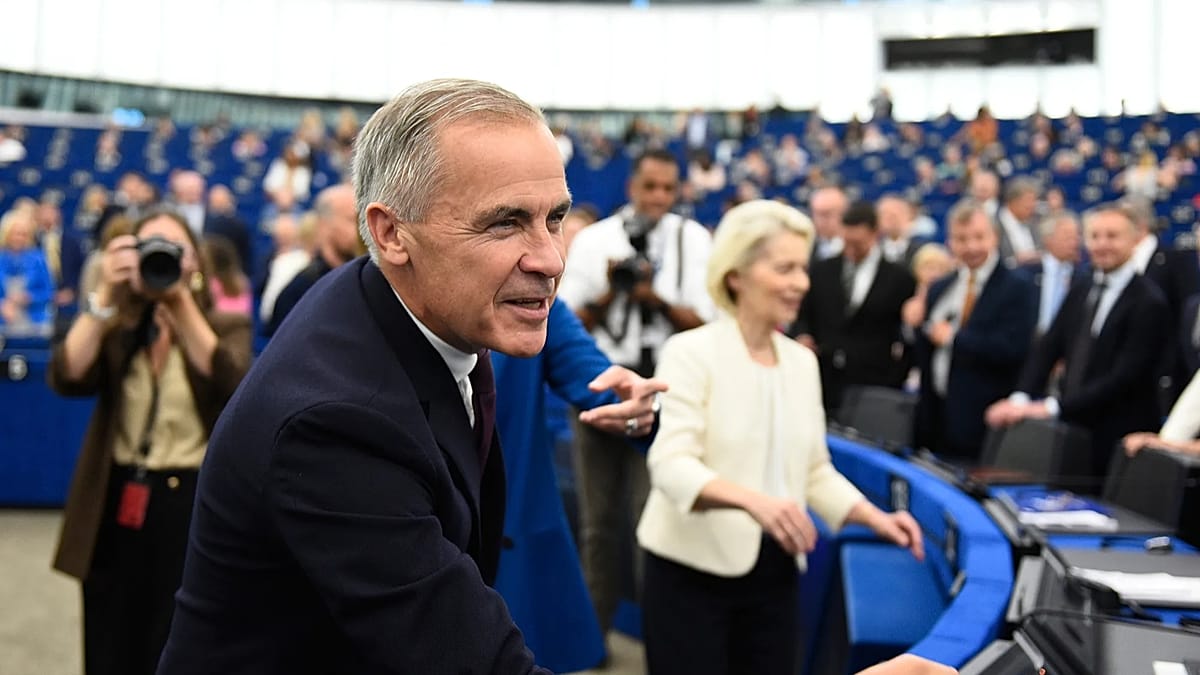
The status announced by von der Leyen during the State of the Union is an entirely new one, with details yet to be made clear. The European Commission’s President also proposed a new alliance with Ottawa covering tech, critical raw materials, energy and defence.
European Commission President Ursula von der Leyen announced on Wednesday that Canada has been invited to become the first “associate member” of the EU.
She announced the move during her 2026 State of the Union address in Strasbourg, to an audience including not only MEPs but also Canadian Prime Minister Mark Carney, who attended her speech in the midst of a trade war with the US.
Since late August, the Canadians have been pushing hard for the Europeans to build a closer relationship with them, though full EU membership is not an option as Canada is not a European state.
During her speech before the MEPs on Wednesday, von der Leyen invited the country to become “the first associate member of the European Union".
“We share one ocean, one set of values, one way of seeing the world. And we will now build our shared future as well,” she added.
A new status
Expectations had been high over the last week after Carney spoke about building a “unique alliance” with the EU.
Canada is not a European state geographically, but it shares the same values as the EU – human rights, democracy, rule of law – which are necessary criteria for becoming a member state.
Several options already exist for countries that don’t have full membership. Norway, for instance, is part of the single market, the EU’s borderless area of free movement of goods, persons, services and capital. Oslo and Brussels also collaborate on joint defence initiatives.
Switzerland also has access to the single market through several agreements – and in the years since Brexit, the United Kingdom and the EU have secured the largest and broadest trade and cooperation deal in the bloc's history, coverering a wide range of sectors. The UK is now taking part in several EU programmes such as Horizon Europe, the EU’s research and innovation programme.
Euronews has learned that Ottawa is already in talks with Brussels to join the Erasmus+ exchange program, Horizon Europe research grants, and mutual recognition of workers’ qualifications.
However, “associate member” is a completely new status, and key questions have not yet been answered – chief among them, whether Canada will have voting rights in EU institutions. Despite their regulatory harmonisation with the bloc, Norway and Switzerland have no say on EU legislation.
A new alliance with Ottawa
German Chancellor Friedrich Merz floated the idea last May of an “associate membership” for Ukraine, which is urgently seeking to enter the EU. In a letter sent to EU leaders, he argued that this status would grant Ukraine access to the decision-making bodies – the European Council, the European Commission and the European Parliament – without voting rights or a dedicated portfolio.
It would also allow the country to tap into certain EU-funded programmes on a "step-by-step" basis.
It’s hard to see Canada in the same category as Ukraine, a country which is at war, but von der Leyen's announcement on Wednesday nonetheless sent a strong political signal in a volatile world where historical alliances are shifting.
“Europe and Canada believe in democracy. That power does not belong to the strongest, the richest, or the loudest – but to all of us,” she said. “Democracies have the freedom to choose with whom to work.”
She also called for a new alliance with Ottawa, which could include tech, defence, Arctic joint projects, but also energy, critical minerals and artificial intelligence.
“We will move from CETA to an Alliance for the Future to create a common prosperity and economic security space,” she said, referring to the 2016 EU-Canada trade agreement that removed tariff barriers between both sides and has been provisionally applied.
The economic and security cooperation between both partners is set to be pushed further during a summit in Montreal in October.