Poland and Ukraine's ‘honours war’ intensifies
Current and former Ukrainian officials are to return honours bestowed upon them by Poland after Ukrainian President Volodymyr Zelenskyy was stripped of the country's highest state honour. Tensions have been...
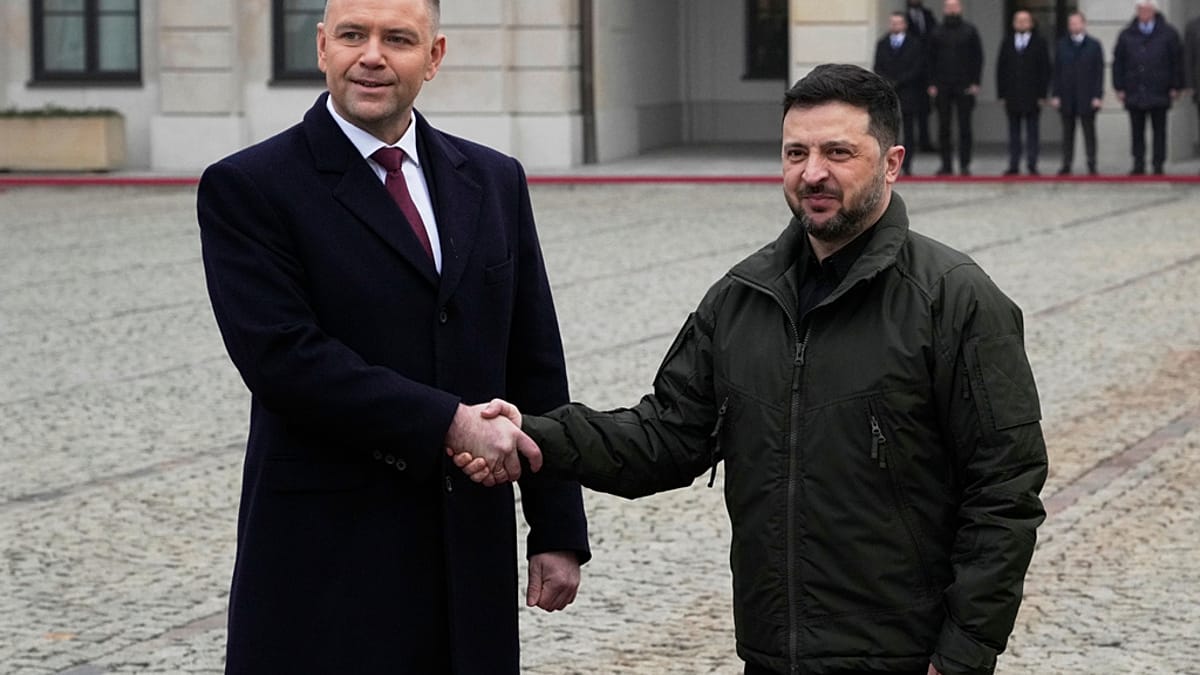
Current and former Ukrainian officials are to return honours bestowed upon them by Poland after Ukrainian President Volodymyr Zelenskyy was stripped of the country's highest state honour.
Tensions have been rising between Kyiv and Warsaw since Zelenskyy named a military unit after the controversial World War Two Ukrainian Insurgent Army (UPA).
In response to the move, Poland’s far-right president, Karol Nawrocki, announced that he was stripping Zelenskyy of the Order of the White Eagle.
On Saturday, Zelenskyy said he had sent the Order back to Poland, posting a photo to social media appearing to show it being packaged up ready to be shipped.
"We believed that the Order of the White Eagle, awarded in 2023, was meant for the Ukrainian People and our army," he wrote, adding that Ukraine was "grateful to the Polish People for their support and cooperation".
Cracks in the alliance?
Nawrocki has insisted that the decision was "not directed against the Ukrainian people” and that Poland would continue to support Ukraine.
Even so, many in Ukraine saw Nawrocki’s move as an attack.
Ukraine’s foreign minister, Andrii Sybiha, was the first to react, announcing that he would return the Commander’s Cross with Star of the Order of Merit of the Republic of Poland, which he received in 2022.
The head of the Office of the Ukrainian President, Kyrylo Budanov, and Ukraine’s ambassador to Poland, Vasyl Bodnar, followed suit by relinquishing their Officer’s Crosses of the Order of Merit of the Republic of Poland.
The second, third and fifth presidents of independent Ukraine, Leonid Kuchma (1994–2004), Viktor Yushchenko (2005–2010) and Petro Poroshenko (2014–2019), also all announced that they were giving up their Order of the White Eagle honours.
Poroshenko made it clear that he had taken the decision in reaction to the Polish president's move, but that it was in no way directed against the Polish people.
Yushchenko also stressed that he was acting in solidarity with Zelenskyy and the Ukrainian army, while calling Nawrocki’s decision “irresponsible”.
How did the crisis begin?
On 27 May, Volodymyr Zelenskyy signed a decree naming the Independent Special Operations Centre “North” of Ukraine's Special Operations Forces as the “Heroes of the UPA”.
He said he had taken the decision “in order to restore the historical traditions of the national army and in view of the exemplary execution of the missions assigned in the defence of the territorial integrity and independence of Ukraine”.
The Ukrainian Insurgent Army, or UPA, was a Ukrainian guerrilla force formed in October 1942 in Volhynia, in north-western Ukraine, as the military wing of the Organisation of Ukrainian Nationalists (OUN-B), an ultranationalist movement led by Stepan Bandera.
While fighting both the German army and Soviet forces, the organisation carried out massacres of the Polish population in Volhynia.
The decision has gone down particularly badly in Poland, and Nawrocki said he had learned of the move “with great sadness”.
“This is not how you build relations between nations,” he said on Friday, adding that glorifying the UPA gave Russian propaganda “a lot of oxygen for disinformation”.
The Polish president doubled down on Saturday, justifying his decision to withdraw the Order of the White Eagle from Zelenskyy by saying that his actions had overstepped the mark.
Some have argued that only Russia stands to gain from the breakdown in relations.
Poland has been one of Ukraine’s main allies since the start of Russia’s full-scale invasion in February 2022, taking in hundreds of thousands of refugees and serving as a logistical hub for Western aid bound for Kyiv.
Polish Foreign Minister Radosław Sikorski said he was convinced that, given the historical context, only Russia could profit from a Polish-Ukrainian dispute.
Sikorski shared a comment by journalist and columnist Witold Jurasz of the newspaper Onet, who argued that by stripping Volodymyr Zelenskyy of the Order of the White Eagle, Nawrocki had indeed won a moral victory but had also suffered a defeat – and, with it, so had Poland as a whole.
Polish Prime Minister Donald Tusk, whose government is at odds with Nawrocki, criticised Zelenskyy’s decision, while stressing that the Ukrainian leader had assured him that he had not intended to offend Poles. He called on the two nations not to lose their solidarity and not to let “history ruin our future”.
For his part, Ukrainian Foreign Minister Andrii Sybiha, who had earlier described the Polish president’s decision as “a strategic mistake... from which only Russia will benefit”, expressed his gratitude to Poles who do not support escalating tensions with Ukraine.
"I wish to thank every Pole who has clearly expressed their stance against escalating tensions with Ukraine. We are staunch supporters of the same approach," he wrote on X.
"We are wise nations, always able to find a way out of a difficult situation. We are bound by a difficult history, a shared future, and the threat from our age-old enemy – Moscow," he added.
Russian officials - who have repeatedly invoked the Second World War as a means to justify Moscow's invasion by claiming it is a fight against “neo-Nazis” in Ukraine - have welcomed Nawrocki’s decision.
“The Polish president has finally stripped (Zelenskyy) of the Order of the White Eagle,” said former Russian president Dmitry Medvedev, now deputy chairman of Russia’s Security Council.