European Commission responds to Italy's call for energy cost relief flexibility
The measures indirectly address Italy's request that the Commission relax its fiscal rules to allow member states to tackle rising energy prices without incurring excessive debt and risking penalties.
The European Commission is set to allow limited energy-related spending from fiscal rules to give EU countries more leeway to address soaring prices.
The measures announced by the EU executive on Wednesday are an attempt to reassure fiscally conservative capitals struggling with skyrocketing energy bills that are threatening industrial production.
In particular, the relaxation is an indirect response to Italy's recent call for the bloc to treat the energy crisis as equivalent to a defence emergency. Italy has the second-highest debt-to-GDP ratio in the EU after Greece, limiting Rome’s room for large-scale subsidies under existing fiscal rules.
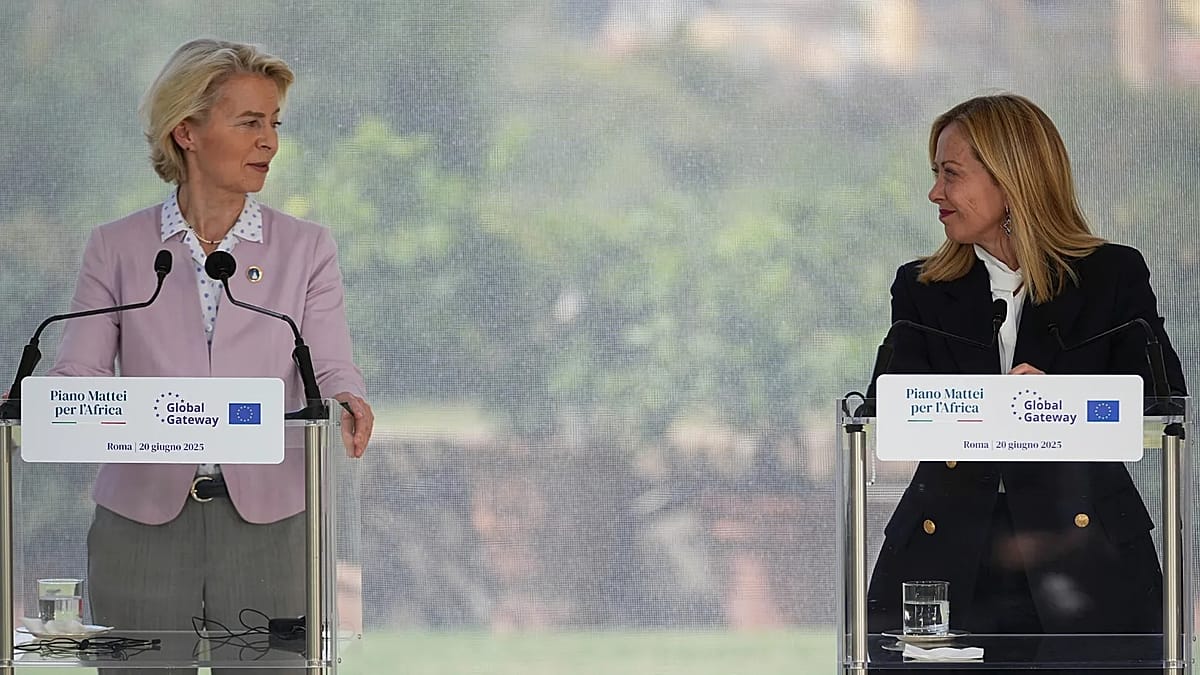
Italian Prime Minister Giorgia Meloni recently accused the EU of being a "bureaucratic giant" that "often sacrifices competitiveness and strategic approaches" in favour of "ideological and technocratic approaches". In a letter to the Commission, she threatened to withhold her backing for the bloc's financial tool to scale up defence investments and military readiness.
As a response, the Commission made a concession to EU countries that have already activated an EU rule that temporarily allows them to spend more money on defence without being penalised for breaking the bloc's standard budget and debt limits: they may now request that part of their fiscal flexibility also cover investments aimed at reducing their dependence on imported fossil fuels.
"We present this package at a moment of profound geopolitical uncertainty and intensifying global competition," said Economy Commissioner Valdis Dombrovskis. "Competitiveness and fiscal sustainability go hand in hand. Both are essential to Europe's long-term prosperity, resilience, and sovereignty."
Italian Foreign Affairs Minister Antonio Tajani welcomed the move, claiming it as a triumph of his country's diplomacy.
"The European Commission has welcomed Italy’s proposals for greater flexibility to tackle the challenges of the energy crisis," he wrote on X. "This is another success for the Italian government, a result of our credibility in Europe."
Commission offers limited fiscal space
Thanks to the new relaxation, EU governments will be allowed to spend beyond their normal fiscal expenditure path on measures such as electricity grids, renewable energy infrastructure, storage, interconnections, industrial electrification or other projects that strengthen energy resilience without triggering corrective action under EU fiscal rules.
However, while the move partially acquiesces to Italy's demands, the EU's executive flexibility remains tightly constrained.
Only 0.3 percent of GDP – out of 1.5 percent per year – can be allocated to energy resilience measures between 2026 and 2028, with a cumulative ceiling of 0.6 percent of GDP over the three-year period.
This design prevents governments from using energy spending as a backdoor route to significantly expanding their deficits and thus undermining the credibility of EU fiscal rules, which are designed to ensure that governments keep their public finances on a "sustainable path" while retaining enough flexibility to respond to economic shocks and invest in policy priorities.
Under EU fiscal rules, public deficits should remain below 3 percent of GDP, while public debt should stay below 60 percent of GDP. EU countries that exceed these thresholds can face closer monitoring and, in some cases, corrective procedures.
Reconciling strategic spending with debt sustainability
The EU increasingly wants member states to spend more on defence, energy security, climate transition and industrial competitiveness. Yet it also remains committed to restoring debt sustainability after years of crisis-related spending, from the Covid-19 pandemic to the 2022 energy crisis triggered by Russia's war in Ukraine and now the global disruption triggered by the war on Iran.
Helge Berger, Deputy Director at the International Monetary Fund (IMF) recently told Euronews that European capitals have failed to provide targeted measures to shield suffering households and businesses from soaring energy prices.
According to the IMF, oil prices have surged by around 70 percent, while European gas prices remain roughly 45 percent above pre-war levels. Although less severe than the 2022 shock, the increases are still expected to weigh heavily on growth.
As a response, several EU governments have lowered energy taxes, a move that Berger warned would making energy artificially cheaper, thus discouraging people from using less energy or switching to alternatives.
The IMF representative cautioned capitals against "dampening the price signal" that results from higher oil, natural gas, and electricity prices, and encouraged them instead to focus on targeted support.