EU backs Pashinyan on the eve of Armenia's defining elections
The EU endorsed Armenia’s PM Nikol Pashinyan and announced a support package to counter Russian sanctions, just days before Armenia’s historic elections. Meanwhile, Pashinyan said he would go to Moscow after the vote and proclaimed that "abandoning Karabakh was my greatest service to Armenia".
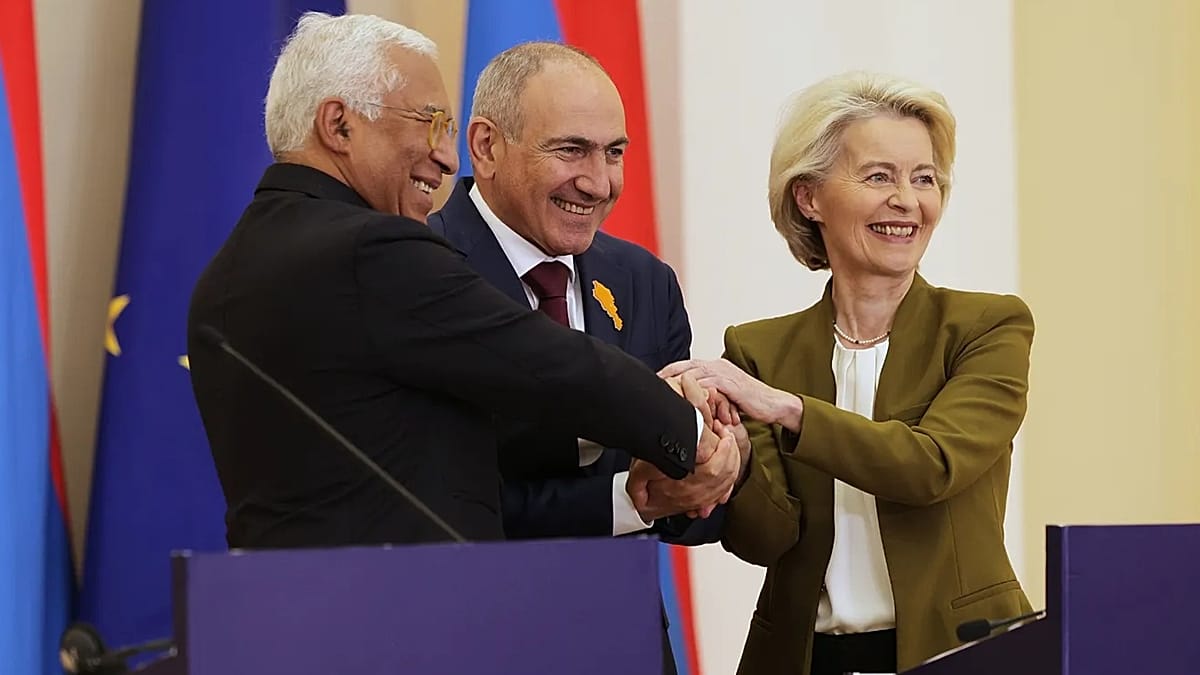
Just days before Armenia’s decisive elections on Sunday, the European Commission declared it was “standing firmly” in its backing of Armenian Prime Minister Nikol Pashinyan, stating it was preparing a support package of measures to alleviate mounting Russian economic sanctions against Yerevan due to its pro-Western, pro-EU turn.
“By extending export restrictions on Armenian products, Moscow is weaponising economic relations for political pressure,” European Commission President Ursula von der Leyen said in a statement on Thursday.
“We know this playbook all too well. This is why Europe stands firmly with Armenia," von der Leyen added.
Von der Leyen said the EU’s support package includes financial assistance of over €50 million with more to come, and practical measures to support Armenian agri-food trade impacted by Russia’s mounting restrictions.
The Commission president said that “a shipment of 10,000 flowers is planned to arrive in Latvia” on Friday and that other measures will keep connecting businesses between the two sides, which, under the EU-Armenia Resilience and Growth Plan agreed in 2024, has already helped 7,000 businesses and contributed to the creation of more than 20,000 jobs.
In parallel, European Commissioner for Enlargement Marta Kos said that von der Leyen and Pashinyan agreed to establish a joint EU-Armenia Task Force to implement a range of measures agreed between Brussels and Yerevan.
The head of the EU executive also said that “Armenia has the potential to become a strategic hub connecting Europe, the South Caucasus and Central Asia,” and that she “expressed Europe's commitment to deliver on the ambitious Connectivity Partnership” concluded at the recent EU-Armenia summit.
Von der Leyen specifically mentioned “the recent reopening of trade routes with Turkey, including the railway connection through Georgia and Turkey” as “an excellent step forward,” in a signal of Brussels' support for Armenia’s decision to normalise relations with Turkey as part of its broader strategy for peace and stability in the South Caucasus following the historic peace agreement between Azerbaijan and Armenia.
The EU’s statement of support coincides with a key statement from US Secretary of State Marco Rubio, who told the US Congress on Wednesday that he thought “there is evidence” that Russia would like Pashinyan to lose the election “as a result of this growing relationship with the United States."
Rubio linked his comment to US President Donald Trump’s recent endorsement of the Armenian prime minister for the upcoming elections, following extensive allegations of Russian interference in Armenia’s election campaign in favour of the pro-Russian opposition, which has been pushing to keep the former Soviet state in Moscow’s traditional orbit.
The statement also came days after the Kremlin recalled its ambassador to Armenia "for consultations" over Yerevan's pro-EU course. At an EAEU summit in Astana last week, Russia and other members issued a formal review of Armenia's membership, threatening to suspend it by December.
'No product will remain unsold'
In recent weeks, Moscow unleashed an economic onslaught of measures restricting imports of various Armenian fruits, vegetables, flowers, and fish products, as well as wine, brandy, and mineral water.
The Kremlin has further threatened to cut critical Russian oil and gas supplies to Armenia. Armenia imports more than 80% of its gas from Russia.
Armenia’s prime minister announced on Tuesday that his government had found new markets for Armenian products in Europe and elsewhere and therefore “no product will remain unsold.”
Pashinyan further said that “several of our business delegations are already working, and the first batches of roses and vegetables have already been shipped. Once they arrive, I will say which countries.”
Armenia sold €2.5 billion worth of goods to Russia in 2025 — roughly a third of its total exports. The products Moscow is now restricting span several of the country's most established food and agricultural sectors: wine, brandy, mineral water, fresh fruit and vegetables, flowers and fish.
Armenia's renowned wines and brandies, although banned from using the word "cognac" in the EU market, already sell in Europe.
Russia absorbed 72% of Armenian wine exports last year, and Armenian brandy sales there hit a record high, but European demand for Caucasian spirits is growing.
Fresh produce — Armenia's strawberries, apricots, peaches and pomegranates are competitive in price — and endemic Sevan trout or ishkhan**,** protected and reared in hatcheries, also have natural buyers in EU markets.
No war of words, Pashinyan says
Meanwhile, Pashinyan has attempted to defuse tensions with Russia over the last few days, and on Thursday he said he agreed with Russian President Vladimir Putin to travel to Moscow to “have a meeting and resolve all current issues.”
"We will not engage in a war of words with Russia, we will calmly defend Armenia’s positions," Pashinyan said during a campaign event in Martuni. “We will not act against Russia’s interests, but neither will we act against our own interests.”
Just days before, he said that Armenia’s EU membership bid is at the moment “theoretical” and that “we will continue to work calmly and steadily, without disputes, within the Eurasian Economic Union, and I am convinced that we still have potential in this direction, which we will use in the near future."
The Armenian premier further said that “relations with Russia are in a transformational phase,” but that he considered this process “positive” and that Armenia’s relations with Russia remained "open and sincere, and we have kept no dark corners in that relationship.”
However, Pashinyan continued his offensive against his critics and the opposition on Thursday, who have repeatedly accused him of giving up on Karabakh and therefore betraying the country.
At a campaign rally, he said that “abandoning Karabakh was my greatest service to Armenia,” as “we were put in a trap and if we continued on that path, we would lose Armenia and Armenian statehood.”
“I knew they would call me a traitor, a land-giver, everything. But today I am very glad I found that strength, stood up, faced the truth, and brought Armenia out of the trap,” the Armenian prime minister said, repeating his earlier statement that the Karabakh chapter was closed for Yerevan as Armenia chose to seek a peaceful future with its former rival Azerbaijan and the broader region.
Pashinyan said it was time for Armenia to look at the future, declaring that “we have no right to pass this bleeding wound from generation to generation, we must pass peace on to our children."
“Today we are more independent, more prosperous, and more of a state than ever before,” the Armenian prime minister concluded.