Russia fires 800 jet-powered drones into Ukraine in four days
Kyiv is enduring hours of daytime air raids and air raid warnings as Russia has fired 800 jet-powered drones into Ukraine in four days, using the faster weapons to sustain prolonged waves of attacksThe...
Kyiv is enduring hours of daytime air raids and air raid warnings as Russia has fired 800 jet-powered drones into Ukraine in four days, using the faster weapons to sustain prolonged waves of attacks
The new-model Shahed drones have a cruising speed of 200mph to 250mph, which is – about double the 115mph achieved by the piston-engine version and beyond the speed of Ukraine’s cheap interceptors, making them harder to stop.
Volodmyr Zelenskyy, Ukraine’s president, said on Sunday that the jet-powered models now accounted for more than half the drones used by Russia to attack and “wear down” the country.
“There were almost 1,500 drones of all types in these four days alone – about 800 of them jet-powered,” the president said. Ukraine was currently relying on combat aircraft to shoot them down, he added.
A Geran-4, the latest jet-powered model, struck an ammunition dump at Myla, a village 15 miles west of Kyiv on Thursday. Thirty-eight people were killed as the strike unleashed hours of secondary explosions in one of the deadliest single attacks of the war, destroying warehouses and damaging nearby homes.
Russia has also made heavy use of the drones in waves of daytime attacks in the past five days, leading to hours of air alerts, particularly in Kyiv. Eight air raid alerts sounded in Kyiv by lunchtime on Monday.
Daytime attacks, although far from unknown, were uncommon previously, prompting some businesses to halt operations until the alert had passed, and leaving residents with the decision of whether to remain indoors, seek shelter, or ignore the warnings entirely.
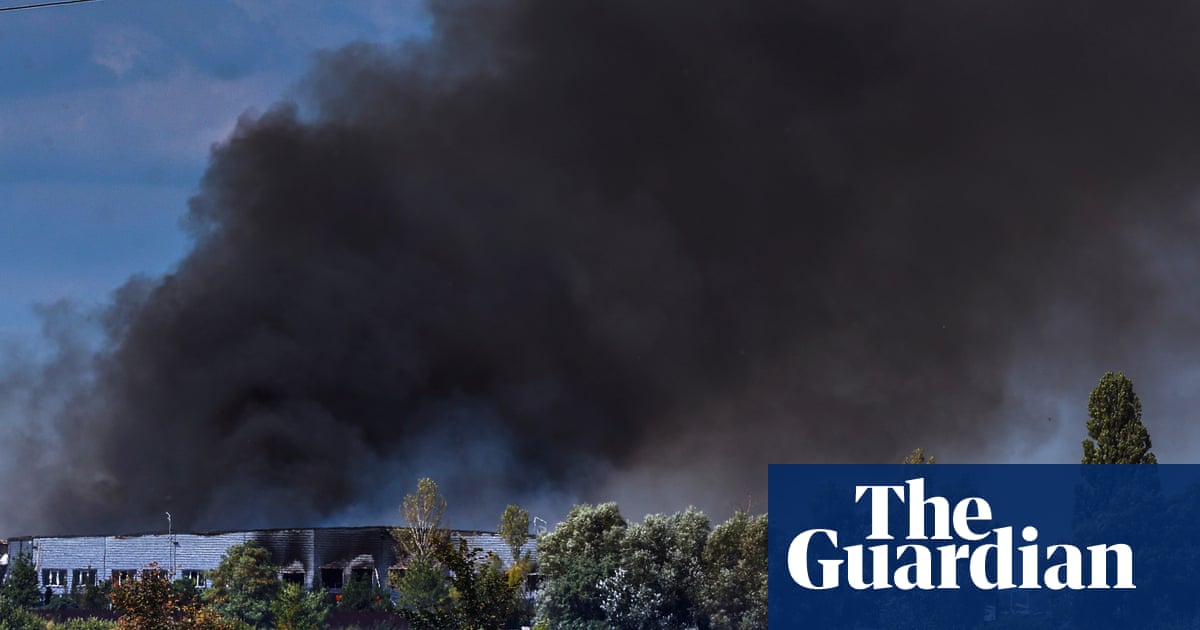
Close drone threats also force emergency services to leave an attack site, potentially worsening the impact of any fire caused by a hit, as happened when a food storage facility was struck in Boryspil, to the east of Kyiv, earlier this month.
Kremlin forces have attacked warehouses around Kyiv in the past month, in retaliation to a Ukrainian campaign targeting the Wildberries and Ozon distribution chains inside Russia. The attacks have led to food shortages in the shops, but a Ukrainian official urged people not to panic.
Serhii Beskrestnov, an adviser to Zelenskyy on defence technology, urged people “do not give in to rumours, misinformation, and panic” and said that companies were rebuilding supply chains in response to the attacks. “We will not die of hunger,” he wrote in a social media posting.
Shahed drones, with a distinctive delta wing, were originally designed in Iran, and the technology transferred to Russia. The jet Shahed, the 238, was first unveiled by Iran in autumn 2023, and appeared in Ukraine shortly after.
But has not been until the spring that Russia has begun to manufacture and deploy its latest jet-powered variant – the Geran-4 – in numbers. Russia now makes more jet-powered drones than the original piston-engined variants, in two models, the delta winged Geran-4 and the Geran-5, which looks like a missile with wings.
Beskrestnov said that at least 2,500 of the jet drones had been launched into Ukraine during August, up from 1,500 the month before. Production date stamps found on the bodywork suggest they are being fired within days after being made at a factory in Yelabuga, he added.
Ukraine had successfully devised a range of low cost ground-launched interceptors fast enough to eliminate a piston-engined Shahed, raising interception rates to above 90%. Over the weekend, the president said that level had to be maintained into the autumn.
Engineers are now racing to make faster interceptor drones able to knock out jet-powered Shaheds, though details are scant. “Four companies have developed the relevant interceptor drones, and one company has the most successful technology,” Zelenskky said.