Love under anti-drone nets: Ukrainian couple wed in Kramatorsk combat zone
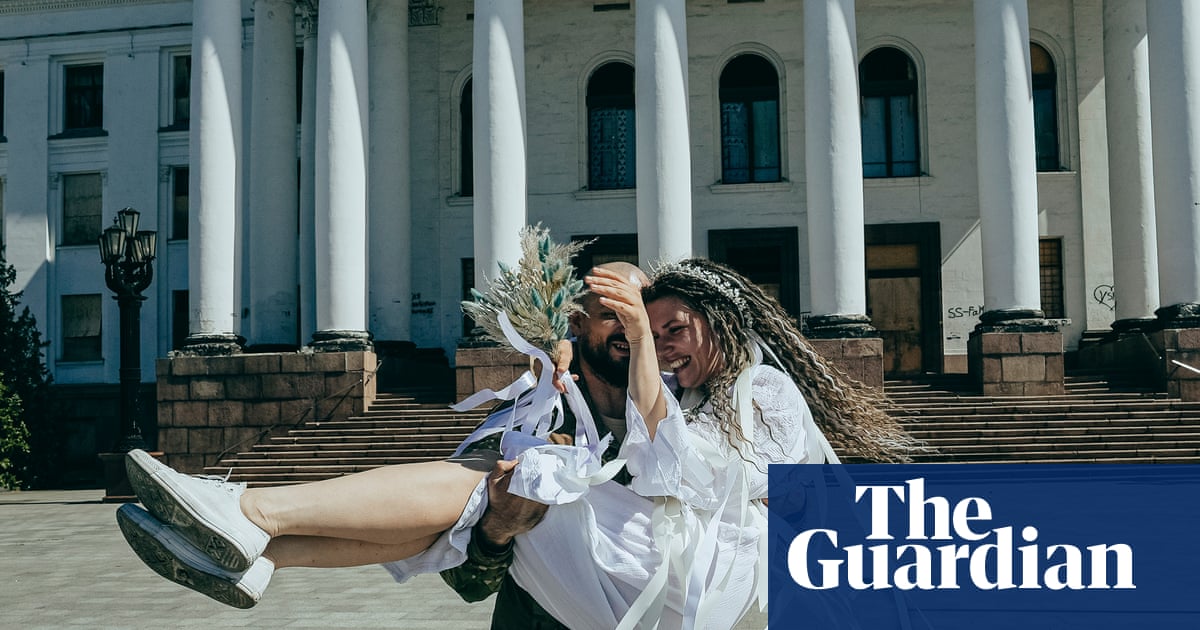
In the bright early afternoon sun of Kramatorsk’s central and now ironically named Peace Square, Tetiana, in her bridal dress, and Oleksandr, in his military uniform, are holding up their phones at the ready....
In the bright early afternoon sun of Kramatorsk’s central and now ironically named Peace Square, Tetiana, in her bridal dress, and Oleksandr, in his military uniform, are holding up their phones at the ready. It is a public holiday, 35 years since Ukraine’s declaration of independence, and a popular day for a wedding, though the open-air location is not obviously ideal.
Three days earlier, Kramatorsk, perhaps Vladimir Putin’s principal target, was formally designated part of the combat zone, the front inching towards the city as Russia closes in on the parts of the Donetsk region it does not control. It is quiet at 2pm though; the ceremony brief. There are no guests other than the Guardian team.
-
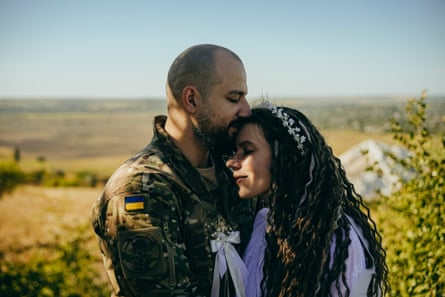
Tetiana and Oleksandr pose for a wedding photo on Mount Karachun, near Sloviansk, the scene of fierce fighting in 2014.
Getting married in Kramatorsk, Oleksandr says, is a necessary act of memory, because soon there may not be much more left to survive. “In this war, all this can just be vaporised, in a few months, in a few days,” the groom explains after the ceremony. “On the battlefield, many cities, towns, small villages where I was two, three years ago, they are now just ruins, just destroyed.”
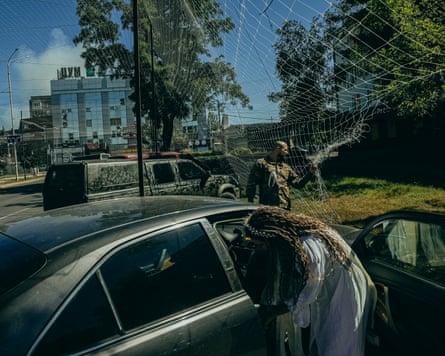
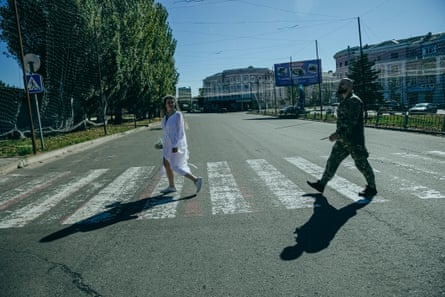
A year ago, Kramatorsk was a functioning city, a regional industrial centre, swollen with the presence of the military. It was possible to slowly sip coffee in the street and talk to local people and soldiers about how the city is an intrinsic part of Ukraine. Now it is covered in anti-drone netting, people and businesses are in short supply; many buildings have been bombed, chipboard replacing windows in those still standing.
-
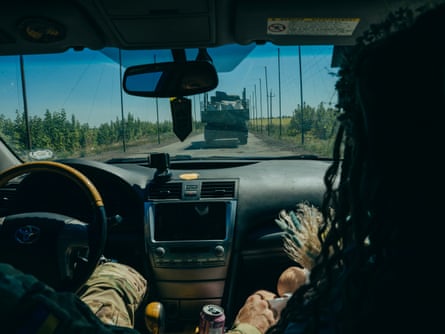
En route to Kramatorsk. The truck ahead is carrying ‘dragon’s teeth’, concrete anti-tank obstacles used in fortifications.
-
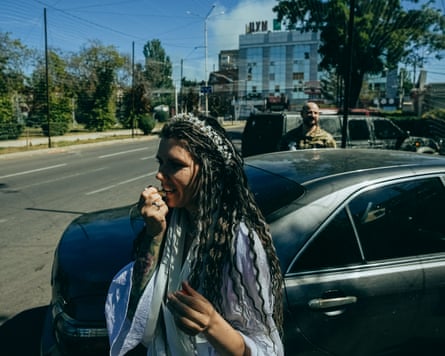
Final preparations for the wedding ceremony in Kramatorsk.
Six people were reported killed between Saturday and Tuesday in 51 shelling incidents as the city heads towards becoming uninhabitable for all but the most stubborn civilians. Reports swirl that Russia’s elite Rubicon drone unit has deployed to attack a city that Putin wants captured by the end of the year, though his forces will almost certainly take far longer, smashing it as they try to do so.
The day before the wedding, Russian quadcopter drones had repeatedly tried to target the vast Ukrainian flag atop an 80-metre (262ft) pole in the city’s central park, just under a mile to the south. There were at least 10 attempts, such is the pettiness of the war at times, and a small tear was visible in the standard afterwards. Yet the couple were determined to marry there, regardless of the threat.
-
Tetiana and Oleksandr cross a street beneath anti-drone netting in Kramatorsk.
Tetiana says it is “about preserving memories of the Donetsk region, if only in this way”. Oleksandr is from Mariupol, captured after a bloody siege at the beginning of the war, while Tetiana spent “every summer” at her grandmother’s home, now in occupied Donetsk, until she was 15.
On her right forearm is a bucolic tattoo, the dacha taking pride of place, its blue tones signifying the Ukrainian region split by over a decade of conflict.
A volunteer combat medic – “I don’t want to say no to military service, the number of wounded isn’t getting any smaller”, she says – Tetiana had been based in Kramatorsk until a few days earlier, but her Hospitallers crew was redeployed to Kyiv.
Undeterred, she travelled back east the day before to meet Oleksandr, a battle captain on deployment. On the day itself, the pair drove for several more hours, the final miles beneath anti-drone netting, to reach their chosen wedding location on time.
Ukraine introduced online weddings in 2024, a necessity in a war in which soldiers and their partners can be physically separated for months on end. The service has rapidly gained popularity in a digitally literate country – 38% of marriages were conducted online in the first half of the year, according to Ukraine’s justice ministry. Though Tetiana and Oleksandr were together, the officiant was on a video call.
The two met as recently as February, after she had reached out online, offering to treat him. Each already looks sure of the other. Oleksandr believes their shared understanding of the war, forced on to their country, will bind them close, at a time when “there is a big gap between military and civilians”. Her “experience in battlefield medical evacuations and so on makes it easier for us to understand each other,” he says.
-
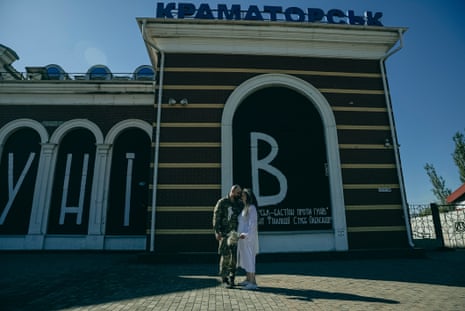
Tetiana and Oleksandr pose for a photo outside a railway station in Kramatorsk, where trains have not stopped since early November 2025 because of security concerns.
Their adult lives have been dominated by the conflict. Tetiana and Oleksandr are the same age as Ukraine itself – 35 – meaning they would have been in their early 20s when Russian-backed separatists captured Kramatorsk and neighbouring Sloviansk in April 2014, beginning fighting in eastern Ukraine that has never ended. Both cities were liberated that July, and only now has the frontline returned.
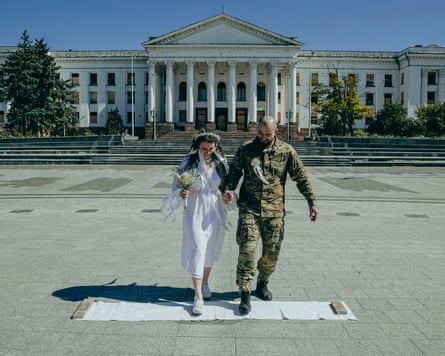
Proceedings begin promptly. Bride and groom hold their phones forward; the town’s already battered Palace of Culture, a five-storey museum and landmark in the Soviet classical style, behind. They place a white, traditional embroidered cloth, a rushnyk, in front of them, though it will not stay down in the wind.
-
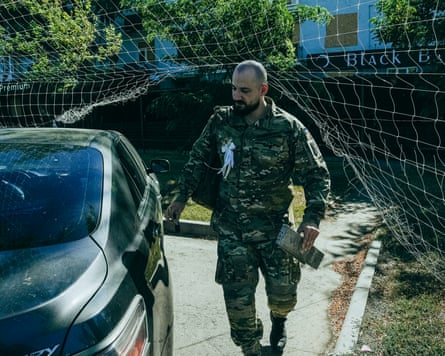
Oleksandr carries loose tiles to hold the rushnyk in place for the ceremony.
Oleksandr brings over two loose tiles, taken from the square’s flooring, to hold the rushnyk in place. The newlyweds will take the tiles with them afterwards. It is not an act of vandalism but rather one of preservation, taking tiles from a square that was relaid six years ago as part of the decommunisation of what had been Lenin Square. Tetiana plans to break the tiles and make a mosaic with them.
-
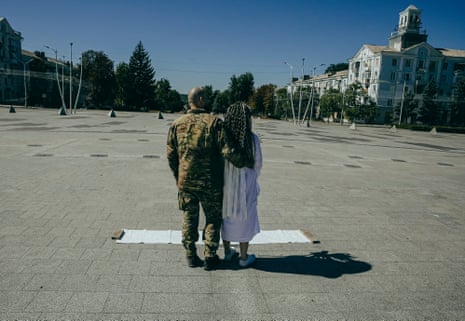
Tetiana and Oleksandr before the ceremony. The empty central square is surrounded by ‘dragon’s teeth’ and anti-drone netting.
-
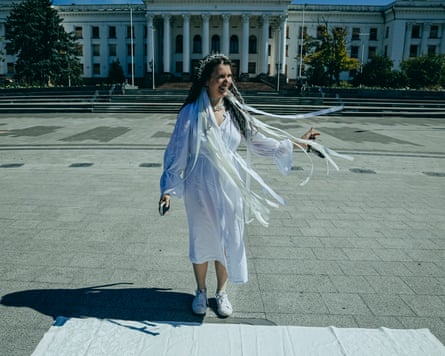
Tetiana and Oleksandr step on to the wedding rushnyk, a traditional embroidered cloth. The ritual symbolises the start of the couple’s life together.
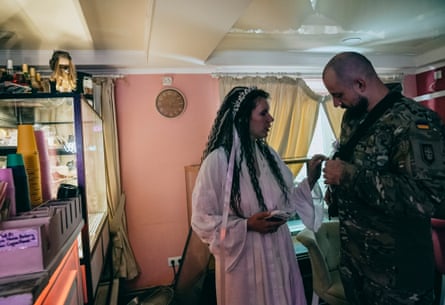
Rings and vows are exchanged, a bridal kiss is shared, and the couple step on the rushnyk together. This is an act of egalitarianism; tradition holds that whoever steps on the embroidered towel first has the last word in the family. After a few more photographs, it is time to head indoors to the nearby Sweet Coffee House Bakery, one of the few businesses still open, though its owner, Kateryna Seledtsova, has relocated to Kharkiv and the cafe feels more like a shelter, albeit one with cream cakes inside.
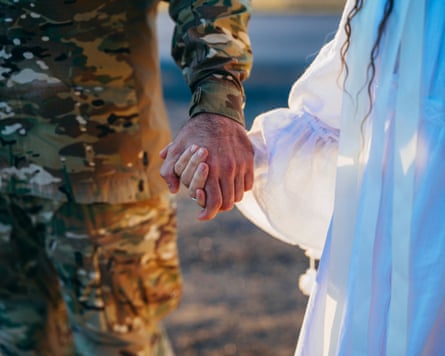
There is a moment of worry in the cafe, because a drone has been spotted above while Tetiana is outside. But she is quickly found and, over wedding cake, the newlyweds focus on their plans for children. “Starting a family during the war is about hope. I think it’s important to build something new, to build something beautiful, in a world that Russia is trying to destroy,” she says.
-
The newlyweds in Sweet Coffee House Bakery, one of the few businesses still open.
“I think that at a time when Russia is trying to spread gloom and darkness, destroy us and frighten us, it is important to create something beautiful, to wear beautiful clothes, to do kind deeds, to help and look after one another, and to love one another. That is what Russia wants to take away from us.”