Beyond 'Disclosure Day': Our picks of Steven Spielberg’s most underrated movies
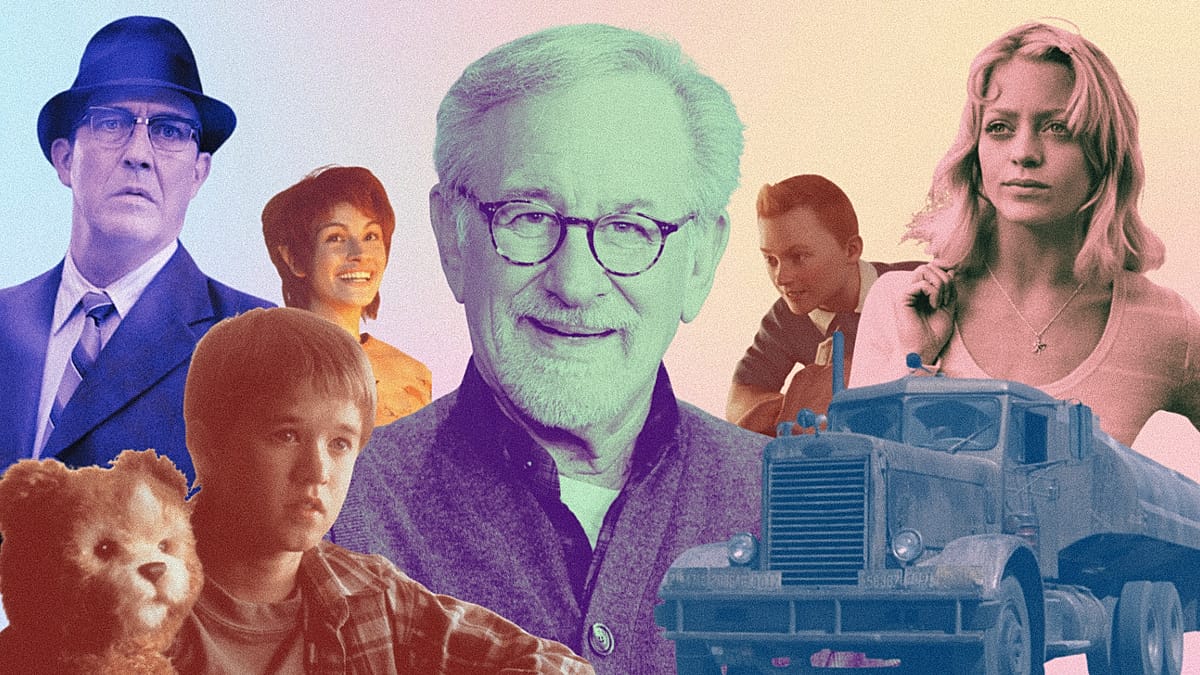
Steven Spielberg's 'Disclosure Day' has a strong box office opening despite mixed reviews. Felt alienated by it or looking to revisit / discover some of the director's filmography? The Euronews Culture team shares their picks of Spielberg’s underrated gems.
Steven Spielberg’s sci-fi thriller Disclosure Day is proving to be a box office hit, having debuted to $93 million globally.
The film marks the celebrated director’s return to human contact with extraterrestrial life, focusing on a whistleblowing mission to uncover a government conspiracy regarding aliens visiting Earth.
While the film is on track to become the 79-year-old director’s best performing original title in the US, reactions have been mixed.
We’re in two minds. On one hand, the uneven script undercuts Spielberg’s efforts, and the third act topples into shmaltzy parody. However, Disclosure Day remains further proof that few directors can balance thrilling entertainment and prestige filmmaking quite like Spielberg. Plus, in a world fighting against rampant cynicism and Elon Musk schools of thought which state that empathy is a weakness, it feels vital – now more than ever – to be reminded that communication and compassion remain humanity’s “evolutionary advantage.”
Read our full review of Disclosure Day here.
Over the course of a career that spans 55 years and 37 feature films, it’s no hyperbole to state that the young boy from Ohio redefined the Hollywood landscape. Spielberg has delivered some of the greatest blockbusters (Jaws, the original Indiana Jones trilogy, Jurassic Park), stirring historical dramas (Schindler’s List, Saving Private Ryan), sci-fi gems (Close Encounters of the Third Kind, Minority Report) and beloved “kids’ films” (E.T. The Extra-Terrestrial, The BFG).
However, for all of his critically acclaimed award-winners and box office successes, some of Spielberg's films have fallen by the wayside...
The Euronews Culture team has selected their picks of Spielberg’s underrated gems – the ones you should choose to discover or revisit if Disclosure Day hasn’t quite scratched your UFO itch...
Duel (1971)
Considering Duel was originally made-for-TV, it almost didn’t qualify for this list. But it’s too damn good to be ignored.
Technically Spielberg’s second film (1964’s Firelight still counts, even if it is partially lost), Duel is a masterclass in edge-of-your-seat suspense. Adapted from the short story by legendary horror and sci-fi writer Richard Matheson, it is a lean and mean tale of man vs truck - a 74-minute cat-and-mouse thriller will have you sweating buckets. Especially because the motive behind the unseen truck driver's dogged desire to terrorise our hero is left deliberately unclear.
A grudge? Sadism? Simply because he can? It's a bit like asking a great white shark why it likes preying on swimmers - and this road movie thrillerdefinitely set the stage for Jaws four years later.
Spielberg was only 25 years old when he directed Duel, and he already showed in 1971 that he had an unparalleled gift for understanding fear and delivering exhilarating thrills. DM
The Sugarland Express (1974)
Sandwiched between his critically acclaimed TV movie Duel (1971) and his major blockbuster hit Jaws (1975), The Sugarland Express is easily sidelined - despite being Spielberg’s very first theatrical release.
Based on a true story from 1969, it follows a doe-eyed Goldie Hawn as a mother willing to do anything to get her child back from the state. After breaking her husband (William Atherton) out of prison, the pair take a Texas highway patrol officer hostage and embark on a high-speed cop car chase.
It’s unusual - and easily forgotten - in its simplicity, most notable for its tension-building, tactile camerawork and immersive southern American atmosphere. But beneath the small-town action, Spielberg’s voice is still distinctive, if not yet fully evolved.
Through clever perspectives - glances and scenic clues in windshield mirrors - he builds an intimate landscape of clumsy, misfit characters, whose hearts are in the right place, even if their actions aren't.
This transforms a classic outlaws-on-the-run story into something that, while tonally muddled, prophesies the cosy charm and big-hearted bombast that would come to define Spielberg’s career - and make his movies so enduringly beloved. AB
Hook (1991)
Hook gets a rough time of it, and Spielberg has even gone on record to say that he was never happy with the way his 1991 adventure film turned out. Fair enough. We're not privy to behind-the-scenes turmoil or what the director had in mind...
However, for our money, it remains the best and boldest take on J.M. Barrie's Boy Who Never Grew Up, as The Beard made Peter Pan grow up, forget his true identity, become a workaholic corporate lawyer and an absentee dad. Spielberg brought new depths to the character's mythos, exploring the liminal space between childhood and the sad world of adults.
The result is a perfect family blockbuster, filled with candy-coloured visuals, swashbuckling showdowns, and so much heart. Robin Williams is a joy to watch as a wounded man trying to rediscover his inner sense of wonder, and what’s not to love about Dustin Hoffman going full panto as Captain Hook and Bob Hoskins stealing a few scenes as the slimy Smee?
It may not be Spielberg’s best family movie (E.T. still has that title), but Hook is certainly one of his most underrated and ambitious offerings. And it certainly strikes a better balance of thrills, emotion and sentimentality than Disclosure Day.
Lastly, bear with us as we recommend a social experiment: Walk into a room and shout "RU-FI-OOOOOOOOOOO!”
Whoever smiles or joins in at the mention of the Lost Boys' leader's name... That person is a potential friend for life. At least a person of great taste. DM
A.I. Artificial Intelligence (2001)
While not necessarily underrated, A.I. Artificial Intelligence tends to fall through the cracks when people recollect Spielberg’s filmography - possibly because it’s so damn emotionally devastating.
Based on a short story by Brian Aldiss from 1969 called "Super-Toys Last All Summer Long", it was actually Stanley Kubrick who first bought the rights in the 1970s. Ever the perfectionist, he spent over two decades developing it into a darker Pinocchio-style allegory about a young robot boy searching for meaning, morality and identity in a corrupted world.
While waiting on technology to advance, Kubrick eventually handed the project to Spielberg in 1995, who - in a pleasing nod to his legendary collaborator - released the final film in 2001.
It marked a tonal turning point for Spielberg too, beginning his unofficial ‘running man’ trilogy - which included Minority Report (2002) and Catch Me If You Can (2002). All of these explored characters on the run, but also layered compelling philosophical quandaries with heart-pounding spectacle.
While Haley Joel Osment remains best-known for his role in Sixth Sense (1999), his performance as David, the first Mecha boy to be given the ability to unconditionally love, is much more powerful. For every moment of stilted body language and robotic speech, there’s a well of only-human longing captured in each blue-eyed stare. His robot companion, Teddy (Jack Angel), is also one of cinema's cutest sidekicks.
In an era of rapid AI advancements, the movie hits even more of a nerve. As AI continues to take over creative industries, and people increasingly turn to chatbots for companionship, there’s the stomach-churning realisation that we’re no longer watching a world that could be - we’re living in it. It’s hard not to feel - as David remarks - like our “brains are falling out”. But there’s something hopeful to hold onto from A.I. Artificial Intelligence too - that nothing can replace the human soul and its ability to dream, connect and create. Without that, humanity becomes a frozen-over fairy tale; something we can only cling to in artificial iterations.
Let's not go there. AB
Munich (2005)
Among the most overlooked entries in Spielberg's filmography, Munich - adapted from George Jonas's book "Vengeance" - arrived to a relatively muted box office and minimal awards attention, and has largely faded from the cultural conversation since. It’s a shame, because it's one of his most brutal, complex and haunting films.
It tells the story of Mossad's covert hunt for the Black September operatives behind the 1972 Munich massacre, where eleven Israeli athletes were taken hostage and killed. What begins as a tightly structured espionage thriller gradually shifts into something much more uneasy: a study of revenge and the psychological cost of trying to “balance” violence with violence. Thus Munich refuses to draw clear lines between terrorism and counter-terrorism, instead suggesting both exist within a shared cycle of horror.
Stylistically, it’s undoubtedly some of Spielberg’s best work. Long lenses, careful blocking, intricate long takes, shots reflecting off windows and fluid camera movements create a world consumed by paranoia and guilt. One sequence involving a telephone booth is a particular highlight, and a filmmaking masterclass in building tension.
Politically, the film refuses easy answers, opening itself to both Israeli and Palestinian perspectives in a way that proved controversial on release and still unsettles viewers today. But twenty years on, amid the continued violence in Gaza and the wider region, Munich feels as urgent as ever. TF
The Adventures of Tintin (2011)
How does a film with the following résumé not get talked about more? Produced by Peter Jackson, co-written by Edgar Wright, voiced by Andy Serkis, Daniel Craig, Jamie Bell, Toby Jones, Nick Frost and Simon Pegg, and directed by Mr Spielberg.
This film has it all - adventure, mystery, whimsical humour, swashbuckling chaos, and some of the most deliriously inventive camera work Spielberg has ever put on screen. And yet it still flies under the radar. Perhaps it's the use of motion capture putting people off - there's likely a lot of unresolved trauma out there from the uncanny dead-eyed stares of The Polar Express. Fair enough. But this one manages to avoid that particular nightmare (for the most part).
The animated film, adapted from Hergé's iconic comic series, follows Tintin, his canine companion Snowy, and a magnificently drunk Captain Haddock as they get swept into a globe-trotting hunt for a priceless model ship. Spielberg’s hand is all over this one - breathtaking one-take action sequences, gorgeous lighting, and some of the slickest scene transitions you'll likely ever see (no exaggeration). John Williams' score is an absolute riot, too. And with Peter Jackson now confirmed to write and direct the long-awaited sequel - now's the time to get on board with this underrated gem. TF
Disclosure Day is currently in cinemas.