Thousands rally in Slovakia against PM Robert Fico perceived as too pro-Russia
Fico, who opposes military aid to Ukraine and maintains close relations with Russian President Vladimir Putin, has repeatedly clashed with the European Union during his current term.
Published on 18 November 2026 - 8:30 GMT+1
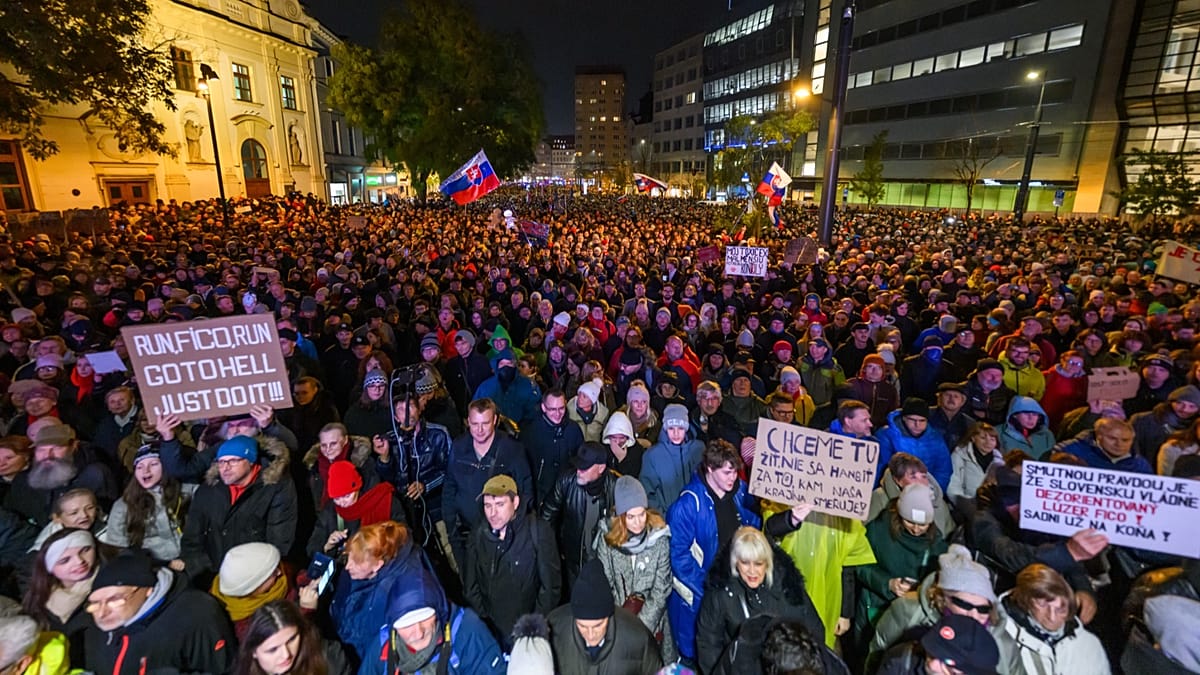
Thousands of people rallied across Slovakia late on Tuesday to demonstrate against the government of Prime Minister Robert Fico, under fire over curbing rights and his close ties with the Kremlin.
Tuesday's demonstrations were held to mark the anniversary of the 1989 Velvet Revolution that toppled communism in the former Czechoslovakia.
The demos came a week after Slovakia's parliament rejected a key government-proposed amendment to the penal code as Fico's coalition had lost its majority, leading to calls for a snap election.
Fico, who has served as prime minister four times in the EU and NATO member over more than two decades, has faced a series of protests since he returned to power in 2023.
Around 25,000 protesters gathered in central Bratislava, the leader of the opposition Progressive Slovakia party said, holding placards with slogans such as "Run, Fico, run!".
"We're the last ones in the European Union to be negotiating with the Russians...It's a disgrace," Igor Vico, a doctor still working at age 74, told the AFP news agency.
"We're at the bottom of the world, not just in Europe, and it makes me sad," he said.
Other demonstrations were also held across the country, including in the eastern city of Košice and Banská Bystrica in the centre.
Close relations with Putin
Fico, who opposes military aid to Ukraine and maintains close relations with Russian President Vladimir Putin, has repeatedly clashed with the European Union during his current term.
Last year, parliament amended the constitution to state that national law takes precedence over EU law in the country of some 5.4 million people.
Fico has also drawn anger over moves to exert greater control over the media and culture and to curb LGBTQ+ people's rights.
Critics have also slammed his efforts to strengthen ties with the Kremlin despite Russia's full-scale invasion of Ukraine, including a visit to Moscow in October by Foreign Minister Juraj Blanár for a meeting of the Russian-Slovak Intergovernmental Commission.
The Slovak government this week brought forward a cabinet meeting to discuss the results of Blanar's Moscow visit and deepening cooperation with Russia from Wednesday to Tuesday, further angering protesters.
Student Jan Ducho, 15, told AFP in Bratislava he did not think the government should be negotiating with Moscow.
"Russia isn't a partner we should have, after all, they attacked Ukraine," he said.
Czechoslovakia split into the Czech Republic and Slovakia in 1993.