
From Ukraine peace to Europe's future: How Russia is shifting the debate
As talks to end Russia’s war in Ukraine make little progress, Moscow is pushing for a wider deal on Europe’s security, raising fears that the Kremlin is seeking to reshape the continent’s future on its own terms.
Ukraine had pushed for European involvement in the Abu Dhabi peace negotiations, but Kyiv may not have anticipated that its efforts would shift diplomatic attention towards a different question: who should represent Europe at the negotiating table?
As the diplomatic process unfolded this week, US envoys Steve Witkoff and Jared Kushner travelled from Abu Dhabi to Moscow for talks with Russian President Vladimir Putin, before heading to Dublin to meet Ukrainian President Volodymyr Zelenskyy.
The Abu Dhabi talks produced an agreement in principle on a major prisoner exchange, but no breakthrough on a ceasefire or territorial settlement. Instead, the diplomatic focus increasingly shifted towards Europe's participation in future negotiations and the continent's security arrangements.
Speaking to Euronews' Shona Murray after meeting the US envoys on Thursday evening, Zelenskyy warned against discussing Europe's future security architecture before ending Russia's war in Ukraine and securing guarantees for Kyiv.
"A lot depends on when and how the war will end in Ukraine and this will have influence on all other steps," Zelenskyy said.
"And all these steps will be after the ending of the war, after the security guarantees for Ukraine," he added.
Zelenskyy argued that Ukraine was already an integral part of Europe's security architecture, and that its potential NATO membership would determine what form the continent's future security arrangements could take.
"We are the part of Europe and we are the parts of security architecture already. So if we are in NATO – that's what I said to Jared and Steve – if we will be in NATO, this is one architecture," he said.
Putting architecture before peace is ‘Kremlin's mental trap’
Speaking to reporters in Dublin on Friday, Estonian Prime Minister Kristen Michal warned that discussions about Europe's future security architecture risked distracting from the immediate priority of ending Russia's war in Ukraine.
"This is a mental trap to talk about European security architecture before the peace. Because this is what Putin does. It makes us talk between each other about our matters, but not about the matter that matters. That is the peace," Michal said.
He called for continued European support for Ukraine and greater pressure on Russia, particularly as Moscow intensifies its attacks on Ukrainian energy and civilian infrastructure ahead of winter.
"The European plan for a while is quite simple: help Ukraine push Russia" he said.
The debate has also raised concerns that Moscow could use negotiations over Europe's security arrangements to revive its longstanding demands over Ukraine and strengthen its position ahead of high-level talks in China next week.
Speaking to reporters in Moscow on Thursday, 12 November, following Putin's meeting with the US envoys, Kremlin aide Yuri Ushakov said Russia expected Witkoff and Kushner to convey the Russian president's messages to Zelenskyy.
"We hope that the messages from Moscow will be conveyed in full detail. We remain in contact with Steve Witkoff and Jared Kushner and will discuss the state of affairs before the meeting between Vladimir Putin and Donald Trump in China," Ushakov said.
From territorial concessions to a new Yalta
Moscow is pushing for a trilateral meeting between Putin, Trump and Chinese President Xi Jinping in China, ahead of the Asia-Pacific Economic Cooperation summit in Shenzhen on 18–19 November, although arrangements have yet to be confirmed.
Speaking to Russian state television following the Abu Dhabi talks on Wednesday, 11 November, Russia's chief negotiator Vladimir Medinsky invoked the prospect of a new great-power settlement, drawing comparisons with the Second World War conferences at Yalta and Potsdam, where the victorious powers negotiated Europe's future.
"The task now is to create a comprehensive security system in Europe that would become a new, modern Yalta and Potsdam," Medinsky said.
He argued that a "fair security system" emerging from the negotiations could guarantee peace in Europe "for decades and even centuries", provided it met Russia's demands.
What the talks were supposed to be about
Ahead of the US-mediated talks in Abu Dhabi earlier this week, territorial disputes and post-war security guarantees for Kyiv were expected to dominate negotiations aimed at ending Moscow's war.
A senior US official suggested that Ukraine and Russia had privately shown "a little bit of flexibility" over disputed territory, raising cautious hopes of progress on one of the most contentious issues in the negotiations.
Trump even suggested that Ukraine could emerge from the war with "a little bit different shape", without specifying what territorial changes he envisaged.
Before the negotiations, Zelenskyy said Kyiv would propose steps to reduce hostilities and seek agreement on arranging a trilateral meeting between the leaders of Ukraine, Russia and the US.
"At the meetings in Abu Dhabi, our team will propose de-escalatory steps, and there must be an understanding of how to arrange a trilateral meeting at the leaders’ level to bring this war to an end fairly and for real," Zelenskyy wrote on X.
But Medinsky's remarks after the negotiations suggested that Moscow's position on ending the war remained unchanged.
He ruled out territorial exchanges involving Russian-held areas along the border and insisted that Moscow would only be satisfied once it achieves victory and secures the peace deal it demands.
"Only when we win and sign a peace agreement on our terms," he said when asked whether the Russian side was satisfied with the outcome of the talks.
Medinsky also rejected the prospect of Russia relinquishing control of territories it has occupied in Ukraine.
"Where the Russian flag has been raised, it must not be lowered," he said.
He insisted that every inch of what Moscow considers Russian territory would be returned to Russia "one way or another".
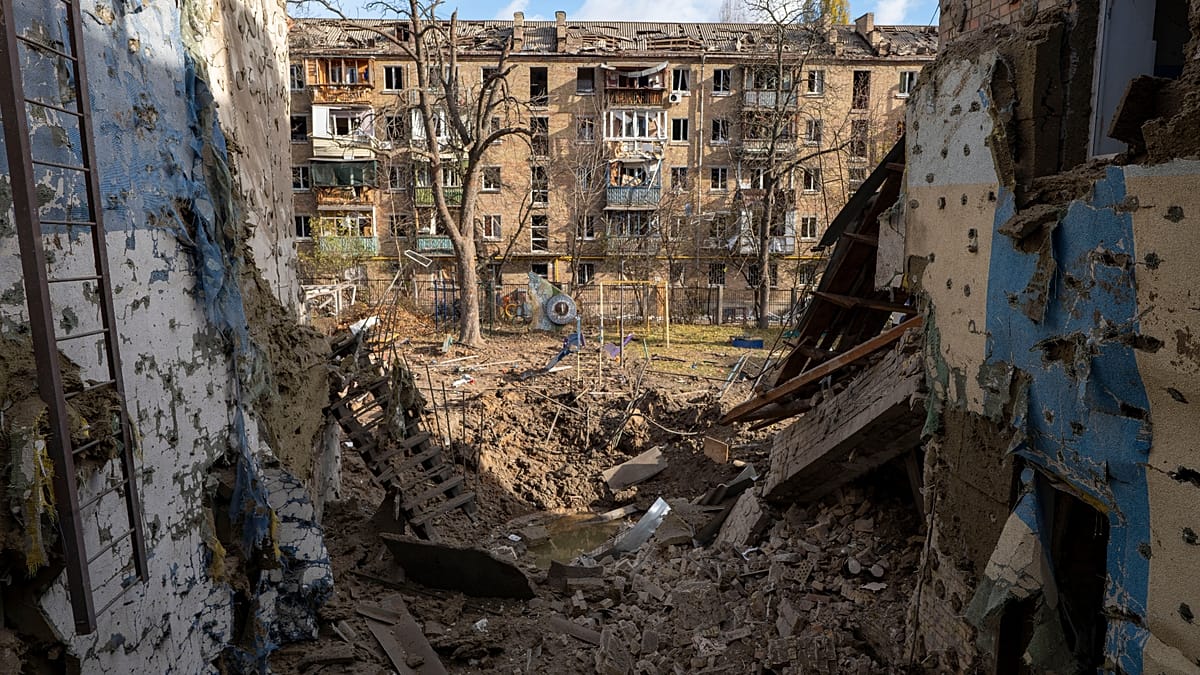
Meanwhile, as diplomats debate Europe's future security architecture, Russia continues to bombard Ukraine.
Russian forces launched 117 drones overnight, including 63 jet-powered drones, according to Ukraine's Air Force. Russian attacks killed nine people and injured 61 across the country, local authorities reported.
In Kyiv, debris from a Russian drone sparked a fire at a hospital in the Shevchenkivskyi district, partially destroying its second floor.