Ukraine's digital minister: 'We want Europe to use Ukraine as an AI sandbox'
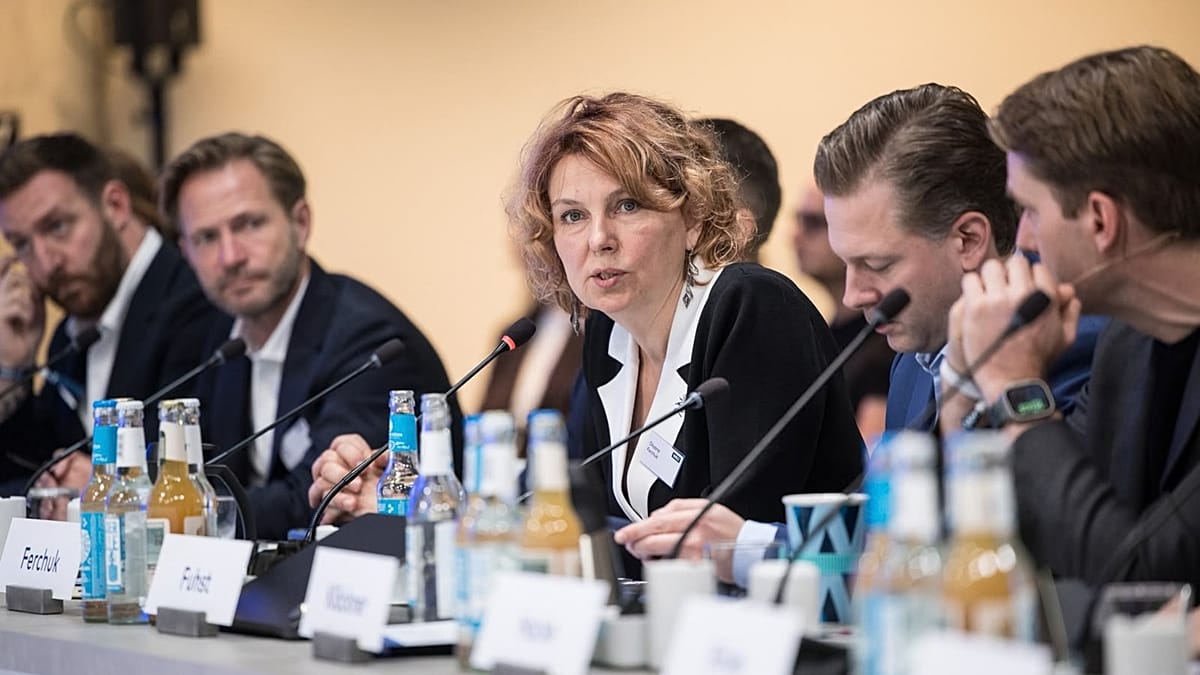
Ukraine has built a digital state under the pressure of war. Digital Minister Oksana Ferchuk tells Euronews what Europe can learn from Ukraine, from digital government and AI to cybersecurity and resilience.
Do you know where your driving licence, ID or marriage certificate is right now? In Ukraine, you can access these and many other essential documents directly on your phone.
The country has built one of the world’s most advanced digital government systems, with services that allow citizens to handle much of their everyday bureaucracy online.
During her visit to Berlin, Ukrainian Minister of Digital Transformation Oksana Fedorova met with her German counterpart, Karsten Wildberger, to discuss how Ukraine and Germany could share their experiences.
The two countries agreed to bring together dedicated teams to take a closer look at what Ukraine has done well – but also at what has not worked – and explore which of its digital solutions could be useful for Germany.
Euronews met Ferchuk at the Ukrainian Embassy in Berlin during her visit to discuss the kind of cooperation Germany and Ukraine can expect, her views on the latest warnings about AI, and how Ukraine's digital infrastructure can withstand Russian attacks.
Euronews: What are some of the key things Germany can learn from Ukraine that these teams will be looking at?
Ferchuk: First of all, our ecosystem of state services, which we utilise in a platform called Diia ("action" in English). It's a mobile app, web portal and network of offline locations where we, as a government, provide public services to Ukrainians.
The app gives users access to more than 30 digital documents, including your passport, driving licence, information about your children, your tax ID and your children's tax IDs. Beyond these documents, which we believe could also be used across Europe as the EU moves in the same direction with its digital identity wallet initiative, we offer a wide range of services. These include selling a car through the app, giving someone else permission to drive your car without having to visit an office and checking and paying fines online.
Another area of the app is where you can get married or divorced online and you can even propose online. Ukrainians living abroad who want to get married under Ukrainian law can also do so through Diia, with our postal service then sending them the official paper certificate by post.
In total, we offer around 250 public services online. We agreed to analyse these services together with the German ministry team, identify some for service design, and potentially even develop a prototype for Germany. We also agreed to build this connection not only between our government teams, but also to introduce German counterparts to the IT companies that have been developing these kinds of applications and services for the Ukrainian government for several years. We call them the GovTech Alliance of Ukraine, and we'll be happy to introduce them to our German partners.
Euronews: There seems to be a greater acceptance of making mistakes along the way.
Ferchuk: This is one of the biggest differences between the IT world and government. In government, we have to do everything in accordance with the law. But as a government, working together with parliament, we also have the ability to change the law.
That is the mentality we have. If we see that a simple, user-friendly service cannot be provided because of certain legislative restrictions, and changing those laws would have a positive impact on society, we change the law and then make the service easier to use. In the IT world, by contrast, success often comes from experimenting and trying things repeatedly.
To give people the freedom to innovate, you have to give them permission to make mistakes. Those mistakes should never compromise data protection or security, and they should never breach the law. But you have to give your IT teams the freedom to make mistakes. Otherwise, they will simply follow what is already set out in the legislation, and there will be no real innovation.
Euronews: If we look ahead to the winter, Russia also targets critical infrastructure, so there can be situations where there is no electricity, no mobile network, or people simply can't charge their phones. How do you make sure that people can still access these essential services in those situations?
Ferchuk: That's a very important question and another area of cooperation with the German government. We discussed it separately because we are not only building a digital state; we are building digital resilience. This is not our first winter. Unfortunately, it's the fourth or fifth, depending on how you count from the very beginning.
Will this winter be more difficult? Yes, we expect it to be, but we have been preparing for it since the summer.
We have a specific programme with telecom operators and are training our teams on what to do when the electricity goes out during blackouts. We are preparing to use generators and batteries to keep base stations running and mobile networks operational. We are now planning for outages of up to five days, with a plan for each area. Unfortunately, Russia started attacking our digital infrastructure a week ago. They attacked more and more our data centres.
Recently, they attacked two of our telecom providers. But the result is that the services are still available because we have backups and can move systems into the cloud or underground. We have a specific resilience strategy for all state-owned and government IT systems and services. We have backups for everything and are now conducting exercises, including deliberately switching some systems off.
It's all part of the training. What Europe can expect from Ukraine is an opportunity to see how the state can use AI to improve public services. With your Ministry of Digital Transformation, we have agreed to connect our AI teams and develop some services together. Your teams will be able to see how we train our models, which models we use and how the architecture is built. And we are ready to share not only our successes, but also our mistakes. This is an important message for the European Union. We are now required to harmonise our legislation with the so-called AI Act.
But we would like to propose a slightly different approach. We propose that Europe use Ukraine as an AI sandbox: a place where it can observe the experiments we are conducting, learn from what works and then implement those lessons safely in the European environment. In the digital sphere, our experience with documents and public services could also be replicated across the European Union, creating a single digital space where documents are accepted across borders and services are available cross-border. This is our proposition to the European Union and to Berlin.
Euronews: Why is Ukraine so digitally advanced? Was this something that was accelerated by the full-scale invasion, or did it already exist before the invasion?
Ferchuk: That's more of a philosophical question. I'd say it started in the early 2000s, when many businesses began innovating and developing digital products, laying the foundations for Ukrainians to start using digital applications. We realised that it was much easier, more convenient and more user-friendly when services were available online.
The first wave of adoption and acceptance really came from the commercial sector. Then, in 2019, a new government came to power, and several prominent figures from Ukraine's IT sector joined it. They had a clear vision and strategy and in 2019 they established the Ministry of Digital Transformation. From that point on, that vision was implemented, refined and continuously updated. As a result, we now have a government that thinks about digital transformation and digital tools across all areas. And it's not just about policies.
We have also created dedicated digital transformation positions in every ministry and every major government body. If you want to provide a service to a citizen, you often need information from different government bodies. We have digitalised much of this information and created a large number of decentralised registers. This is also very important: the registers are protected, and the information is never stored in one central database.
When you, as a citizen, request a service, we only retrieve the specific information we need about you from each relevant register or database. We then bring that information together to provide the service. That is one of the reasons why this system is possible.
Euronews: How do you protect data when so many government services are online? Russia is using hybrid warfare, including cyberattacks. Is there a specific security system or firewall in place, or does accessing only specific pieces of information from different ministries already provide an additional layer of protection?
Ferchuk: Both.It's a really complex architecture that is, first of all, decentralised. Second, we classify information according to its level of importance. We have open information and a lot of open data that is publicly available in Ukraine.
Then we have personal information, which is protected and not publicly available, but can be accessed when you request it as an individual. And then there is classified information, which has to be protected under much stricter rules. For each type of information, we have specific rules on how it should be protected, based on international best practices.
Is it 100% safe? In IT, you can never say that anything is 100% safe. But this is also a battlefield. The enemy is attacking us in cyberspace every day. There are thousands of attacks every year, and we are constantly developing our skills and our community of experts who know how to protect and monitor these systems 24/7.
We have what we call security operations centres, where teams monitor system logs and analyse anomalies and user patterns, increasingly with the help of AI. So it's a constant process: the enemy improves its tactics, and we improve our tools and defences.
Euronews: Like a cat-and-mouse game.
Ferchuk: It's a constant technology race. The good thing is that Ukraine has a large community of IT specialists and a strong academic sector, producing around 20,000 IT specialists each year.
This environment has also helped us build a strong community of cybersecurity experts. The major companies that develop and sell cybersecurity tools globally are also very interested in testing their technologies in the Ukrainian environment.
Euronews: Is there a parallel here with the defence industry? With drones, for example, companies are gaining valuable battlefield experience because their systems are being tested and used in Ukraine.
Oksana Ferchuk: It's the same approach, but the difference is that this experience is valuable not only for countries at war. Cyberattacks are already a reality for many countries. Different types of adversaries, not just Russia, are using these tactics to disrupt or destabilise the IT systems of other countries and their allies. So this knowledge is very valuable.
The good thing is that the major companies producing cybersecurity tools are very interested. They come to us, and we work with them directly. They provide us with new updates, and there is also a continuous cycle of innovation: new tactics from the enemy, new products from vendors, and new defensive tactics and experience from our teams. It's developing very quickly. That’s why we are concerned and would really like our partners and allies to be part of this race and see what's happening.
The Baltic countries are very good at sharing this experience. We would love Germany to do the same.
Euronews: You've mentioned AI. Some AI developers themselves warn about the risks of increasingly powerful systems. From a more basic perspective, how do we ensure that AI doesn't get too much access to our digital infrastructure?
Ferchuk: I don’t really want to comment on it in those terms, because some people make very emotional statements that are then picked up by other media. I'd rather approach it from a different perspective. When the internet was first developed, there were concerns that it would change the world, take away our jobs and so on. So we shouldn’t be afraid of this new technology.
When you look at AI in more detail, you understand how advanced it is and what kind of fundamental changes it can bring to our everyday processes. AI is a really powerful tool. It can help us analyse more data, make more decisions based on facts rather than feelings and, above all, eliminate the routine bureaucratic work that everybody hates. So I see the influence of AI in a very positive way.
At the same time, for people who are afraid of AI and are wondering whether to use it to modernise their economies and everyday lives, they have to look at what is happening in other countries, where this question is no longer being asked. Those countries are already in a race, actively building infrastructure and training specialised models that increase productivity and efficiency and will have a huge economic and cultural impact.
If your country or your industry is not using this technology, somebody else in another country already is. And we have to remember that we are part of a global market and are competing globally. So I would say it’s really wrong not to pay attention to this technology. It can improve our lives dramatically. We just have to be wise enough to put the right guardrails in place and use it in an ethical, effective and responsible way. We actually have a strategy for using AI to achieve the maximum possible impact.
Our vision is to build what we call a full AI stack. We are working on our own sovereign AI factory infrastructure. At the same time, we use cloud infrastructure to compare the performance of different models. We mostly use open models and train them for specific tasks, and we now have a lot of experiments under way for government use.
Then we have the application layer. This includes the mobile applications I mentioned earlier. Diia is a government services app used by more than 24 million Ukrainians. It's a great platform for showing people what an AI-powered service can look like. We launched the world's first AI assistant that helps you understand how to access the government service you need.