Where does Iran deal leave US-Israel relationship as they reach ‘a fork in the road’?
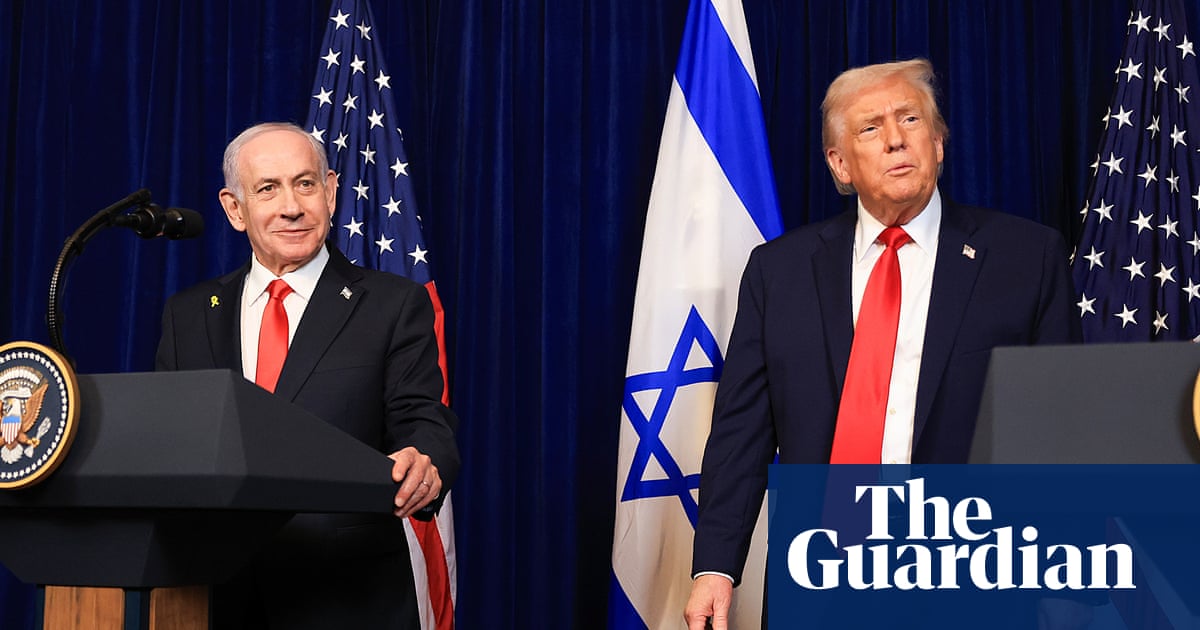
It took more than a day after news of Donald Trump’s deal with Iran went public for Benjamin Netanyahu to speak out.When he finally appeared at a press conference on Monday evening, the Israeli prime minister...
It took more than a day after news of Donald Trump’s deal with Iran went public for Benjamin Netanyahu to speak out.
When he finally appeared at a press conference on Monday evening, the Israeli prime minister skirted a cornerstone of his past public appearances: his excellent relationship with the US president.
“There are cases in which President Trump and I do not see eye to eye,” he said when asked about that. “I am responsible for Israel’s security interests, and it needs to be done wisely.”
As to the deal, he told its many critics not to pass judgment yet: “We do not know what the agreement will be.”
Increasingly, the Israeli prime minister who had dominated relations with five US presidents has had to face the prospect of Israel going it alone against Iran. It is a remarkable turnaround from a mere four months ago, when his intervention and a White House presentation that he had given to successive US administrations finally hit home, convincing Trump to mount a joint attack.
But if Netanyahu has not been forthcoming about his souring relationship with Washington, then the converse has not been true. In one conversation with Axios, Trump said that he was “so pissed off” and told Netanyahu that he had “no fucking judgment”.
In public, Trump laid into Netanyahu for launching strikes against Lebanon, where the Iran-backed Hezbollah is in conflict with Israel, on the “special day” when his peace treaty was to be announced. “Bibi has to be more responsible with respect to Lebanon,” Trump told reporters on Tuesday, adding that “too many people are being killed.”
“You don’t have to knock down an apartment house every time you’re looking for somebody,” he said. “There are a lot of people in those apartment houses and they’re not all Hezbollah.”
For Netanyahu, who has leveraged enormous lobbying support in the United States, this was a nightmare turnaround. The combined pressure of a US president desperate to exit the war he launched and of an upcoming Israeli election challenge have flipped the script, leaving him as a potential spoiler to a grand bargain that could have enormous political consequences for him.
“Let’s be clear, Trump has enormous leverage,” said Aaron David Miller, a senior fellow at the Carnegie Endowment for International Peace. “No American president has ever talked to an Israeli prime minister the way Donald Trump has talked about Netanyahu. No American president has ever allowed his private conversations to be leaked and so profanity-laced and mocking. It’s really quite extraordinary.”
There are many politically-charged unknowns in the deal, including the potential release of billions of dollars in frozen Iranian assets or other financial aid to Iran, a clause of the Obama-era Iran deal that Trump had publicly blasted at the time. “The worst thing you can possibly do in a deal is seem desperate to make it,” he subtweeted Obama in 2015 when the White House signed the nuclear deal called the Joint Comprehensive Plan of Action (JCPOA).
Now, Trump has telegraphed his desire to get out of the war he launched earlier this year – leaving Netanyahu to manage a difficult set of political consequences. Besides the release of frozen assets, attention has turned to southern Lebanon, where Iranian officials and US officials have claimed there will be a ceasefire but Israeli politicians have said that troops will not abandon their positions.
US officials have said that Israeli forces would not be forced to withdraw from southern Lebanon and would have the right to defend themselves, but privately have sought to restrain Netanyahu to prevent a deal from being derailed.
“Their withdrawal was not a condition of the deal,” said a senior US administration official. “The deal is a ceasefire, and it will not be a one-way ceasefire, meaning that if Iran is not able to control Hezbollah, and if they attack Israeli positions or Israeli towns, Israel will have the right to defend themselves and respond.”
But that is not a blank check – and Netanyahu is in a bind.
On the one hand, he has led the country in three wars in Gaza, Lebanon and Iran without a clear victory in any. Declaring peace, particularly one dictated from abroad, will bolster criticism of his foreign policy as he faces a tough re-election in the autumn.
On the other, with the US now relying on Gulf intermediaries and Pakistan to broker a peace, the strategic interests of the United States and of Israel are diverging. During a briefing on Monday, one senior Trump administration official extolled the direct, high-level conversations that the US was now holding with the Iranian leadership.
“We’ve reached a fork in the road,” said Alan Eyre, a distinguished diplomatic fellow at the Middle East Institute and former senior US diplomat. “Netanyahu sold President Trump on this action plan that went sideways quickly, and now President Trump wants to end this war as quickly as possible.”
“So he’s done with that, but Netanyahu is paying as prime minister of a country – the only country in the world where this is a really popular war,” he addded.
Down but never out, Netanyahu will have to find a way to navigate the coming week before Friday’s signing ceremony and then the months of what observers expect to be a tenuous ceasefire and difficult negotiation period. With the terms of the deal between Iran and the US still unpublished, Netanyahu may still expect negotiations to fail – as many do – given the right pressure.
Netanyahu’s “got to figure out a way to navigate this in the next several months”, said Miller. “And I think the Iranians have figured that they have him in a box.”