Chinese goods transshipment haunts Trump-Xi meeting: nine Latin American countries flagged
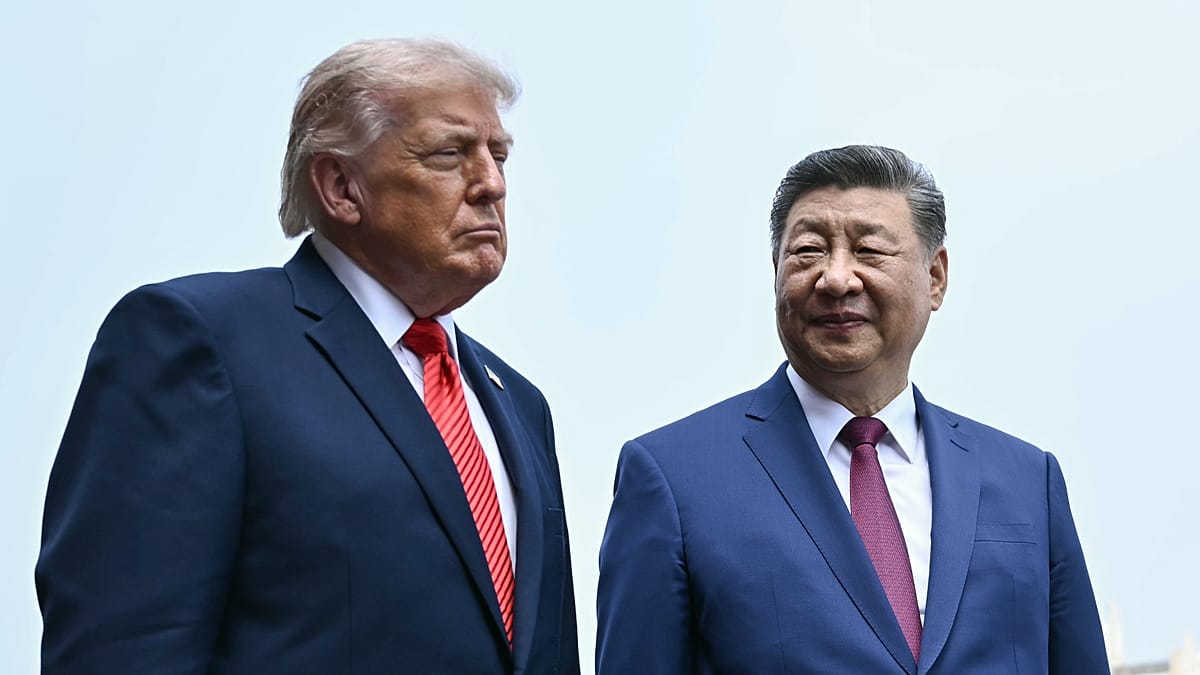
This Thursday 24 September, Xi Jinping will meet Donald Trump again, this time at the White House, four months after the two last saw each other in Beijing. The meeting comes with a backdrop that weighs...
This Thursday 24 September, Xi Jinping will meet Donald Trump again, this time at the White House, four months after the two last saw each other in Beijing. The meeting comes with a backdrop that weighs particularly heavily on Latin America.
In August, the White House published a report on trade transshipment, the shipment of Chinese goods through third countries to avoid tariffs, which flags more than 40 economies as risk points, nine of them in Latin America or the Caribbean: Mexico, Brazil, Argentina, Chile, Colombia, Peru, Panama, Costa Rica, Dominican Republic.
The "great transshipment scam": what the US report says
The document is titled The Great Transshipment Scam: Rise, Scope, and Costs (source in Spanish) and was signed on 13 August by the White House Office of Trade and Manufacturing Policy, headed by Peter Navarro, Trump's chief adviser on trade and manufacturing.
It runs to 25 pages, with a Trojan horse made of containers on the cover. The mechanism it describes is a familiar one: relabelling, repackaging, re-invoicing, minor assembly work and false declarations of origin, all supported by free zones, bonded warehouses and logistics hubs where there is no real transformation of the product.
The report does not provide a single headline figure, but instead compares five independent estimates of the money lost, two from US official bodies and three from private firms, which the White House itself warns are neither additive nor directly comparable with one another, because each one uses a different methodology and covers a different universe of products.
Goldman Sachs offers the most conservative estimate. It puts the loss at 40 billion dollars a year (almost 35 billion euros), the lowest figure, based on an econometric model using 2023 data and focused solely on the re-export channel.
The White House Council of Economic Advisers puts the range between 34.2 and 89.6 billion dollars (between 29.782 and 78 billion euros), with 60 billion dollars (52.25 billion euros) as the midpoint, by cross-checking tariff codes country by country.
The private AI supply-chain intelligence firm Exiger puts the figure at 75 billion dollars (65.3 billion euros), a number the report adopts as its central case for the rest of its calculations on jobs, GDP and lost revenue.
The Department of Commerce offers a broader reading with a simple method, calculating an upper ceiling of 109 billion dollars (94.914 billion euros), although with a stricter cross-check of exact shipments via Mexico, India and Vietnam it cuts this to 67 billion (58.3 billion euros). Altana, another supply-chain intelligence company, sets the upper limit at 303 billion dollars (263.852 billion euros), the widest and least tightly defined of the five estimates.
On that base of 65.3 billion euros, Exiger's, the report calculates an annual loss of between 16.545 and 22.64 billion euros in tariff revenue, to which it adds 450,000 jobs displaced and up to 150 billion less in GDP.
The fact that five sources arrive at such disparate figures is not a contradiction but a reflection of what each of them measures and how granular their data are. At one end of the spectrum is Goldman Sachs, which isolates one very specific channel, goods that are rerouted specifically to dodge the China tariff, and measures it with final 2023 data; hence the lowest number.
At the opposite end is Altana, which does not analyse products one by one but relationships between factories: it tracks which facility produces what, through which intermediary and to which destination, and counts as potential transshipment any suspect route, including goods that do undergo a real transformation in the intermediate country. This breadth of criteria is what pushes its estimate up to 303 billion.
That combination of reasonable breadth and on-the-ground verification at factory level is what leads the White House to adopt Exiger's figure as its "central case" for the rest of the report, jobs, GDP, lost revenue, instead of choosing either the highest or the lowest of the five.
To put these figures in context, the White House compares them with items in the federal budget itself: 21.722 billion euros is almost the same as the budget request the Space Force has made for 2026 (22.991 billion euros) and exceeds that of US Customs itself (20 billion).
The report also provides evidence from enforcement on the ground: comparing the 526 days before and after Trump's inauguration, shipments with irregularities detected by Customs rose by 245%, from 93,744 to 323,677, and the additional revenue associated with those irregularities increased by 169%, from 8.36 to 22.469 billion euros.
The legal basis for tightening these controls is executive order 14411, "Strengthening Customs Enforcement" (Fortalecimiento de la fiscalización aduanera), which Trump signed on 3 June 2026 and which grants Customs more tools on importers' liability, bonds, ownership transparency and penalties.
On that basis the "Detective Border" is being built, the artificial-intelligence system that Customs is already testing to cross-check shipping routes, ownership histories and declared production capacity.
Nine Latin American countries among the 40 singled out
Washington divides the 40 countries into three tiers according to their role in the network. In the first, that of "diversified scale leaders", Mexico appears alongside Canada, the European Union, India, Japan, South Korea, Taiwan and Israel.
In the second, with deeper production integration with China, are Brazil together with Indonesia, Malaysia, Thailand, Turkey and Vietnam. The third tier, that of "smaller opportunistic targets", groups Argentina, Chile, Colombia, Costa Rica, Panama, Peru and the Dominican Republic, along with Singapore, Switzerland, the United Arab Emirates and other small economies.
The report also includes a map of "Latin American corridors", Argentina, Brazil, Chile, Colombia and Peru, defined as diversion routes between the Pacific and the Atlantic that combine bonded warehousing with regional assembly.
The White House itself stresses, however, that appearing on the list does not amount to a formal accusation of fraud: it acknowledges that the increase in exports from these countries to the US does not in itself prove that illegal transshipment is taking place.
Mexico was the first to react. President Claudia Sheinbaum rejected the allegation on the very Friday the report came out: "We have shown the United States that there is no triangulation scheme", she said at her morning press conference, explaining that a large share of the goods arriving in Mexico gain real added value before being re-exported, within the law. Her government is in direct contact with the Department of Commerce and with the US trade representative, Jamieson Greer.
In Santo Domingo, the Ministry of Industry, Trade and MSMEs also moved to defend the transparency of its foreign trade, stressing that the report imposes no sanctions or restrictions and that the reference to the Dominican Republic reflects its free zones and port infrastructure, not any irregular operation that has been detected.
Several of the countries named had already made moves before the report, gestures that now take on a different meaning: Mexico imposed tariffs of up to 50% on Chinese cars in December, ahead of the review of the USMCA, and Colombia set a 35% tariff in March on steel imports from countries without a trade agreement, with China as the main party affected.
The tug-of-war with CK Hutchison and China
No case illustrates the tension better than Panama's. On 29 January, Panama's Supreme Court declared unconstitutional the concession, in force since 1997, that allowed Panama Ports Company, a subsidiary of Hong Kong's CK Hutchison, to operate the ports of Balboa and Cristóbal at both ends of the canal.
The lawsuit was brought by the Office of the Comptroller General, which alleged contractual irregularities and an accumulated tax debt close to 1.2 billion dollars (1.046 billion euros). The ruling came in the middle of negotiations, already stalled at that point, on the sale of those ports to a consortium led by BlackRock for 22.8 billion dollars (19.877 billion euros), a deal that Beijing had asked to handle "with caution".
The US Congress hailed the decision as a defeat for China in the canal; Panama took effective control of the terminals on 23 February, and China responded by freezing talks on new projects in the country and summoning the Panamanian ambassador.
President José Raúl Mulino said that Panama would not be pressured by Beijing. Months later, the country appears in the lowest tier of the transshipment report, but with symbolic weight that outweighs any trade figure.
What is at stake for the region in the 24 September meeting
According to the official agenda for the Washington meeting, they will discuss issues such as the Strait of Hormuz, financial sanctions on Iran, the global tariff war and controls on artificial intelligence. On the question of the global tariff war in particular, Latin America will gain prominence "on the board", as foreign-policy analysts describe it: China overtook the European Union years ago as Latin America's second-largest trading partner, and in several countries it is already ahead of the United States in terms of trade volume.
The Peruvian port of Chancay, financed with Chinese capital, had already featured in analysis ahead of May's summit in Beijing as a source of concern for Washington, which sees it as an infrastructure with potential dual use, civilian and military, in the South Pacific.
Neither Brookings nor most analysts expect that 24 September will produce signed agreements on transshipment: the consensus, several say, is that the day will be more about photos than commitments, although the tightening of customs controls that began in August will continue regardless of what happens at the White House that day.