French Senate election: National Rally secures group, France Unbowed wins first seat
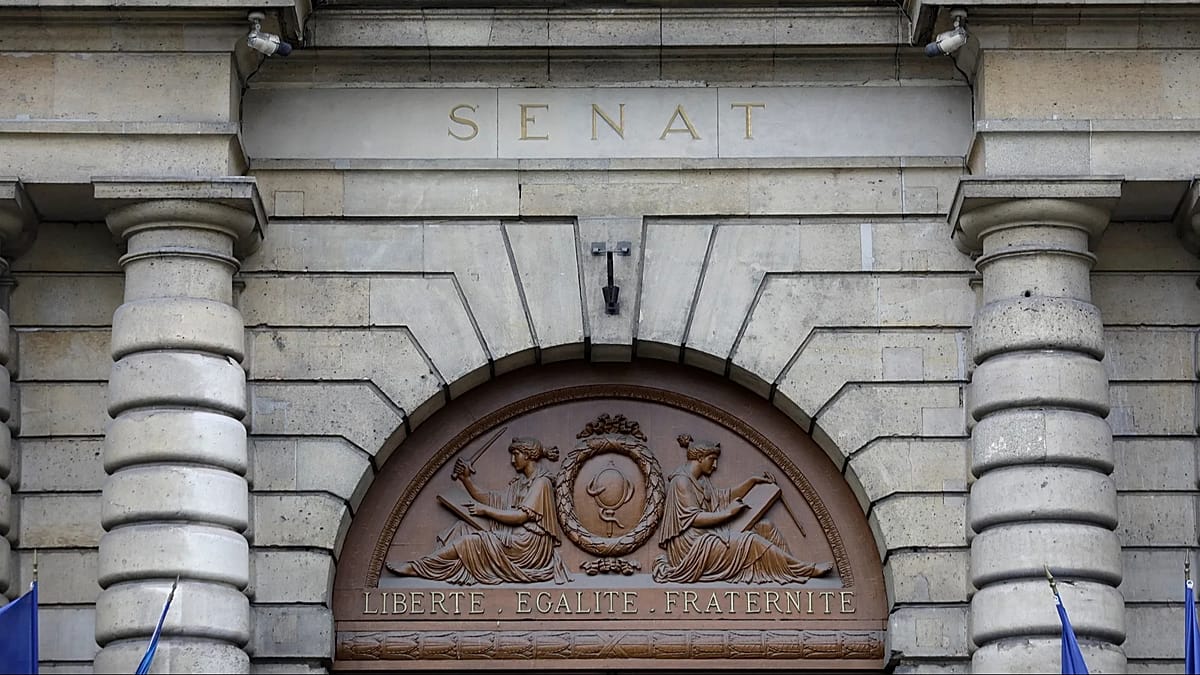
An election that left the balance of power in France's upper house largely unchanged, yet brought two novelties: a future RN-UDR group and LFI's symbolic arrival in the Luxembourg Palace.
In the last vote before France's 2027 presidential election, the Senate contest has taken the far-right National Rally (RN) and its UDR allies to a new milestone: at least 15 senators elected and the prospect of forming a parliamentary group.
On Sunday, half of the upper chamber was renewed in 63 départements, particularly in the south, though not in the Paris region. Senators are chosen by indirect universal suffrage, with the vote cast by grands électeurs, mostly local officials.
While the overall balance of power in the Senate is unchanged, one of the key questions in this election concerned the RN. Twelve years after its first members entered the Senate, the party is now in a position to form its own group. The advance reflects its local roots, especially around the Mediterranean, and the gains it made in last March's municipal elections.
Speaking to reporters, party president Jordan Bardella hailed results that "mark a milestone in the RN's roots in our country" and a "further step towards the election of Marine Le Pen in a few months."
Le Pen, the RN's candidate for the 2027 presidential race, called it "a historic victory," saying that "a major step" had been taken with the creation, for the first time, of a Senate group.
A Senate group would give the RN more funding and the right to request a Senate inquiry committee each year.
Right-wing majority holds firm as Macron allies lose ground
Les Républicains remain by far the largest force with 123 senators, alongside their allies in the Centrist Union, who hold 71.
The Socialist Party is holding up well. The final tally, expected on Monday, will show whether it keeps its place as the second-largest force in the chamber, ahead of the centrists.
The group backing Emmanuel Macron in the Senate, the RDPI (Rally of Democrats, Progressives and Independents), is expected to fall from 19 to 14 senators. That would leave it almost level with the future RN-UDR group and with the Greens.
LFI clinches its first seat
La France Insoumise (LFI) makes its debut at the Palais du Luxembourg with the election of Gabriel Amard, Jean-Luc Mélenchon's son-in-law, in the Rhône.
Mélenchon welcomed results that, in his view, show that "in every département, LFI is achieving scores far higher than its number of grands électeurs."
"A good omen for 2027," said the four-time presidential candidate.
It remains to be seen which group Amard will sit with. "Once you have one member in an assembly, it's the beginning of the end for the others," he told Public Sénat, in a pointed reference to the tense relations between LFI and the other left-wing parties.
In a post on X, outgoing Senate president Gérard Larcher (LR) said he was "taking note" of the emergence of a ninth group, the RN-UDR, which he called a "consequence of the outcome of the municipal elections". He nevertheless urged the Senate to "remain an assembly of calm debate, of reason, of reflection", "an assembly where the law is made and where the government's action is scrutinised".
Larcher also announced that he will run for a sixth term as head of the upper house.
Prime Minister Sébastien Lecornu congratulated "the senators, women and men, elected or re-elected today," and assured them that "the government will work with each of them, in respect of parliamentary debate and of our institutions."
The newly elected senators take up their posts on 1 October, the day the Senate president is elected. The groups must submit their lists of members by 5 October.