

‘Removing Netanyahu is the most important thing’, Mustafa Barghouti tells Euronews
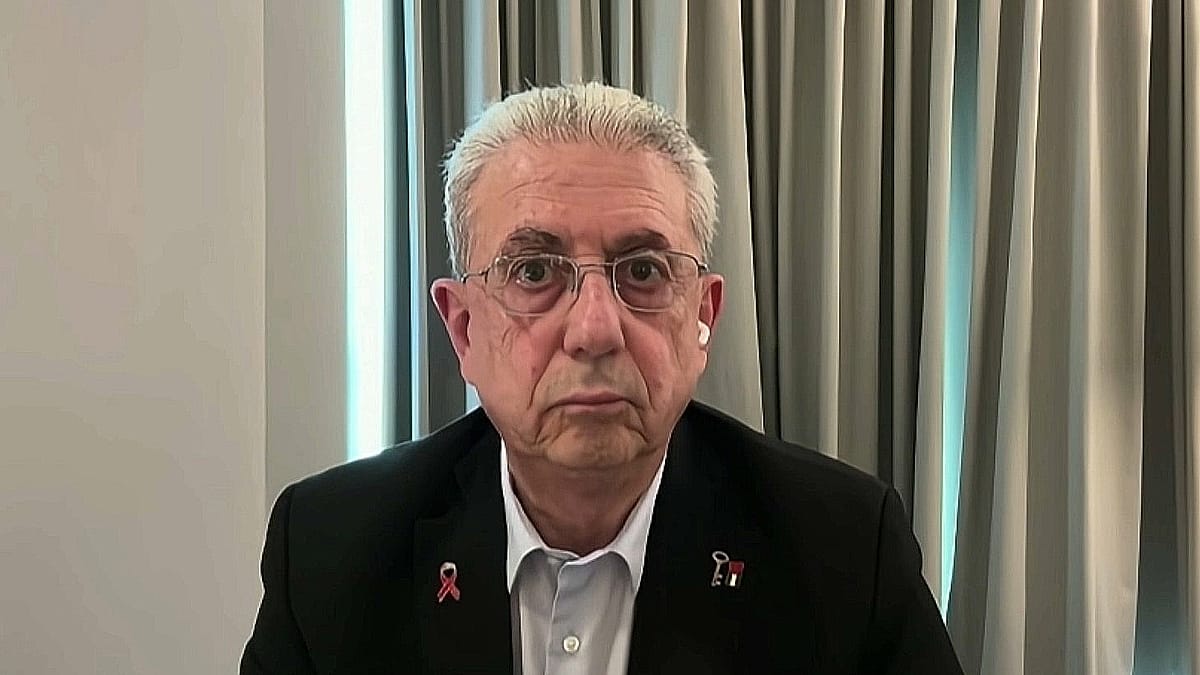
Changing the government in Israel is the top priority for Palestinians, according to one of the West Bank’s most prominent political figures. Arab parties hold the balance of power after Israel’s election and would be key to forming a new government.
An Israeli government led by Gadi Eisenkot would be better for Palestinians because removing current Prime Minister Benjamin Netanyahu from power is the most pressing issue, says Mustafa Barghouti, leader of the Palestinian National Initiative, a political party active in the occupied West Bank.
Speaking on Euronews' Europe Today, he argued that the opposition leader should rely on Arab members of the new Knesset to form a government, sidelining ministers Bezalel Smotrich and Itamar Ben-Gvir, whom he labelled “fascist.”
The Arab parties - Joint List and United Arab List (Ra’am) - made significant gains in the election, winning a record 19 seats between them, effectively turning them into kingmakers. Their support would be crucial for Eisenkot, as the opposition camp led by the centrist Yashar party fell short of a majority in the 120-seat Knesset.
“Netanyahu has been responsible not only for slaughtering Palestinians in Gaza and for enhancing ethnic cleansing in the West Bank, but [also] for creating wars with Lebanon, with Syria, threatening Jordan, and trying to impose Israel as an imperial force controlling the Middle East,” Barghouti said.
Working with Arab parties requires breaking campaign pledges
However, Eisenkot declared after the election that he will do his utmost to form “a Zionist government.”
Almost all parties in the opposition “Change Bloc” are reluctant to ally with Arab parties. Eisenkot’s Yashar, B’Yachad, Yisrael Beytenu and the Democrats all more or less explicitly ruled out cooperating with Joint List and Ra’am before the election, and any agreement would likely require them to abandon campaign pledges.
“All Zionist parties in Israel, whether in government with Netanyahu or in opposition, share the same views of rejecting Palestinian rights, including a Palestinian state, right of the Palestinians to self-determination, the idea of ending the Israeli illegal occupation,” Barghouti said, adding that all these political forces "are supportive of continuing the genocidal war on Gaza."
Arab parties represent the just over 2 million Palestinians who are citizens of Israel, roughly 21% of the country’s population, and do not include the 5.5 million non-citizen Palestinians living in the occupied West Bank and Gaza
That segment of Israel's electorate supports ending the war in Gaza, stopping illegal Israeli settlements in the West Bank and is largely in favour of a two-state solution, all sensitive topics for Israeli public opinion.
'We are not leaving'
Removing illegal Israeli settlements from the West Bank is the only way to save Palestinian statehood, according to Barghouti.
“For these extreme Israeli parties who reject a two-state solution, the only solution is ethnic cleansing of Palestinians. But we are not leaving. We are here. We’re going to stay. We will resist,” he said.
Settlement activity has surged to an unprecedented level over the past two years, according to a UN report on the topic. The UN says there are more than 400 settlements and outposts in total, all illegal under international law.
The coming weeks will be crucial for forming a government in Israel.
President Isaac Herzog will now consult party leaders before tasking the candidate he believes has the best chance of securing enough support.
That leader has a maximum of 28 days to form a government, with a possible 14-day extension. If he fails, the president can give a second candidate a maximum of 28 days. If this second attempt also fails, the Knesset can request that a third candidate be given 14 days.
If all attempts fail and the deadlock proves impossible to resolve, another election is called, as happened four times between 2019 and 2022.
Video editor • Guillaume Goodey
Additional sources • AP