Death toll in Japan earthquake rises to 23 as aftershock and heat complicate rescue efforts
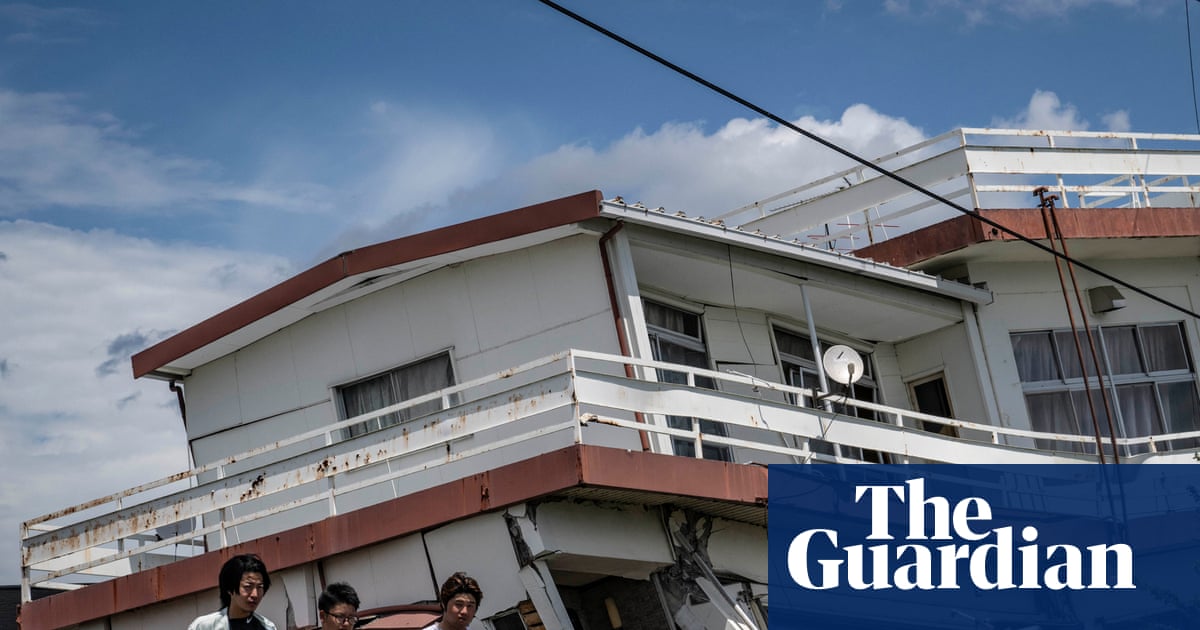
The death toll from the major earthquake that hit Japan on Tuesday rose to at least 23 as the search for trapped survivors inside a badly damaged shopping mall and collapsed houses in the country’s south-west...
The death toll from the major earthquake that hit Japan on Tuesday rose to at least 23 as the search for trapped survivors inside a badly damaged shopping mall and collapsed houses in the country’s south-west continued.
The magnitude 6.8 earthquake that struck the Kumamoto prefecture on the island of Kyushu has injured at least 62, the prefectural government said. That number has steadily grown, fanning fears it will rise.
Almost 5,000 Self-Defence Forces personnel deployed to the region will be challenged by temperatures rising to 35C on Thursday, officials said, and a significant magnitude 5.8 aftershock hit overnight to further complicate recovery efforts.
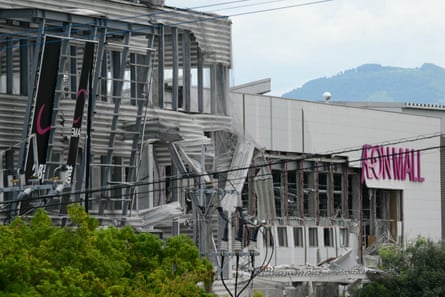
About 170 rescue workers are searching the Aeon mall shopping centre in the town of Kashima, which was bustling with thousands of people when the quake happened.
The company said about 3,000 customers were evacuated to a parking lot before a gas explosion happened in another part of the mall, where some people were still working. Eight people have been pulled from the rubble of the mall. Of them, three have died.
Japanese media footage of the mall showed that part of the ceiling had caved in, and metal pieces and other debris were scattered about as helmeted and masked rescue workers searched the area.
In the first reported death of a foreign national, a Vietnamese technical intern was killed after a crane fell on him at a factory where he worked, according to the Vietnamese government.
Nearly 34,900 homes were still without electricity and 15,000 homes without running water, Kumamoto officials said. More than 8,800 people left their homes to stay in over 400 shelters, where power sources were being added to provide air conditioning.
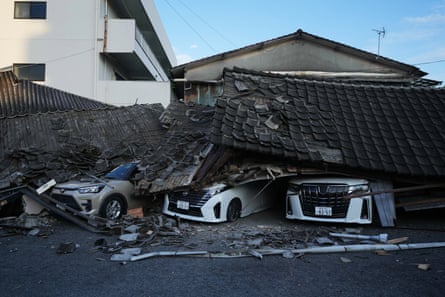
Aerial police footage showed some homes in residential areas were completely flattened, including a few that crumbled into a nearby river.
“There are people who are still waiting to be rescued, and it’s a race against time,” the prime minister, Sanae Takaichi, said on Wednesday. “We will go all out to find and rescue as many people as we can.”
A government spokesperson said on Wednesday more than 9,000 people had sought refuge in 506 shelters in three regions of Kyushu island.
Some stunned locals said the quake was the biggest they had felt in their lifetimes, measuring at the top of Japan’s seven-level shindo scale.
“It was the strongest quake I ever experienced,” Kanzo Matsumoto, 73, the operator of a luxury onsen hot spring inn in Yatsushiro, told Agence France-Presse.
Japan’s Geospatial Information Authority said some ground surfaces were displaced by as much as 87 centimetres in the quake.
Takaichi said the region had suffered extensive damage, including collapsed buildings, fires and damage to roads.
Some auto and chip manufacturers with plants in Kyushu halted production on Wednesday.
Toyota said it would halt operations at three plants in the region through Friday as it weighed the quake’s impact on suppliers and logistics.
Kyushu is a key base for Japan’s automotive and semiconductor industries, which account for roughly two-fifths of regional industrial output.
Analysts said factory shutdowns at automakers and chip manufacturers appeared to be driven largely by precautions for workers, rather than by damage to production facilities.
Japan is one of the world’s most seismically active countries, sitting on top of four major tectonic plates along the western edge of the Pacific “ring of fire”.
Kumamoto was hit by two devastating earthquakes in 2016, which killed 273 people and injured more than 2,800.
The archipelago, home to about 125 million people, typically experiences hundreds of jolts every year and accounts for about 18 percent of the world’s earthquakes.
With Associated Press, Reuters and Agence France-Presse