
Boeing shares tumble after it releases cautious growth forecast
Boeing shares slumped around 9% on Tuesday as the company's cautious production growth timeframe surprised Wall Street, deepening questions about how fast recent plane certification and defence procurement...
Boeing shares slumped around 9% on Tuesday as the company's cautious production growth timeframe surprised Wall Street, deepening questions about how fast recent plane certification and defence procurement wins will translate to the bottom line.
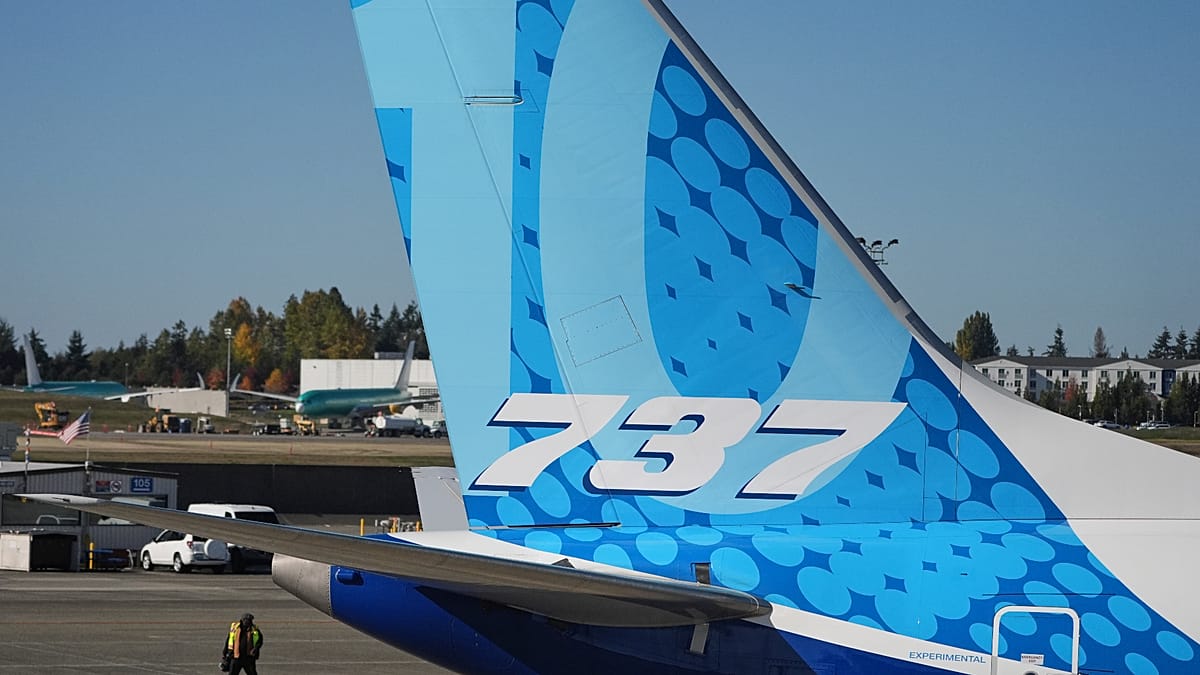
Chief Executive Kelly Ortberg said the company does not expect 737 MAX output to reach 52 per month until the second half of 2027 as it must first "stabilise" output at 47 per month.
Raising 737 MAX output has been viewed by investors as central to revenue and profit growth. But Ortberg, who joined Boeing in the aftermath of safety disasters, defended the approach.
"We're making progress, but we still have more work to do, and I'm expecting it'll take us into next year to get fully stable at this rate," Ortberg said of the 47 plans per month, citing the need for greater predictability in wings production and with the production of fuselages at its Kansas operation.
"It's more important that we do this ramp right than what particular month we achieve a rate break," Ortberg said.
Ortberg also put a timeframe on when the company will achieve $10 billion (€8.98bn) in annual free cashflow, saying it will reach the key target of financial health in 2029.
After Ortberg released this statement, shares fell further, suggesting analysts had expected a quicker timeframe.
"Everybody wants us to go faster. I get that, but we're going to stay disciplined as we ramp up here," Ortberg said.
Ortberg joined Boeing as CEO in August 2024 as the company struggled to move past a pair of deadly 737 MAX crashes and a near-catastrophic 737 MAX flight in January 2024 in which a window blew out mid-flight.
The company at the time faced criticism that the problems stemmed from a culture that chased quick payoffs while short-changing safety.
Boeing is making "slow but steady" progress, aviation expert Richard Aboulafia of AeroDynamic Advisory said in an email to AFP. "But the supply chain remains a major concern and one that's only partly in Boeing’s control."
Smaller loss
Ortberg's comments came as Boeing reported a third-quarter loss of $116 million (€100m), compared with a loss of $5.3bn (€4.6bn) in the year-ago period, mostly from delays to certification of the 777X, the latest generation in Boeing's long-range, wide-body commercial jet family.
The results translated into a larger earnings-per-share loss than analysts expected, but shares did not move significantly after the earnings press release was published.
Ortberg cited the Federal Aviation Administration's certification of the 737 MAX 7 and 737 MAX 10, as well as a "transformational" Pentagon award for the US Navy's next-generation fighter jets, as evidence of momentum.
Revenues rose 4% to $24.2bn (€20.9bn), driven by increased deliveries in the defence, space and security business and higher sales in Boeing Global Services.
Revenues for commercial aircraft dipped from the year-ago period, with Boeing delivering 161 aircraft in the quarter, just one more than in the 2025 period.
Boeing executives expressed confidence that the much-delayed 777X would be certified in 2027, projecting deliveries of between 10 and 15 aircraft next year.
"We're providing this with confidence that the team's ready to go execute," Ortberg said of the latest targets.
Ortberg expects free cash flow to gradually grow from about $2bn (€1.7bn) in 2026 to $6bn (€5.2bn) in 2028 and $10bn (€8.6bn) in 2029, with higher levels thereafter.
"As I mentioned, over the last two years, we've made exceptional progress restoring trust, retiring risk, and transforming our culture and rebuilding the foundation of safety and quality that will help ensure durable success," he said.
"We have also been deliberate about not getting ahead of ourselves, given the range of outcomes tied to the production ramp, certification timing, and other critical programme execution," he said.
"But we appreciate that it's been difficult for shareholders to assess how our progress will translate into financial performance. We're now at a point where the range of outcomes is narrowing."