Iran to host dozens of foreign leaders for Khamenei's funeral, with Western nations absent
Millions of Iranians and delegations from around 30 countries are expected at funeral ceremonies for Ali Khamenei that open in Tehran this week, Iranian officials say, with senior figures from Russia,...
Millions of Iranians and delegations from around 30 countries are expected at funeral ceremonies for Ali Khamenei that open in Tehran this week, Iranian officials say, with senior figures from Russia, Pakistan and Afghanistan's Taliban government among those attending.
Khamenei, 86, was killed on 28 February in strikes on his residence in central Tehran.
His body has lain in state for three days at Tehran's Grand Mosalla, the country's largest prayer complex and the usual venue for major state occasions.
Video published by Iranian state media showed an earlier mourning ceremony Thursday night for Khamenei.
The black-clad mourners, whom state media identified as coming from families of those who lost loved ones in the 12-day conflict in 2025 and the recent Iran war, threw scarves and other items for attendants to brush against the coffin, a common practice in Iran seen as a blessing.
Later, state media showed images of Khamenei’s casket draped by a red flag with white calligraphy reading “Ya Hussein,” a Shiite expression in remembrance of the 7th-century martyrdom of the Prophet Muhammad’s grandson.
It had been flying over the Imam Hussein golden-domed shrine in Karbala, in neighbouring Iraq. The flag also traditionally symbolises both the spilt blood of someone unjustly killed and a call for vengeance.
The dead being honoured include Khamenei's son-in-law, his eldest daughter, a 14-month-old granddaughter and the wife of Iran's new Ayatollah Mojtaba Khamenei, the son of the previous leader who remains in hiding after reportedly being wounded in the attack.
Iran's Parliament speaker Mohammad Bagher Ghalibaf, Foreign Minister Abbas Araghchi and President Masoud Pezeshkian, key leaders in the country's civilian government, have already paid their respects.
Who is attending
Foreign ministry spokesperson Esmaeil Baghaei said at least eight heads of government or state and parliamentary speakers from 12 countries would attend, with delegations from Iraq, Afghanistan and Pakistan already in Tehran.
According to the list published by Iranian state-run media, Russia is sending former President and Deputy Chairman of the Security Council Dmitry Medvedev as special envoy of President Vladimir Putin. China is sending the vice chair of the Standing Committee of the National People's Congress.
Afghanistan's Taliban government will be represented by acting Foreign Minister Amir Khan Muttaqi, while Iranian media also report that Prime Minister Hassan Akhund and Ahmad Massoud, leader of the National Resistance Front, may attend.
Iraq's delegation is headed by President Nizar Amidi and parliamentary speaker Haibet al-Halboosi, alongside Nechirvan Barzani, prime minister of the Kurdistan Region.
Pakistani Prime Minister Shehbaz Sharif will attend alongside army chief Asim Munir and others, while India is represented by Lieutenant General Syed Ata Hasnain, governor of Bihar, and Foreign Affairs Minister Pabitra Margherita.
Turkey is sending Vice President Cevdet Yılmaz. Azerbaijan's delegation is led by parliamentary speaker Sahiba Gafarova, with some reports suggesting President Ilham Aliyev may also attend.
Armenian Prime Minister Nikol Pashinyan, Georgian President Mikheil Kavelashvili and Tajik President Emomali Rahmon are also to attend, along with Kazakhstan's deputy Prime Minister and Foreign Minister Yermek Kosherbayev and Turkmenistan's Gurbanguly Berdimuhamedow, chair of the People's Council.
Further delegations are expected from Bangladesh, whose Prime Minister Tarique Rahman and parliamentary speaker Hafizuddin Ahmed are reported to be attending.
Malaysia will be represented by Agriculture Minister Mohamad Sabu after Prime Minister Anwar Ibrahim said he could not attend due to prior commitments.
Delegations are also expected from Oman, Qatar, Belarus, Kyrgyzstan, Uzbekistan, Egypt, Ghana, Nicaragua, the Democratic Republic of Congo, Serbia and Cuba.
Iranian media also report delegations from Tunisia, Lebanon, Namibia, Sri Lanka, Myanmar, the Gambia and Thailand, as well as representatives of the Shanghai Cooperation Organisation and the Economic Cooperation Organisation.
Baghaei said no European country had been formally invited.
Those attending, he said, were "standing on the right side of history," while he accused European governments of a "shameful" stance towards the US and Israeli military action against Iran.
Countries that Tehran saw as having taken "an inappropriate position" on the strikes were not invited, he said.
Six days of mourning
Iran has announced a six-day funeral programme.
Public farewell and mourning ceremonies begin at Tehran's Grand Mosalla on Saturday and Sunday, followed by a funeral procession.
Ceremonies continue in Qom on Monday, before religious ceremonies on Wednesday in Najaf and Karbala, two of Iraq's holiest Shia sites. The final funeral and burial will take place in Mashhad on Wednesday.
Khamenei will be buried in his home city of Mashhad, near the shrine of Imam Reza, one of Shia Islam's holiest sites.
Tehran, Qom and Mashhad will be closed during the relevant ceremonies, officials said, and all public and private offices in Tehran have been ordered shut from Saturday to Monday, with much of the city centre closed to private vehicles.
Tehran's airspace will be partly closed from Friday and fully closed on Monday.
If realised, Iranian officials' estimate of 15 to 20 million attendees would make this the largest state funeral in the country's history.
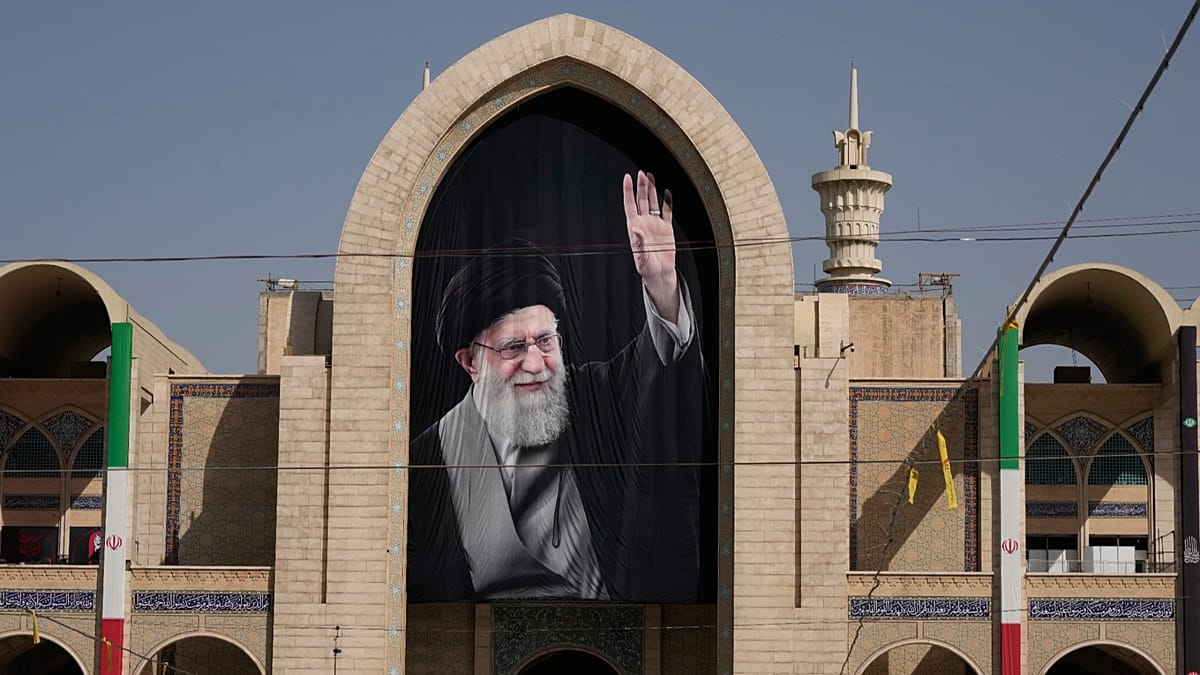
In Tehran, images of the late Khamenei's fist could be seen in banners and in a giant statue in Tehran's Enghelab Square, framed by what appeared to be ballistic missiles flying through the air. In his first message to the nation, read by a state television anchor, Mojtaba Khamenei said he saw his father’s body after his death with a raised, clenched fist.
The banners read “We must rise" in Arabic, English and Farsi.
Still no Mojtaba as commanders resurface
It remains unclear whether Mojtaba Khamenei, Ali Khamenei's son and successor, will attend the main Tehran ceremony.
He has not appeared in public since the strike that killed his father, and Iranian media say he is unlikely to attend for security reasons, citing government sources.
He was also absent from a memorial service on Thursday for his wife, who was killed in the same attack.
Since his appointment as the country's ayatollah, the younger Khamenei has addressed the nation only through written statements read out on state-run televisions.
Israel's repeated threats to kill Mojtaba Khamenei drew a warning from Iran's joint military command Thursday.
“We warn the enemies of a strong Iran, especially the United States, the Israeli regime and their regional and extraregional accomplices, to avoid any miscalculation and to consider the harsh and regret-inducing responses that the sons of the Iranian nation in the armed forces will give to any threat or aggression against our beloved country,” the military command said.
IRGC top commander Ahmad Vahidi appeared in public on Thursday for the first time since the war began in February, paying his respects beside Khamenei's coffin.
He had not been seen publicly since 8 February, weeks before the war started.
“They must know that the pure blood of our martyred imam will mark another turning point in the victories of beloved Islam across the global arena,” Vahidi told state television in comments aired Friday.
“They will take to their graves the wish to see this nation surrender. This nation will rise higher day by day through this pure blood.”
Vahidi is believed to be playing a prominent role in determining Iran's position in talks with the US and is reported to be part of the inner circle around Mojtaba Khamenei.
Major General Hatami, commander-in-chief of the army, said at a separate farewell ceremony for senior commanders that Iran would "avenge the blood of the martyred Imam (Ali Khamenei) and the martyrs."
Major General Abdollahi, commander of the Khatam al-Anbia Central Headquarters, Iran's joint military command, declared "victory on the battlefield," crediting it to defence priorities set by Khamenei.
Tehran's continued influence in Iraq
Similar ceremonies are planned in Najaf and Karbala, a sign of Iran's continuing influence among Iraq's Shia community.
Ghalibaf, speaker of Iran's parliament and Tehran's chief negotiator with the US, told his Iraqi counterpart Haibat al-Halboosi that Iran and Iraq had "stood side by side in both difficult days and days of joy."
Ghalibaf called the funeral "one of the most important junctures in Iran's history" and urged a mass turnout, saying on Thursday that "the nation's call for revenge must echo in the ears of the whole world."
On the Strait of Hormuz, Ghalibaf said "important issues have been signed in the recent (memorandum) with the United States," adding that under international law, management of the strait "should be shared between the two littoral states, Iran and Oman," while Iran was "taking on board the views of the Gulf littoral states, including Iraq."
Al-Halboosi called Iran's position "a historic steadfastness" and congratulated Tehran on the interim agreement, saying Ghalibaf's role in reaching it had been significant.
He said he hoped the strait would reopen "so that, by resuming oil exports, we can compensate for the losses inflicted on Iraq during the war," and described "a very high level of solidarity" between the two countries' populations over the US and Israeli strikes.
What happens after the funeral
Attention is expected to turn to the transfer of power under Mojtaba Khamenei, regional diplomacy and a decision on the Strait of Hormuz once suspended talks between Iran and the US resume.
On Thursday, the Khatam al-Anbia Central Headquarters warned that "any US interference in the Strait of Hormuz will be met with a swift and decisive response."
It described the waterway as "an area under the undisputed sovereignty of the Islamic Republic of Iran" rather than, in its words, "a playground for aggressive America."
It said all vessels must use Iran-designated routes or face "an immediate and decisive response."
Indirect talks between Iran and the US, conducted through mediators, have been paused during the mourning period.
They are expected to resume after the burial, with the large number of foreign delegations in Tehran seen as a likely venue for informal high-level contacts on the sidelines.