
EU enlargement at a turning point as leaders gather for Euronews summit
Leaders meet at Euronews’ second Enlargement Summit at a pivotal moment for EU expansion. Montenegro is held back by bilateral disputes, Albania by protests, while Moldova and Ukraine make uneven progress. The Commission’s roadmaps risk widening the gap between frontrunners and stalled candidates.
Published on 3 November 2026 - 7:00 GMT+1
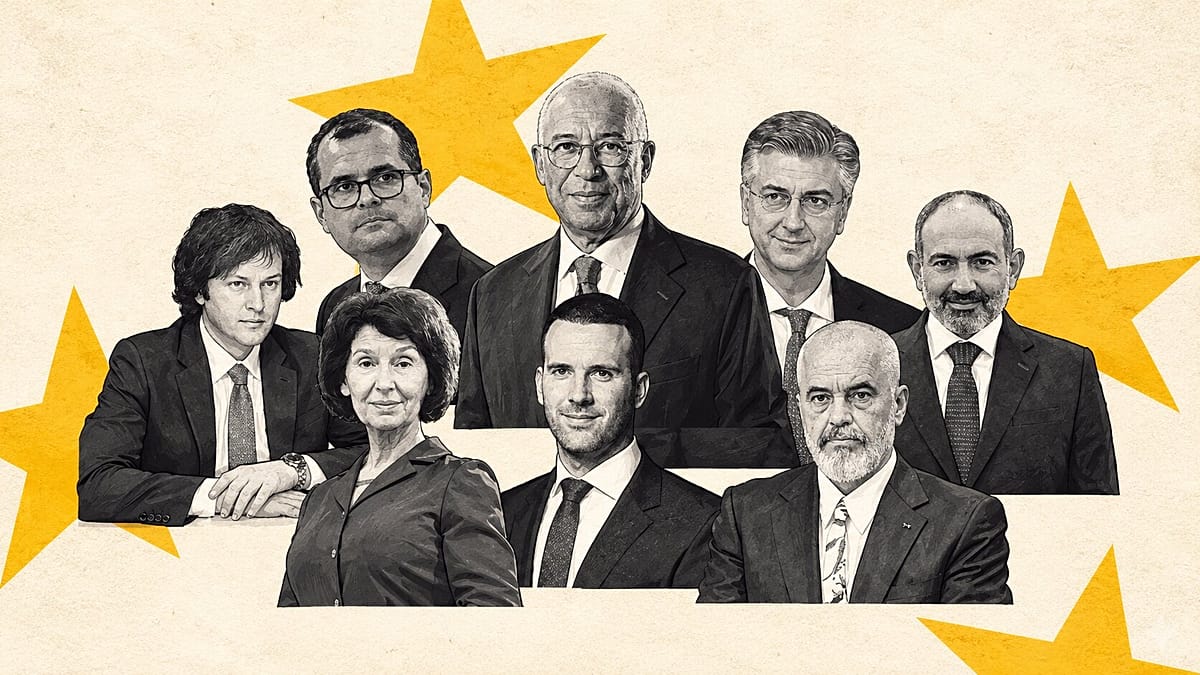
The leaders of Ukraine, Albania, Moldova, Georgia, North Macedonia, Armenia, Croatia and the European Council are gathering at a pivotal moment for EU enlargement.
Ukrainian Prime Minister Serhii Koretskyi, Georgian Prime Minister Irakli Kobakhidze and European Council President António Costa are among those taking part in the second edition of the Enlargement Summit in Brussels.
A decade after the Brexit referendum, the EU is trying to turn enlargement momentum into concrete results by spelling out the steps the most advanced candidates must still take to finalise their accession.
But the European Commission’s upcoming roadmaps for the so-called frontrunners, Montenegro, Albania, Moldova and Ukraine, risk widening the gap with hopefuls whose bids have lagged for years, such as North Macedonia and Georgia.
Montenegro is closest to the finish line, but its progress is getting bogged down in bilateral issues with Croatia, rooted in the troubled legacy of the Yugoslav Wars of the 1990s.
The EU executive has recently proposed institutional safeguards for new member states, which are currently being discussed in the context of Montenegro’s accession treaty. That treaty is due to serve as the blueprint for how Brussels deals with newcomers.
Albania, generally considered the second closest, has been shaken by major protests over preparatory work for a luxury resort in a protected area, planned by US President Donald Trump’s son-in-law Jared Kushner.
Moldova, meanwhile, has been catching up so fast that the Commission has had to reallocate internal resources to keep pace with Chișinău, which is close to closing a chapter it has only just opened.
Ukraine has finally begun to make formal progress thanks to the change of government in Hungary, and is still expected to open all negotiating clusters before the end of the year. Agriculture, however, is set to become a sticking point in the talks.
In the Western Balkans, Serbia, the region’s largest country, has recently seen a change of government that has raised hopes in Brussels of a reset in relations and renewed enlargement momentum.
The rest of the region, including North Macedonia, Bosnia and Herzegovina and Kosovo, has seen its accession bid stall and is effectively losing access to EU regional funding in favour of the frontrunners.
In the Caucasus, Georgia’s accession has effectively halted amid democratic backsliding and a diplomatic shift towards Russia. Enlargement Commissioner Marta Kos last month called it “a candidate country only on paper”.
Armenia, still formally not a candidate, is considering applying for EU membership. It has taken several steps towards the bloc as it tries to reduce its dependence on Russia following its conflict with Azerbaijan.
In recent years, the EU has made enlargement a key plank of its external relations, offering its neighbours a membership prospect to draw them into its orbit. Now Brussels must show that its enlargement ambitions can deliver results.