Trieste, sightings of bull rays: unique case in Mediterranean, but they threaten mussel farms
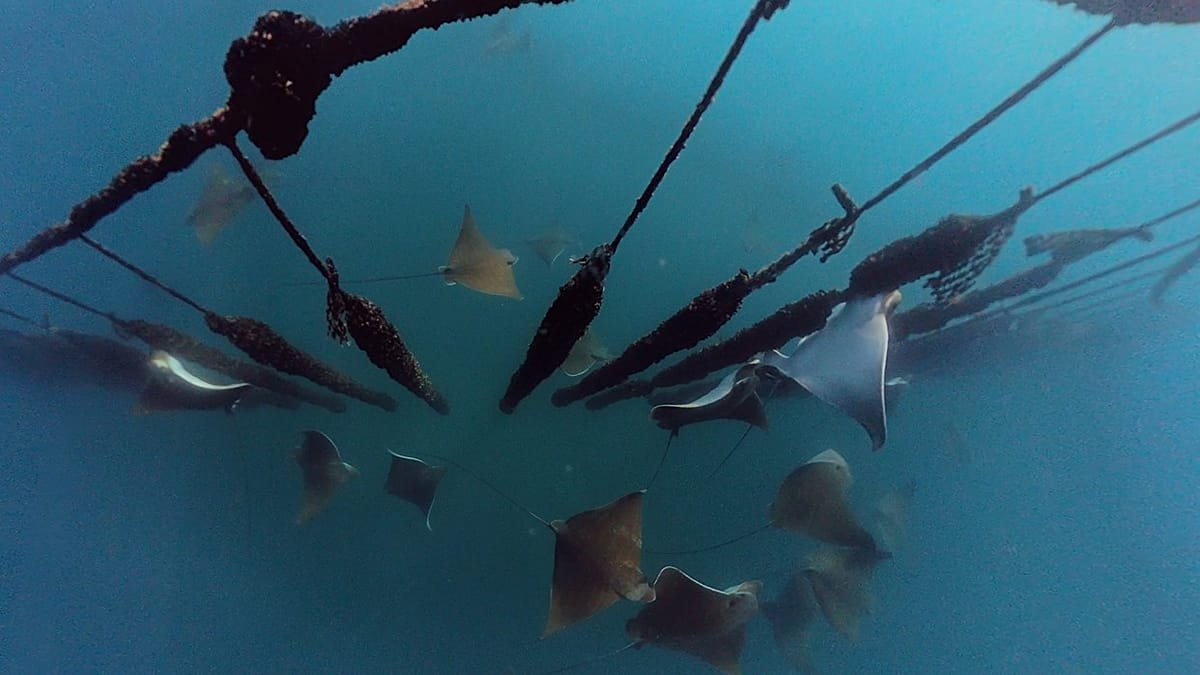
Sightings of this protected species are unprecedented in the Mediterranean in scale and frequency, but they threaten local mussel farms. In the Gulf of Trieste, a trial using magnetic deterrents has been launched to identify and drive the animals away.
In recent years, an unprecedented development has been observed in the Gulf of Trieste, a case unique in the entire Mediterranean. Large groups of bull rays (locally known as “vaccarelle”), among the biggest eagle rays in the Mediterranean, are being sighted with increasing frequency in the coastal waters off Trieste.
Over the past three years the phenomenon has reached a significant scale and frequency, even though this is a species already present in the Mediterranean Sea and recorded for years.
“This is the first year in which we are seeing a high number of individuals gathering in groups that have reached as many as 50 animals,” says Saul Ciriaco, head of monitoring activities for WWF Miramare Marine Protected Area (Amp) and vice-president of the cooperative Shoreline.
The phenomenon has naturally sparked the interest of researchers and enthusiasts, as this is a rare, protected species, but at the same time it is creating problems for local mussel farms, which have reported damage to their mussel lines, as these have become an easy food source attracting the animals.
“We had never seen this kind of interaction between bull rays and human activities,” explains Simona Clò, marine biologist and scientific director of MedSharks, an association for the conservation of marine species in the Mediterranean, stressing the need to find non-invasive technologies and solutions to protect mussel farmers and safeguard the bull rays.
The Gulf of Trieste has thus become a testing ground for coexistence between these species, a project run jointly by Amp Miramare and, at European level, by Life Eu Sharks and Life Prometheus: two projects co-financed by the European Union’s Life programme.
Changes in fisheries policy and warming seas among the causes
The shift in European fisheries policy has reduced the number of animals caught, as they were often taken as bycatch, the so-called incidental catch when another species is being targeted.
“Stricter and more selective fishing rules have also improved their reproductive performance,” Ciriaco explains. This combination is thought to be one of the reasons behind the increase in animals sighted off the Adriatic coast.
“On top of that, winter water temperatures in the Mediterranean have reached a level the bull ray finds tolerable, as it prefers waters ranging from 11 to 28 degrees Celsius. In winter the temperature does not fall below 10 degrees. So whereas the Gulf of Trieste used to be just a transit area, it has now become suitable for them to stay,” he adds.
Similar cases have been recorded in Greece and Turkey in recent years. Bull rays have also been reported near mussel farms off Olbia, but Trieste is the first place to have documented the phenomenon on a significant scale.
A species protected by the United Nations
Bull rays are cartilaginous fish, like rays, belonging to the Myliobatidae family. They are native to tropical and temperate waters and are a sizeable species, reaching up to two metres across.
The species is considered highly at risk on a Mediterranean scale and is protected both by the Barcelona Convention – which aims to protect the Mediterranean Sea from pollution and imposes protective measures for threatened species – and by the UN Bonn Convention on migratory species.
It is also included on the Red List of the International Union for Conservation of Nature (IUCN), which records the conservation status of animal and plant species worldwide.
Monitoring and identification: the Life Eu Sharks project
“These sizeable groups of bull rays do not visit just one mussel farm, but move within a fairly wide area stretching from Grignano almost as far as Monfalcone. We are talking about around twenty kilometres of coastline to be monitored,” says Ciriaco, explaining that in this case the monitoring activity carried out by Shoreline focuses mainly on counting individuals and applying a protocol to identify them.
These activities form part of the broader Life Eu Sharks programme, the European project aimed at promoting and conserving protected species of sharks and rays.
Last year the Environment Ministry supplied several drones to track and photo-identify specimens, as the only way to quantify precisely the presence of these animals in the waters of the Gulf of Trieste depends on being able to recognise them.
“The largest group sighted so far comprised around 50 individuals, but the numbers could be much higher,” says Clò, who works with the Life programme.
Thanks to the project “we are able to identify individual animals by the characteristic ‘fingerprint’ formed by the stripes on their back,” the biologist points out.
They may be different animals each time, and their presence can vary with the season, although the combination of factors considered suggests that bull rays may have found the Gulf of Trieste to be a suitable place to settle.
This means that “they have more time to realise that it is simpler and more efficient to eat mussels directly off the ropes,” Ciriaco suggests.
The threat to mussel farming: the Life Prometheus project
Bull rays are “durophagous” animals, meaning they feed mainly on crustaceans and hard-shelled molluscs, but they usually forage on the seabed. They are also what are known as “opportunistic” animals, in other words “they make maximum use of available resources and the presence of easily accessible farms is an ideal situation for them,” Clò explains.
However, this poses a problem for mussel farms, which suffer substantial economic losses, although these are hard to quantify, as other factors also threaten mussel farming, such as rising water temperatures and other predators like turtles, for example.
In search of a solution that protects both sides, Shoreline in the Miramare Marine Protected Area, in cooperation with Life Eu Sharks, has launched the European project Life Prometheus.
The trials, carried out together with mussel farmers and researchers from the Universities of Padua and the Marche Polytechnic University, involved installing electromagnetic deterrents on the lines to drive bull rays away.
“These small magnets have a disturbing effect on the animals, but they are not harmful. We now need to see whether the system actually works,” says Ciriaco.
For Ciriaco it is in any case “necessary to assess the effectiveness and applicability of the device, because the cost and labour needed to deploy so many magnets would require a major and costly effort.”
A model for coexistence
One of the next steps is to set up a round table with the Friuli Venezia Giulia regional authorities and the harbour master’s office. “Bull rays are important animals for the environment. Moreover, they swim close to shore and this is something that should be valued,” says Clò.
Identifying designated areas in the Gulf of Trieste where snorkelling and underwater photography with these rare animals can be promoted could provide a compensatory solution that would allow interaction between the species.