
Kazakhstan seeks Antwerp-Bruges partnership to boost trade via Middle Corridor
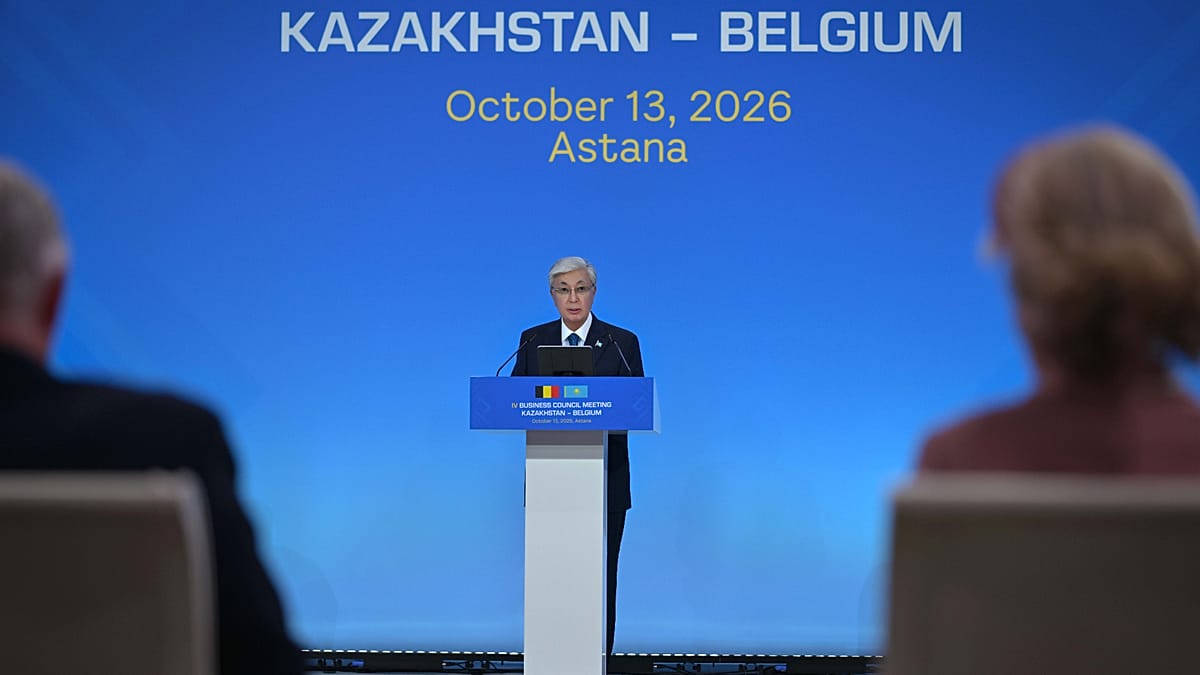
Kazakhstan is seeking closer cooperation with Belgium on the Middle Corridor, including a potential partnership between the Port of Antwerp-Bruges and the Caspian ports of Aktau and Kuryk, as King Philippe and Queen Mathilde make their first state visit to the country.
Kazakhstan is seeking a partnership between the Port of Antwerp-Bruges and its Caspian ports of Aktau and Kuryk as the country looks to expand trade along the Middle Corridor, President Kassym-Jomart Tokayev said.
Speaking at the Belgium-Kazakhstan Business Council in Astana, attended by King Philippe and Queen Mathilde of Belgium, Tokayev said Kazakhstan was investing heavily in railways, roads, seaports and terminals along the route.
“In this context, Belgium’s rich experience as a major European logistics center is particularly valuable to us. We anticipate a concrete partnership linking the ports of Antwerp-Bruges, with the ports of Aktau and Kuryk. This could open wider markets for our metals, petrochemicals and agricultural products,” he said.
King Philippe also expressed Belgium’s support for the Middle Corridor, calling for closer links between the route and European ports, railways and logistics hubs.
The Middle Corridor, also known as the Trans-Caspian International Transport Route, connects China with Europe through Kazakhstan, the Caspian Sea and the South Caucasus, providing an alternative to traditional east-west routes.
A day earlier, Nurlan Zhakupov, CEO of Samruk-Kazyna, Kazakhstan’s sovereign wealth fund which manages some of the country’s largest transport, energy and industrial companies, told reporters on the sidelines of the official welcoming ceremony for King Philippe and Queen Mathilde at Akorda that talks with the Port of Antwerp-Bruges were underway.
He said Kazakhstan was interested in drawing on the Belgian port’s expertise and eventually reaching concrete agreements and logistics contracts.
Speaking later to Euronews, Zhakupov said the route's viability would ultimately depend on its economic case.
“For the Middle Corridor, it has to make economic sense and deliver an economic benefit. That is why negotiations are ongoing — it is a large and complex process,” he said. “I think concrete results are not far off.”
Challenges along the road
The Port of Antwerp-Bruges was not represented at the business council, but the discussion focused on the practical challenges facing the Middle Corridor.
Speaking to Euronews after a session on new trade routes between Europe and Central Asia, Ahlers Logistics CEO Dave van den Bos said that while investment in physical infrastructure was already under way, one of the biggest challenges was coordinating handovers between the numerous companies and authorities involved along the route.
As many as 15 different companies or authorities can be involved in a single shipment from Europe to Kazakhstan, van den Bos said.
“Digitisation is the most important,” he said. “Even if the capacity is there, if you’re standing at the border with your document and waiting for someone to give a green light or a stamp, that’s still going to delay quite a bit. Infrastructure is easier to fix than the whole digitisation of it.”
Van den Bos said transit times from Europe to Kazakhstan had fallen from around 80 days to roughly 40–60 days, although port congestion and weather on the Caspian Sea still cause delays.
According to Kazakhstan Temir Zholy, the country’s national railway company, the Middle Corridor transported around 44,000 TEUs in the first eight months of 2026, up 58% from the same period last year.
Kazakhstan is seeking to increase overall freight volumes along the route to 10 million tonnes, a target Tokayev previously announced.
Investment and critical raw materials
Belgium is among Kazakhstan’s ten largest investors, with more than $15 billion invested in the country over the past two decades, according to Tokayev.
The forum's sidelines saw 17 agreements covering logistics, agriculture and food processing, artificial intelligence, energy, healthcare and manufacturing.
Tokayev also highlighted critical raw materials, stating Kazakhstan already produced 21 of the 34 raw materials considered critical for European industry and supplies Belgium with titanium and molybdenum products.
“By combining our resource potential with Belgian investment, technology and expertise, we can build a strategic partnership in this critically important area,” Tokayev said.
Belgium and Kazakhstan deepen ties
King Philippe and Queen Mathilde's visit is the first state visit by a Belgian monarch to Kazakhstan and the wider Central Asian region. President Tokayev welcomed the royal couple with an official ceremony at the Akorda presidential palace in Astana, followed by talks between the two sides.
The visit comes ahead of the 35th anniversary of diplomatic relations between Kazakhstan and Belgium next year.
“Your visit gives new impetus to preparations for this important anniversary and opens up opportunities to fill our cooperation with concrete results,” Tokayev said, describing Belgium as a long-standing and reliable partner for Kazakhstan in Europe.
“We are convinced that we can take our cooperation to a new level,” King Philippe said. “The delegation accompanying me includes representatives from a wide range of promising, forward-looking sectors.”
As part of the state visit, Tokayev and the royal couple visited Kazakhstan’s National Museum, the National Children’s Rehabilitation Centre and the Alem.ai International Centre for Artificial Intelligence in Astana.
The programme also included a rectors’ forum and a roundtable on critical minerals. King Philippe and Queen Mathilde are due to continue their visit in Almaty.