Thursday briefing: Now he has the power to do it, can Andy Burham really end homelessness in the UK?

Good morning. On 29 June, as the media gathered in Manchester at the People’s History Museum to hear Andy Burnham set out his blueprint to transform the UK, over in Westminster the 1824 Vagrancy Act was...
Good morning. On 29 June, as the media gathered in Manchester at the People’s History Museum to hear Andy Burnham set out his blueprint to transform the UK, over in Westminster the 1824 Vagrancy Act was quietly repealed. It ended two centuries of criminalising people for the typically blameless fact of not having a home.
While this largely symbolic move away from punishment to prevention was welcomed by charities, it did nothing to tackle the scale of the problem. The number of people sleeping rough on a single night in the autumn of 2025 in England – the most recent snapshot – was at a new record high of 4,793, exceeding the previous peak of 4,751 in 2017 and the fourth annual increase in a row. This is despite UK government spending on homelessness more than doubling in the past five years.
On Monday, addressing the nation for the first time as prime minister, Burnham said his first instruction in office would be “to end rough sleeping in our country”. It was a familiar refrain for Burnham watchers – he made a similar pledge on his first day as mayor of Greater Manchester in 2017, after spending the early morning in the city’s Albert Square with people who had slept out there overnight.
And he’s by no means the first Labour leader to be thus moved: the “scandal” of citizens forced to sleep outdoors in all weathers was one that Tony Blair vowed to end in 1999 – an aim his government came close to achieving before progress unravelled under successive Conservative governments. It was a commitment that Jeremy Corbyn had planned to announce if elected prime minister.
I spoke to Dr Maya Singer Hobbs, of IPPR North, about the Manchester rough sleeping case study, and what lessons it holds for a national effort. But first the headlines.
Five big stories
-
Middle East | The US has signed a landmark nuclear deal with Saudi Arabia that could allow the kingdom to enrich uranium in the future.
-
UK news | A political lobbying firm founded by the former electoral strategist for Boris Johnson secretly pays journalists to write pieces for British newspapers that are favourable to their clients.
-
UK politics | Andy Burnham is immersed in a deepening political row after ordering a review of plans for the early release of thousands of killers, rapists and sex offenders from prison in September.
-
Environment | Extreme heat supercharged by the climate crisis is sucking Europe dry in summer and intensifying the drought hitting the continent, a scientific analysis has found.
-
World news | A modelling scout who recruited women for Jeffrey Epstein has been found dead at his home near Paris, French officials have said.
In depth: ‘It’s not easy sitting on the ground with people walking past you’
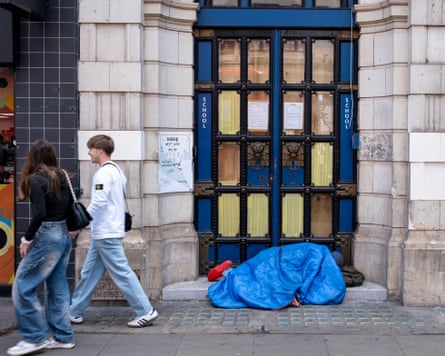
Whenever I write about rough sleeping, I remember Mark Starr. I spoke to him in 2019 when Glasgow city council was piloting a scheme to help homeless people with digital exclusion. We talked about what it was like to have his first email address at the age of 53, but also his childhood in Kent, his work as a teenager at the local stables and his love of horses. “Never in my wildest dreams did I imagine I’d end up on the streets,” he told me. “It’s not easy sitting on the ground with people walking past you.”
The article was never published because Mark died on those same streets after we met. A few months later my colleague Simon Hattenstone talked to Mark’s family for his devastating series on The Empty Doorway. I mention this now as a reminder to myself, as much as anyone else, that every rough sleeper is an individual, quite likely with friends and family who miss them, and certainly with memories and dreams of better days.
Rough sleeping – and homelessness more broadly – have risen to record levels in recent years, and the reasons are many and various: a chronic shortage of social and affordable housing, local initiatives derailed by the pandemic, inadequate support for prison leavers or those fleeing domestic abuse. Young people especially become vulnerable when tenancies end, and housing benefit can’t keep pace with soaring private rents – especially in city centres like Manchester. And then there is hidden homelessness, sleeping in a car or on a friend’s sofa and abruptly tipped into crisis when circumstances change.
Charities working with migrants describe a funnel effect as individuals granted asylum have nowhere to go after their 42-day “move-on” period from home office accommodation. Add to this the growing numbers whose immigration status gives them no recourse to public funds – perhaps someone who has exhausted their appeal process or who has conditions attached to their visa – meaning they are barred from homelessness services but also have no right to work.
On Monday, IPPR North published a report, co-authored by Singer Hobbs with the charity Crisis, calling for a genuinely “housing-led” approach to homelessness. As reported by our north of England editor Josh Halliday, it predicts current levels of homelessness could rise by 25% to more than 230,000 people by 2030 without radical action from central government.
We know that Burnham was paying attention: he had been due to write the foreword for the report before he launched his bid for re-election to the Commons.
The Manchester model
The report recommends the national rollout of two Manchester-tested initiatives. Burnham’s “A Bed Every Night” programme expanded emergency overnight accommodation to anyone who needed it, not just to those with “priority need”, like pregnant women or people with children, to whom councils already owe a statutory duty.
Alongside this, Housing First is a model that targets the most entrenched rough sleepers, who usually have very high support needs on account of addiction, mental illness or other challenges. It works on the assumption that people make most progress when based in stable housing rather than a hostel or B&B. Following success in the US and Finland, Housing First has been piloted in the West Midlands and Liverpool too, as well as across Scotland.
What can’t be underestimated is the significance of Burnham making rough sleeping his immediate mayoral priority. “He expended political capital,” says Singer Hobbs, “and people working in the sector told us that made it easier because they knew exactly what he wanted.”
This forced much more effective collaboration across boroughs and agencies, for example, sharing data on who was rough sleeping in different areas.
Scaling up
Although rough sleeping numbers in Manchester fell every year from 2018 to 2021, post-pandemic they have crept back up. Local charities interviewed on Monday after he made his pledge argued that a nationwide approach was needed to tackle many of the systemic drivers of rough sleeping, something IPPR North, and Burnham himself, have likewise identified.
“As the mayor of Greater Manchester, he had no control over many of the things that drive homelessness,” says Singer Hobbs, “the welfare system, the home office or the Ministry of Justice. As prime minister, he has those levers.”
The challenge now is what she describes as “the eternal balance of any kind of devolution”. For frontline services, it makes sense to have coordination at hyper-local level – where many rough sleepers are already well known. But prevention sits nationally, ensuring “you don’t end up with a policy being made in one department inadvertently driving homelessness up somewhere else”. One preventive act, for example, would be increasing the “move-on” period for those recently granted refugee status.
And criticism has been levelled at A Bed Every Night. The offer could be a bare minimum of a sleeping bag on a hostel floor, and night shelters have little capacity to move people out of their current circumstances, sometimes escalating their vulnerabilities. The UK government is already spending billions on expensive and regularly sub-standard temporary accommodation, with growing numbers getting stuck at this stage because of the lack of available housing. Research for the Children’s Commissioner for England last year found that 520 families in England had been living in a B&B for over a year.
IPPR North has examined some innovative approaches: Wigan has leased long-term empty homes at lower rates from private landlords; Waltham Forest has repurposed council-owned buildings. But this is another pinchpoint for Burnham: can he do enough at the end of the housing chain to ensure temporary accommodation is just that – a brief emergency provision on the way to a settled home.
If Burnham really does “oversee the biggest council housebuilding programme since the postwar period”, as he outlined in June, that will also go some way to ease the pressure on local authorities. But his predecessor Keir Starmer’s efforts to tackle the crisis by building 1.5m homes over five years stalled because of a perfect storm of high interest rates, rising construction costs, and the impact of Brexit.
Look north
Here it is worth taking a detour through Scotland, where Holyrood’s homelessness legislation has been lauded as some of the most progressive in the world. But it has failed to deliver because of a catastrophic mismatch between ambitious legal rights and the practical resources required to fulfil them.
The vast majority of Scottish councils already have the Housing First programme Burnham favours, but, like in England, rough sleeping has been on the rise since lockdown. Campaigners in Scotland suggest that, despite the standout early success of the pilots, momentum was lost after Covid, with the Scottish government failing to provide the long term oversight and vision required.
And unlike England, in Scotland – and recently in Wales – the concept of priority need has been abolished. But at a time when local government is struggling financially, this universal duty to house anyone who is unintentionally homeless added a huge additional burden on councils. It has also attracted people newly granted asylum in other parts of the UK to the country, something Reform were swift to weaponise during the Holyrood election campaign earlier this year.
Nevertheless, IPPR North and Crisis argue this move is fundamentally fairer, and have urged the UK government to roll it out nationwide, albeit with a timeline in place and additional resources. Charities in Scotland believe this would at least balance the system, reducing the incentive for people in need to move across the border.
An end to rough sleeping?
after newsletter promotion
Can Andy Burnham end rough sleeping across the country? “I’d like to think so,” says Singer Hobbs, with the immediate caveat that the funding he announced on Monday is unlikely to be enough.
It has been substantially reduced before: Blair’s rough sleepers’ unit was spearheaded by the cast iron problem-solver Louise Casey who also coordinated ‘Everyone In’ at the start of lockdown, which gave local authorities across England just three days to move all rough sleepers into emergency accommodation. That showed what could be achieved if homelessness was treated as a public health crisis.
Most people – fortunately – won’t ever experience homelessness, and yet it is becoming an increasing public anxiety. According to polling ahead of May’s Holyrood elections, one in three Scots were worried they could lose their home in the coming years, while 61% were more likely to vote for parties who prioritised action on homelessness.
“People sleeping rough is a really visible sign of our public realm not being fit for purpose,” says Singer Hobbs. Burnham already understands that homelessness is a political choice. Now facing an electorate weary of broken promises, he has staked his government’s reputation on it.
What else we’ve been enjoying

-
This Guardian investigation exposes how the ultra-processed food industry is copying the tactics of big tobacco: when all else fails, sue (even if you’ve no chance of winning). Hettie
-
If you haven’t tried this already, use our new analysis tool to discover how different voting systems return wildly different election results in your local area. Libby
-
How do you solve a problem like the Treasury? Burnham’s first week as PM showed just how much power it holds, and as Larry Elliot writes, his chancellor has a challenge on his hands. Hettie
-
We’re big fans of feedback on First Edition, so I’ve taken time to read and digest what Guardian readers say they want from Andy Burnham’s premiership. Libby
-
Tate needs a total rethink, a fresh pair of eyes, and should maybe even start calling itself “the” Tate. I enjoyed reading our art writer Jonathan Jones on the job facing the institution’s new director. Hettie
Sport

Cycling | Anti-doping authorities at the Tour de France have rejected accusations of preferential treatment towards Paul Seixas, the teenage French rider and home favourite who is placed fourth overall.
Football | Southampton’s manager, Tonda Eckert, is facing a lengthy suspension from all football activity after being charged with three counts of misconduct by the Football Association.
Football | The Amazon founder Jeff Bezos has held talks about joining the consortium that is seeking to buy 30% of Liverpool.
The front pages
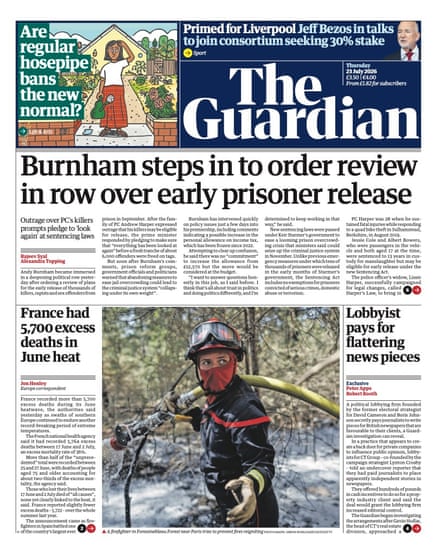
“Burnham steps in to order review in row over early prisoner release”, is the Guardian’s front page today. The Times leads with “Prison chaos as Burnham calls halt to early release”, the Mail also goes on “Burnham forced to review early prison release”, the Telegraph’s take is “‘It is deplorable that freeing prisoners early is acceptable’” and the Express splashes “My Andrew and every victim deserves better”.
Elsewhere, the FT writes “Fear for winter supplies drives gas prices near Iran war peaks”, the i Paper has “Water execs face criminal charges, accused of major conspiracy to fake sewage tests”, the Sun leads on “Stig: I nearly died in Freddie crash”, and Metro says “Andy Tap!” on Burnham’s transport plans.
The Latest
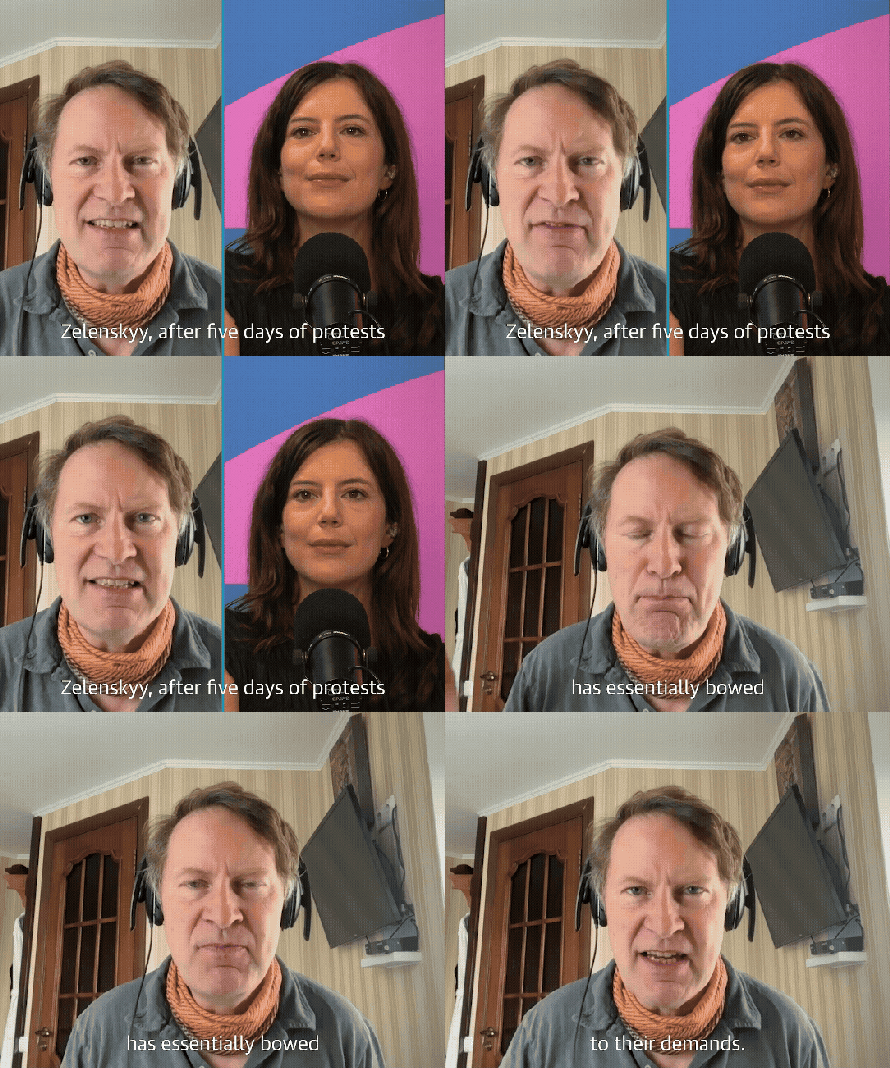
Zelenskyy ousts Ukraine army chief after protests
Volodymyr Zelenskyy has fired his commander-in-chief, Oleksandr Syrskyi, in Ukraine’s biggest military shake-up in two years. Nationwide protests broke out after Zelenskyy sacked Mykhailo Fedorov as defence minister, who the Ukrainian president says will now be brought back into government in a ‘prominent position’. Lucy Hough speaks to the Guardian’s senior international correspondent, Luke Harding.
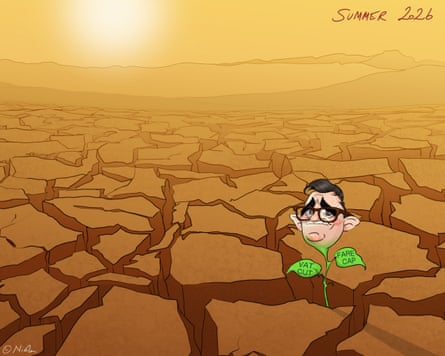
Cartoon of the day | Nicola Jennings
The Upside
A bit of good news to remind you that the world’s not all bad

Ray Exworth created one of Britain’s most extraordinary bodies of sculpture, but almost nobody has even seen it. He had just one major exhibition in his lifetime, at the Whitechapel Gallery in 1975. But then he disappeared almost entirely from public view, retreating to a labyrinth of sheds in remote Cornwall, where he spent the following decades working on his sculptures. Now, a new book, “Ray’s Sheds,” provides unprecedented access to this work for the first time. It documents his unwavering dedication and asks what the purpose of art is when it’s never publicly seen.
Sign up here for a weekly roundup of The Upside, sent to you every Sunday
Bored at work?
And finally, the Guardian’s puzzles are here to keep you entertained throughout the day. Until tomorrow.