Blame game as Brussels builds ‘Europe’s largest frying pan’ instead of shady square
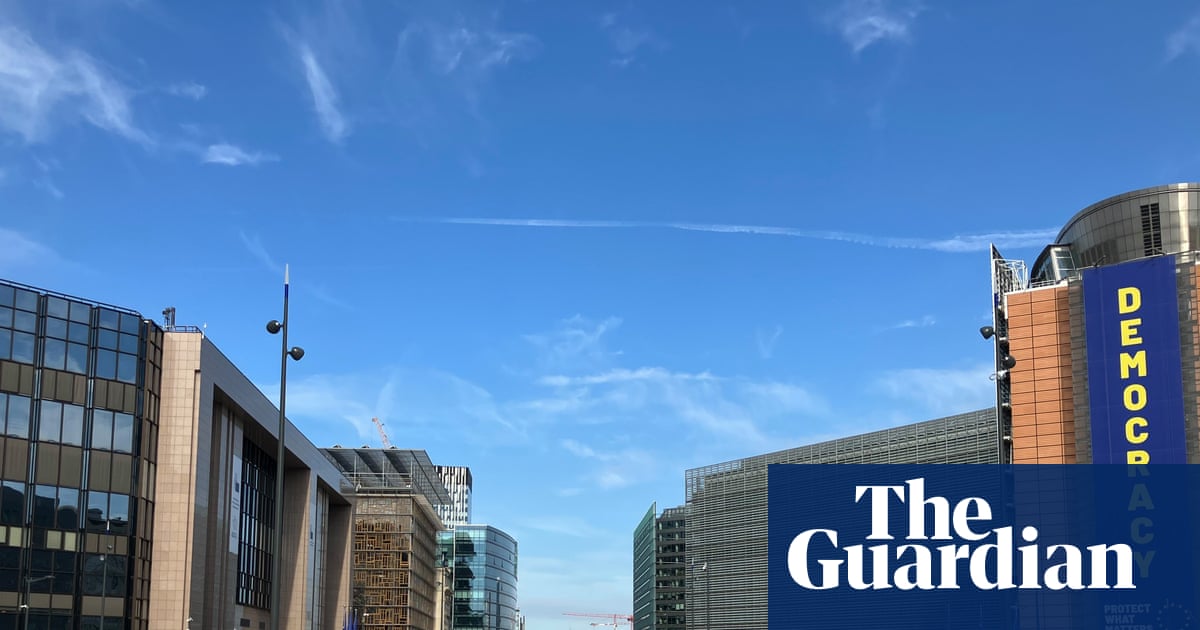
The redevelopment plan for Schuman Square at the heart of the EU quarter in Brussels was very ambitious. From a traffic-clogged, nondescript roundabout, it would become “an urban agora”, a greener, calmer...
The redevelopment plan for Schuman Square at the heart of the EU quarter in Brussels was very ambitious. From a traffic-clogged, nondescript roundabout, it would become “an urban agora”, a greener, calmer meeting place, nothing less, said a former head of the Brussels government, than “a symbol that beats as the heart … of the European project”.
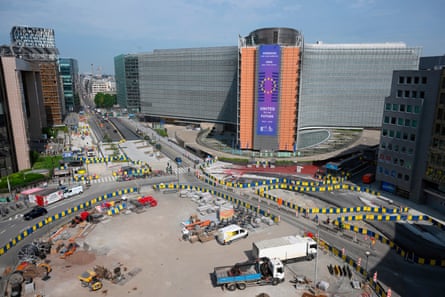
It did not turn out that way. The result, say critics, is Europe’s largest frying pan, a concrete expanse with little greenery or shade. While the number cars has reduced and the space is remodelled with smart grey paving, the centrepiece – a steel canopy with a green roof – was never built.
Pascal Smet, a former Brussels minister for mobility, who launched the project in 2015, said he was disappointed, angry and sad. “Schuman Square is the carte de visite [the calling card] of Brussels. It is the symbol of Europe,” he said from a cafe on the square. “This should be a meeting place for people.”
Outside on a humid July day around lunchtime, few were lingering on the vast concrete area.
An international competition resulted in a Belgian-Danish consortium of architects being chosen to redesign the space, promising an “urban agora”. The roundabout is named after Robert Schuman, the former French foreign minister, who is celebrated as a founding father of what became the European Union.
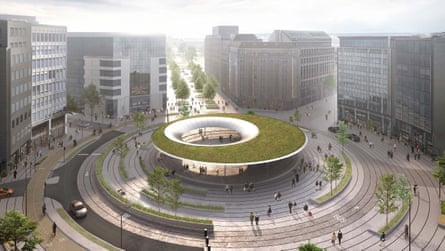
The canopy was to be the crowning glory. Planners imagined that EU officials and local people would lunch and chat under its shelter, which was modelled on the European parliament’s semi-circular chamber, the hemicycle.
Tourists, it was hoped, would flock to the landmark and take selfies in its mirrored reflection. The green roof would be a refreshing contrast to the surrounding glass and steel EU buildings, offering respite from the sun, a need underscored by the record-breaking heatwave that hit Belgium in June. It would also shelter people from more traditional Brussels weather – it rains about 200 days a year.
“The project is not finished,” its engineer-architect, Francis De Wolf, told the Belgian daily Le Soir. “It is very difficult for me to understand what has happened behind the scenes in politics.”
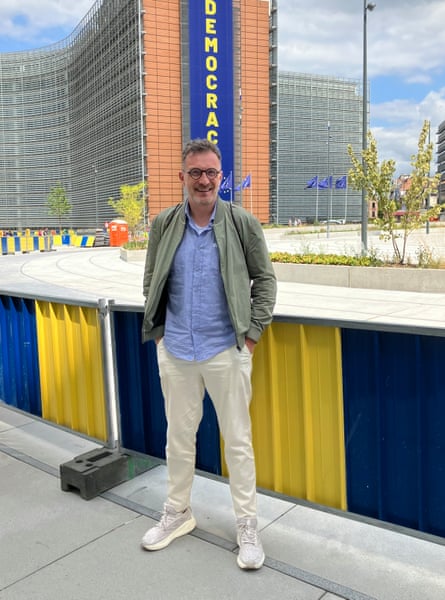
It was always going to be a complex project: majestic tall trees were out of the question as the square sits over an underground car tunnel, railway and metro station, and a maze of gas and water pipelines. Planners also have to take into account the security needs of the surrounding EU institutions and its use as a venue for frequent demonstrations. The square is within the security perimeter of the European Council building, the “space egg”, which hosts regular summits of EU leaders.
By the time work began in 2023 – six years after the winning design had been chosen – costs had spiralled as a result of high Europe-wide inflation stoked by the Covid pandemic and the Ukraine war, say city officials. The budget was announced as €25m (£21m) in 2023, with €17.4m from EU Covid recovery funds.
Then came a Brussels political crisis.
Power in Belgium is very decentralised and regional governments, including Brussels, have wide-ranging controls over public works, most transport and urban planning. The governance of Brussels is extra complicated: a bilingual city with 14 parties in the 89-seat parliament.
after newsletter promotion
After Brussels elections in June 2024 produced no clear result, parties were deadlocked over a new government for the city of 1.2 million people. Big construction projects were put on hold and investments were frozen. A coalition led by a Francophone liberal minister-president finally emerged this year after a record-breaking 613 days of negotiations.
In the interim, the caretaker government had been unable to authorise new funds to pay for the higher costs of the canopy, but faced a deadline to complete works in order not to lose EU funds. “So we were in quite a conundrum, because we did not have the right to put the money into the canopy,” said François Deschamps, a spokesperson for the Brussels minister for mobility and public works, Elke Van den Brandt, who has held the post since 2019.
The caretaker government in June 2025 appealed to the EU for a top-up. Their plea was shot down by Belgium’s prime minister, Bart De Wever, who denounced Brussels as “a failed state”. De Wever, a fiscal conservative on a mission to bring Belgium’s federal finances under control, argued that “begging” numerous European institutions for help was a national embarrassment.
Taking office in February 2026, the new Brussels government cancelled the canopy, whose costs had shot up from €13m from €5m, Deschamps said. The Brussels council of ministers decided, Deschamps said, “we could do something greener, something cheaper, and something that still fulfils the goal, which is to bring shade and refreshment”.
Brussels is in talks with architects to develop “something as green as possible within the building limitations of the square”, possibly with water features, Deschamps added. The city hopes the square will be finished by the summer of 2028, with details on the plans promised by the end of the year.
Smet continues to argue for the canopy, while more than 2,100 people have signed a petition, launched by the Brussels branch of his Flemish socialist party, calling for its construction. But Smet says he is open to other ideas: “If you can imagine something better, that allows demonstrations, [deals with] security issues, is green, is iconic, is symbolic for European unity … if the alternative is better, I will not say no.”