
Cyprus signs $1.8bn deal to develop first gas field, with exports to Europe via Egypt
The deal is a key step towards harnessing Cyprus' natural gas reserves and bolstering energy cooperation in the Eastern Mediterranean, with exports to Europe via Egypt and production due to start in 2028.
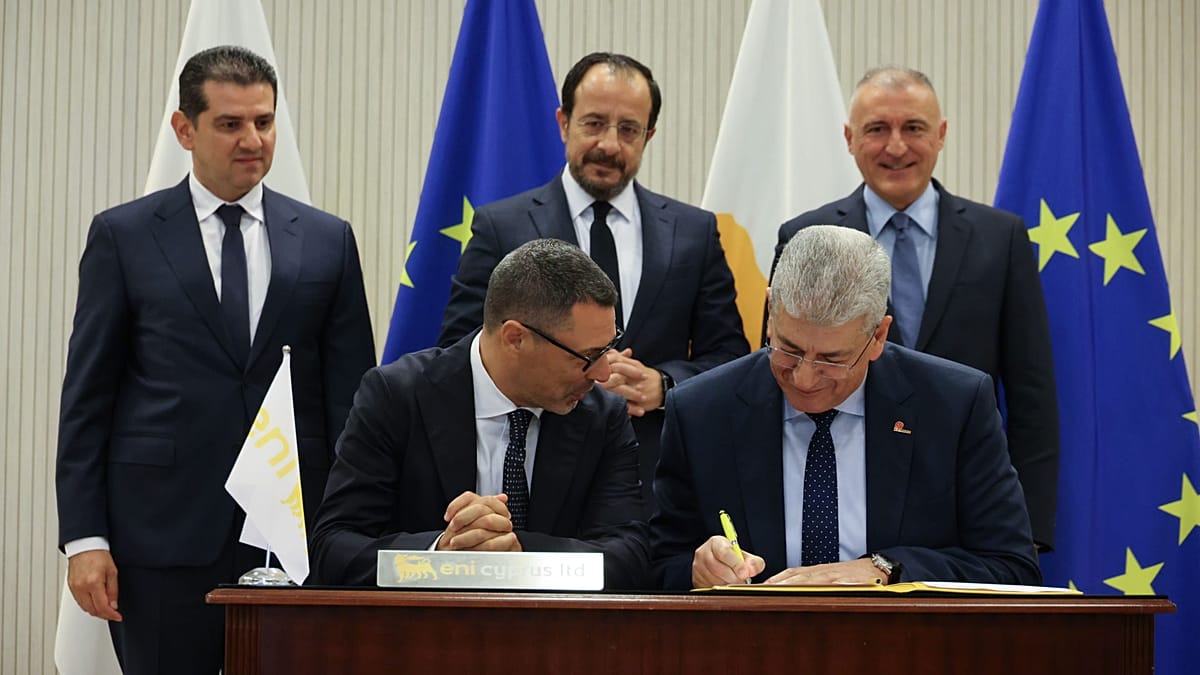
On Monday Italian energy group Eni signed contracts worth up to $1.8 billion (€1.61 billion) to build the infrastructure needed to develop the Kronos natural gas field inside Cyprus's Exclusive Economic Zone (EEZ). Eni's partner is French group Total, as the two companies will work together to mine the area.
The project aims to commercialise Cypriot natural gas via Egypt, with exports to international markets and Europe expected to begin once production starts, which is currently scheduled for 2028.
The agreements represent a major milestone in Cyprus's efforts to strengthen its position on the energy map of the Eastern Mediterranean, while also contributing to the diversification of Europe's natural gas supply sources.
The President of the Republic of Cyprus, Nikos Christodoulides, received an Eni delegation at the Presidential Palace, headed by the group's Chief Operating Officer of Global Natural Resources, Guido Brusco. This was followed by the contract-signing ceremony covering the design, equipment procurement, construction and installation of the infrastructure required for the development of the field.
The president of Cyprus, Nikos Christodoulides, issued a written statement on the agreement, in which he says among other things that "The signing of contracts worth up to $1.8 billion dollars for the development of the 'Kronos' field, and by extension the first commercial exploitation of Cypriot natural gas, constitutes a strong vote of confidence in our country's energy prospects, with particular geopolitical and economic significance."
In his speech, Brusco described the development as a historic milestone for Cyprus, as it is the country's first hydrocarbon field development project.
More than 3 trillion Cubic feet of gas
According to Brusco, the Kronos field holds estimated reserves of more than 3 trillion cubic feet (TCF) of natural gas, with production forecast to rise to as much as 500 million cubic feet per day once operations have stabilised.
The gas will be transported to Egypt, where it will be processed using existing infrastructure, including facilities linked to the Zohr field off the coast of Egypt.
It will then be fed into the Damietta liquefied natural gas plant, from where it will be exported to international markets, chiefly in Europe.
Using Egypt's existing infrastructure is a central pillar of the plan, as it enables the development of the field through regional energy partnerships and facilitates the commercial exploitation of the gas.
"Historic milestone for Cyprus"
The Eni executive underlined that the company has been active in Cyprus since 2013, investing for more than a decade in expertise, human resources and technological infrastructure.
He said the move of the Kronos project into the implementation phase is the result of this long-term effort and cooperation between the Republic of Cyprus, Egypt, Eni and TotalEnergies.
"It is our first development project in Cyprus and confirms our commitment to being a long-term partner in the country's energy future," he noted.
At the same time, he described the project as the starting point for a new chapter in Cyprus's energy industry, with the potential to strengthen the country's role on the regional energy map.
Brusco also referred to Egypt's contribution, stressing that cooperation between the two countries has shaped a viable route for the commercial exploitation of Kronos gas.
In closing, he emphasised that the start of implementation marks the launch of a complex energy project that demands high-level expertise, close coordination between all stakeholders and strict compliance with safety standards.
Kronos field: Production targeted to start in 2028
Eni and TotalEnergies decided in July to accelerate the project's roll-out, setting a target of starting production in the first half of 2028.
A key advantage is the ability to use existing infrastructure that is expected to reduce development costs and shorten the time needed to build the necessary facilities.
Cooperation between Cyprus, Greece, Egypt and Italy at the heart of energy strategy
Beyond the economic and commercial dimension of the project, the development of the Kronos field highlights the strategic importance of strengthening energy cooperation in the Eastern Mediterranean.
Cooperation between Cyprus, Greece, Egypt and Italy can become a key pillar of a broader energy corridor linking Eastern Mediterranean fields with the European market. Cyprus has the potential to produce new volumes of natural gas, Egypt has the processing and liquefaction facilities, Greece offers a strategic location and interconnections for channelling energy flows towards south-eastern and central Europe, while Italy provides an important entry point to one of the European Union's largest energy markets.
The harnessing of these capabilities creates scope for infrastructure investment, deepening trade ties and the development of new energy transport routes. At the same time, it can strengthen the negotiating position of European countries and mitigate risks arising from dependence on a limited number of suppliers and supply routes.
Europe's energy security and diversification of supplies
For Nicosia, the significance of the agreements goes beyond their immediate economic value. According to daily newspaper Phileleftheros, revenues from gas sales are not expected to begin flowing straight away.
Eni's commitment is a vote of confidence in Cyprus's prospects and reinforces the case for tapping Europe's own energy resources in order to reduce its reliance on external suppliers.
These developments take on particular importance at a time of heightened tensions in the Middle East and concern about the impact of the confrontation between the US and Iran around the Strait of Hormuz, one of the world's most important energy shipping lanes.
The risk of disruption to energy flows across the wider region underscores Europe's need to secure alternative supply sources and strengthen strategic partnerships with countries that possess energy resources and the infrastructure needed to export them.
In this context, the development of new fields in the Eastern Mediterranean can help diversify Europe's energy mix, limiting the risks associated with excessive dependence on specific countries or transport routes.
However, the actual contribution of Cypriot gas to Europe's energy security will depend on when production starts, the available export capacity, the commercial agreements in place and the conditions prevailing in global markets.
The exploitation of Kronos does not automatically mean replacing supplies from the US or Russia, but it can add another option to Europe's energy portfolio.
The companies implementing the project
As part of advancing the project, contracts are to be signed with specialised companies that will undertake specific tasks for the development of the field and the necessary infrastructure.
In particular:
- Baker Hughes: Design, supply and construction of subsea production systems.
- Dalmine: Works related to natural gas export pipelines and MEG transfer.
- TechnipFMC: Execution of works for flexible production lines.
- McDermott: Transport, offshore installation, tie-in and commissioning of subsea pipelines and equipment.
- Oceaneering: Construction of the main subsea control cables.
- CMHI: Construction and installation of a floating control unit.
- Petrojet: Construction of a new onshore natural gas pipeline in Egypt between Zohr and Damietta.
- Saipem: Provision of offshore drilling services using the Saipem 10000 drillship.
New energy projects in the Eastern Mediterranean
The Kronos field is part of a broader surge of activity in hydrocarbon exploration and development in the Eastern Mediterranean.
US energy giant Chevron is continuing talks on the development of the Aphrodite field, with its partners Israel's NewMed Energy and the UK's Shell.
At the same time, according to media reports, Shell has reached an agreement to sell its stake in the field to Hungarian energy group MOL, with the transaction expected to be completed in early 2027.
The progress of these projects will play a decisive role in Cyprus's ability to turn natural gas discoveries into commercially exploitable resources and to strengthen its participation in regional energy value chains.
The stakes, therefore, go beyond the development of another gas field. They concern the Eastern Mediterranean's ability to evolve into a reliable energy corridor for Europe, through investment, regional partnerships and infrastructure that connect production with European markets.
In this endeavour, closer cooperation between Cyprus, Greece and Egypt is particularly important, as it can combine the region's production potential with Europe's need for a safer, more diversified and competitive energy supply.