Medieval shipwreck in Lake Constance surprises underwater archaeologists
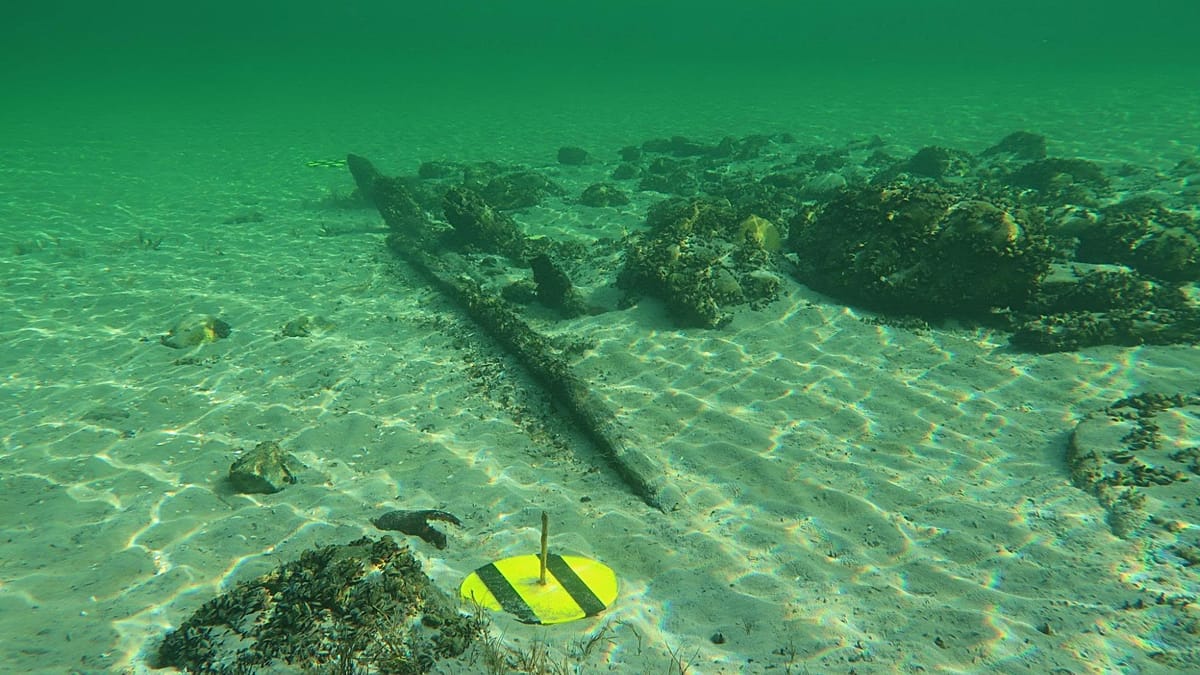
In an interview with Euronews, Prof Dr Tobias Pflederer of the Bavarian Society for Underwater Archaeology explains the discovery of wooden parts of a shipwreck in Lake Constance and what makes the find special.
By Kirsten Ripper & Euronews with BGfU
Published on 18/07/2026 - 8:00 GMT+2•Updated 10:31
Off Lindau in Lake Constance, underwater archaeologists have discovered wooden parts of a shipwreck that appear to be much older than initially assumed.
"The tip came from a recreational diver who knows the area well. He had already suspected it might be a wreck," reports archaeological research diver Prof. Dr Tobias Pflederer when asked by Euronews. In his main job he is a cardiologist in Kaufbeuren and a professor at the University of Erlangen, but he is also honorary president of the Bavarian Society for Underwater Archaeology (BGfU).
"The really exciting thing was that we were able to identify the wooden remains as a wreck. That was by no means clear at the outset. They could have been other wooden remains. But once several frames and parts of the hull were protruding from the lakebed surface, the interpretation was quickly obvious," explains Pflederer.
A frame is a load-bearing structural element of a boat, a ship or an aircraft. Connected frames form the ship’s hull, like ribs. The BGfU’s underwater archaeologists had previously found several, much heavier dugout boats in Lake Constance and also in Lake Chiemsee, some of which are on display at the Deutsches Museum in Munich.
The newly discovered medieval vessel is apparently between eight and twelve metres long. Its beam measures about three metres.
The frames and other wooden parts in Lake Constance, Germany’s largest inland body of water, were discovered off Lindau near the border with Austria. The opposite shore belongs to Switzerland.
Even last year, before the current heatwaves, water levels in Lake Constance were already at a historic low.
A shipwreck from the late Middle Ages
What really surprised the underwater archaeologists was the age of the shipwreck. "We had actually expected it to date from the modern period. There are already a few late-medieval wrecks in Lake Constance, but only a handful – so far just four. This wreck can therefore provide further insights into shipbuilding and navigation on Lake Constance in the late Middle Ages."
The analysis of a small wood sample – carried out in coordination with the Bavarian State Office for Monument Protection – showed that the wreck dates from between 1420 and 1450 AD, as the Schwäbische Zeitung also reports.
Underwater archaeologist Pflederer is extremely modest: "So far we have only carried out two dives and made an initial survey, that is, we produced orthophotographs and took a wood sample from one of the frames. Using radiocarbon (C14) dating we were then able to place the wreck in the 15th century AD."
Recovery would be extremely expensive
In contrast to the spectacular find of a ship’s cargo from Roman times in Lake Neuchâtel in Switzerland, no recovery of the wreck from Lake Constance is planned for the time being.
Tobias Pflederer says: "Recovery always means that the wreck parts have to be professionally conserved and preserved. That is an enormously expensive undertaking. Moreover, nothing is more conserving and protective than leaving the wreck underwater, ideally covered by sediment. A small-scale excavation is being considered in order to identify the ship’s construction method and its exact dimensions."
Further information on the association’s projects on several lakes can be found on the website of the Bavarian Society for Underwater Archaeology (source in German) (BGfU). The association has around 100 mostly volunteer members. They include professional archaeologists and trained research divers, but also students, experienced recreational divers and people who pursue underwater archaeology as a hobby.
Additional sources • Schwäbische Zeitung