Calls for killing of Trump at funeral of Iran supreme leader Ali Khamenei
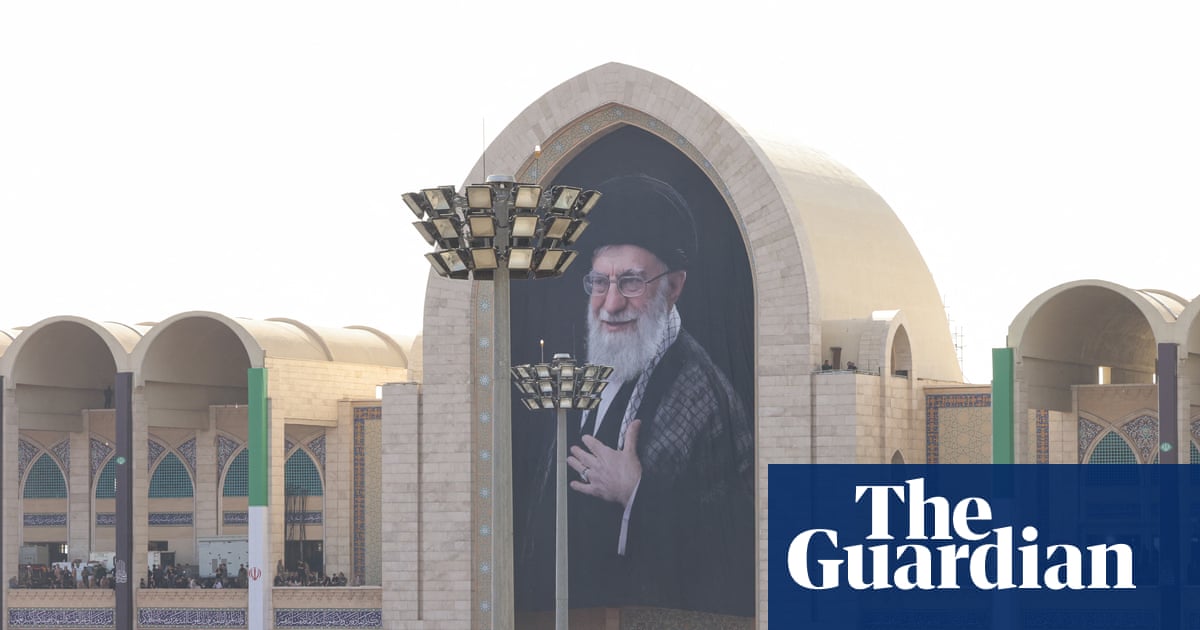
Beside the coffin of the assassinated former Iranian supreme leader Ali Khamenei at a packed prayer hall in Tehran on Sunday there were calls for the killing of Donald Trump.Iran is staging a week of mass...
Beside the coffin of the assassinated former Iranian supreme leader Ali Khamenei at a packed prayer hall in Tehran on Sunday there were calls for the killing of Donald Trump.
Iran is staging a week of mass funeral processions for Khamenei, who was killed along with other members of his family on the first day of the US and Israeli war on 28 February. The funeral was delayed because of the war.
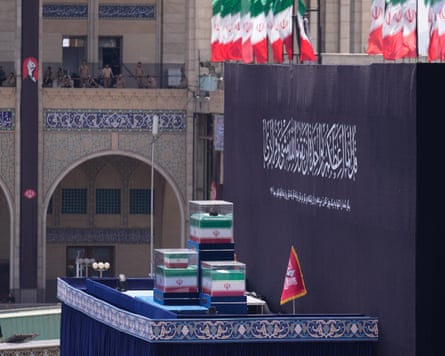
The funeral prayers for the former supreme leader and four other family members created a political spectacle at Tehran’s Imam Khomeini Grand Mosalla that melded grief with calls for revenge.
Many people had stayed in the mosque overnight or arrived well before dawn to be ready for the start of the prayer reading at 8am.
Holding Iranian flags and pictures of their martyred leader, and waving red flags symbolising vengeance the crowds were vastly larger and more militant than on Saturday, the first day of this elaborately conceived funeral designed to impress on the world that Iran has social resilience and determination to preserve its independence.
“From now on the shroud is our garment. I swear by your blood; Trump’s murder is our responsibility,” Mohammad Rasouli, a poet, said at a poetry recitation immediately before the prayer reading at the farewell ceremony. He asked: “Why is the most bastard man in the world still alive? The world is no longer a good place for Trump. Why should we not kill the man who killed our imam? It would be a disgrace if we did not.”
His scripted and authorised remark led to a mixed reaction, but most cheered enthusiastically.
Khalil Shirgholami, Iran’s ambassador to Armenia, said on X: “You can kill people, but you can’t kill ideals. You killed Ayatollah Khamenei, but in reality you broke a bottle of perfume, the fragrance of which has now spread everywhere.
“You will never understand this because you have no civilisation, no history, no honour.”
Mohammed Bagher Zolghadr, the secretary of the national security council, said: “People are shouting two slogans in farewell to their leader: resistance against enemies and revenge for the blood of the martyred leader of Iran.”
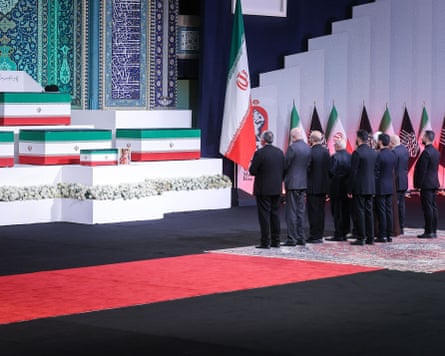
The main funeral prayers were led by Ayatollah Ja’far Sobhani, a 97-year-old cleric from Qom, but readings were given not just for Khamenei but for three other members of his family, including his daughter-in-law Zahra Haddad Adel, and his 14-month-old granddaughter Zahra Mohammadi Golpaygani. The size of the granddaughter’s coffin was one of the most poignant sights at the ceremony.
The absence from public view of Mojtaba Khamenei, Iran’s new supreme leader, since the death of his father, was made more conspicuous on Sunday when, unlike his three brothers, he was not seen in the mosque.
Appointed as supreme leader 10 days after his father’s death, Mojtaba has not appeared in public or recorded any audio message for three months, and did not attend his wife’s funeral last Thursday. His brothers, Mustafa, Massoud and Meysam, stood alongside one another beside their father’s coffin.
Most senior members of the Iranian government, including its political, military and judicial wings, also attended, suggesting Iranian officials have some kind of assurance that the ceasefire agreed with the US precludes any attack on the ceremony. The al-Quds force commander Esmail Qaani and IRGC commander Ahmad Vahidi were also in full view, something that was inconceivable in the early days of the war.
However, the determination to protect Mojtaba Khamenei at all costs may be understandable given the mindset of some Americans, revealed by Laura Loomer, a sometime confidante of President Trump. On social media she described the funeral as a “target-rich environment” while the US conservative commentator Mark Levin said the funeral had “been an opportunity lost”.
The streets surrounding the mosque were festooned with pictures of Mojtaba accompanying his father, while clerics had set up stalls distributing thick books containing collections of his speeches. Officials acknowledge that Mojtaba was injured in the attacks, but have said no permanent facial disfigurement or amputation occurred as a result of the deadly blast on the first day of the US-Israeli attacks.
On the stage where the coffins lay, mourners chalked up messages of love and grief for their killed leader, and messages of loyalty to his successor. One in English read: “Kill Trump.”
Many in the funeral crowd, as they stood in heat above 36C, waved red flags. The chant “No compromise, no surrender, only revenge” frequently filled the vast courtyard.
The space, said to hold 30,000 people, had been filled well before dawn. Some men dressed in white burial shrouds (kaffan) to demonstrate their willingness to die as martyrs for the “master of martyrs”. The mosque itself, despite 40 years of construction, remains incomplete, with swathes of the building under tarpaulin. Sanctions have delayed the construction, making the building a monument to the years of conflict with the west.
No official attendance figures were given but unofficially authorities claimed more than 2 million attended the opening day of the ceremony. The ceremony includes a mass procession on Monday in Tehran before the body is taken to the holy city of Qom, then transported to two holy cities in Iraq and then to its final resting place, Mashhad, where Khamenei was born in 1939.
Inadvertently, Trump played into the hands of the Iranian leadership when he expressed surprise at seeing mourners in tears saying: “I thought they hated him.” He speculated: “Perhaps they are fake tears.”
But the mourners’ grief appeared genuine, stricken by the loss of their spiritual leader and figurehead of Iran for nearly four decades. Many revealed they had travelled large distances with little income to be involved in the final farewell. Pilgrims were sleeping on the floor for three days in Tehran in makeshift dormitories in school classrooms or oil industry offices, or private houses. Mosques, districts and friends set up stalls surrounding the mosque area operating long into the night offering watermelons, kebab wraps and fruit juice to passersby. “We will fight the Americans with pitchforks if necessary,” said Leila Ahmadi from Boyer-Ahmad as she cheerfully served tea.
After midnight in Tehran, thousands of mourners filled the streets of the capital carrying flags and banners of Khamenei. There have been fiercely passionate nightly street rallies in many of the major squares in Tehran.
One who attended, Husain Dehghan, a 70-year-old book translator, explained: “The people had a sense of grief after the terrorist assassination of our leader so it is a sense of solidarity and a way to exchange information.
“People have been in a devastating state of shock from losing their leader. I know the west calls him a dictator, and he was not popular with every Iranian, but for the majority there was respect and affection for him.
“It is completely unacceptable to assassinate the major leader of another country when there was no declared war. In the middle of negotiations to start a war is pure deceit, and it shows the importance of Israel in US thinking. The aim may have been to subject Iran to US colonialism, but this is a nation with a long history and when a country is attacked, it is motivated since its survival is at stake.”
Referring to the mass protests against the regime that were brutally suppressed earlier this year, he added: “That is true of many of the young people that protested in January; they realise the Americans and Israelis do not have the goodwill of people in mind when they talked of regime change.”
Another long-term resident, Ibrahim Kalim, said: “I was very nearly killed in the street by an Israeli bomb. It was a matter of seconds.
“You cannot know the effect at night of counting 20 or more bombs landing just miles from you and trying to judge if they are coming closer as the house shakes, or the effect of seeing Israeli jet planes flying overhead. At one level it is humiliating.
“Many might want reform here, but it has to be a reform we shape. The Americans do not understand this. It is perfectly human to disagree with your government, and defend the nation in which you have been born if it is attacked.”
But only miles away in the middle-class northern Tehran district, a different cafe scene was under way with families without hijabs going to restaurants. Culturally this part of Tehran is not hugely different from the Emirates. All Iranians are going through tough economic times, but the pain is not equally distributed
The disparity in wealth between those who attend the funeral and those who do not is striking.