Banderol, Russia’s new low-cost weapon testing Ukraine’s air defences
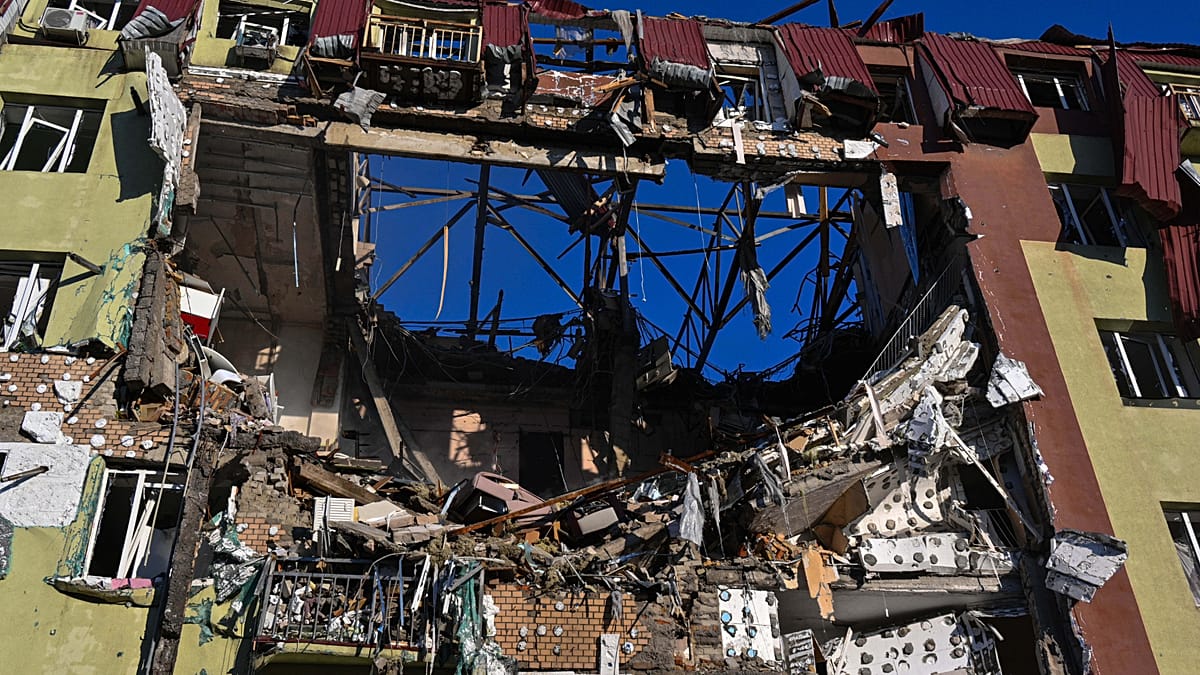
Russia is stepping up its use of the Banderol, a relatively cheap new weapon that carries a smaller warhead than conventional cruise missiles but can force Ukraine to use the same scarce and costly air defences to intercept it.
Published on 20/08/2026 - 12:29 GMT+2
Russia deployed Banderol munitions in its overnight large-scale attack on Ukraine on Thursday, in what has become Moscow’s growing use of a low-cost weapon designed to overwhelm Ukraine's air defences.
Ukraine’s Air Force said the Banderols were intercepted during a barrage that also included cruise missiles and Shahed-type drones.
First recorded in Ukraine in spring 2025, the Banderol has become an increasingly common weapon of Russian attacks.
Also known as the S8000, it is a small jet-powered loitering munition that combines features of a cruise missile and a jet-powered attack drone.
It is considerably cheaper and carries a smaller warhead than a conventional cruise missile, but can require many of the same sophisticated air-defence systems to bring it down.
That imbalance is what makes the weapon particularly troublesome for Ukraine. Russia can produce and launch Banderols relatively cheaply while forcing Kyiv to commit scarcer and potentially more costly resources to intercept them.
Cheap weapon, expensive problem
The way the Banderol is launched adds to the challenge it poses. Unlike cruise missiles fired from strategic bombers, its use does not require the deployment of aircraft, whose take-off can give Ukrainian forces additional warning of an impending attack.
Manufactured by Russia’s UAV maker Kronshtadt JSC, the Banderol is primarily launched from Orion reconnaissance drones manufactured at the same plant, but has also been integrated into Mi-28 helicopters.
It can travel at more than 500km/h and has a range of up to 500km.
Because of the limited range, Moscow forces are launching Banderol’s from Russian-occupied Crimea towards the Odesa region.
Ukraine's Presidential envoy for Sanctions Policy Vladyslav Vlasiuk said these missiles are involved in around 80% of Russian attacks on Odesa's infrastructure.
The weapon carries a 114kg fragmentation warhead containing up to 50kg of explosives. That is substantially smaller than the payloads of Russia’s Kh-101 and Iskander-K cruise missiles, which can carry warheads weighing roughly 400kg to 500kg.
But the Banderol’s significance lies less in its destructive power than in the economics of defending against it.
A Russian cruise missile can cost about €685,000 to produce, while the Banderol is estimated to cost between €42,500 and €127,500 depending on the components used.
That puts it broadly in the same price range as the Iranian-designed Shahed, one of the cheapest and most widely used weapons in Russia’s mass aerial attacks on Ukraine since 2022.
But the two pose different challenges for Ukrainian air defences. Shahed-type drones can increasingly be targeted with relatively inexpensive interceptor drones.
The faster Banderol requires more capable short- and mid-range air defence systems designed to counter cruise missiles, as well as MANPADS or fighter aircraft.
Russia may therefore be able to use Banderols not only to strike targets but to stretch the Ukrainian systems responsible for defending against more powerful cruise missiles.
The weapon relies on satellite navigation for guidance and can be disrupted by electronic warfare, but it also has an autonomous navigation system.
The Banderol also illustrates Russia’s continued ability to obtain foreign technology for its weapons industry despite Western sanctions and export restrictions imposed over the war.
According to Ukraine’s military intelligence agency HUR, the weapon contains a Chinese-made jet engine, a Japanese battery and predominantly US-made electronic components.