Poland's Top Economist: Germany’s economy needs “bold revolutionary approach”
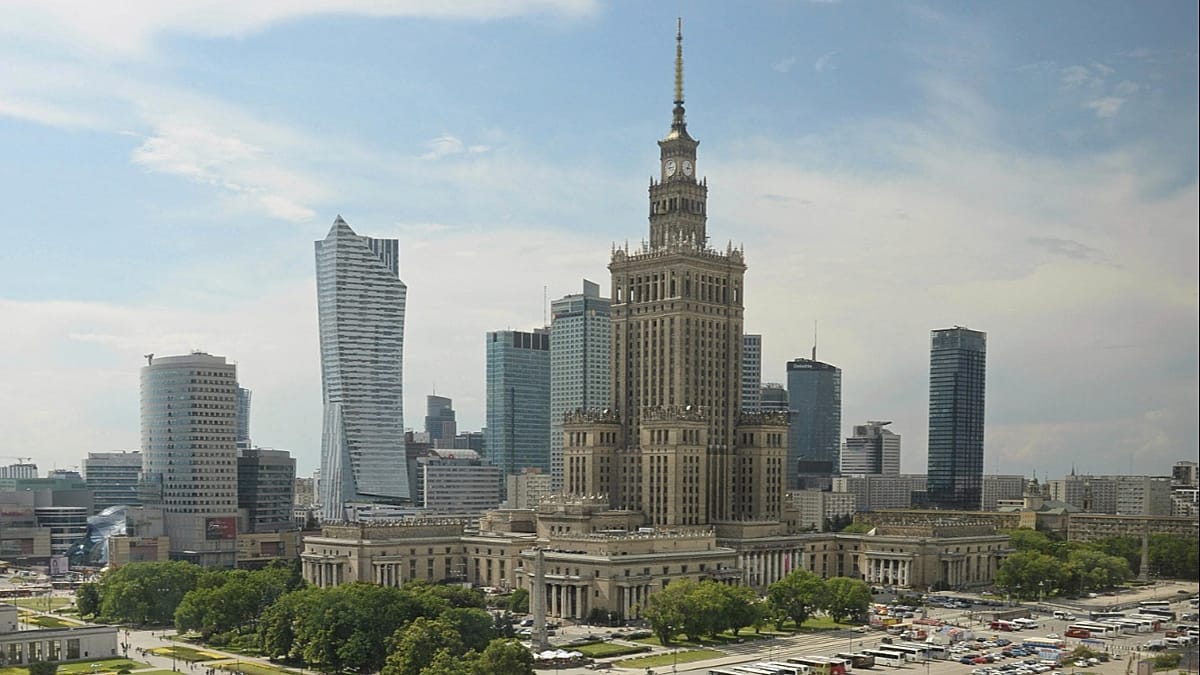
Germany is Europe's largest economy. Poland is Europe's most successful one. For economist Marcin Piątkowski, that sounds like a "match made in heaven." In an interview with Euronews, he explains what Germany can learn from Poland's remarkable economic success story.
While Germany continues to struggle with economic stagnation, Poland is expected to remain one of Europe's fastest-growing economies in the years ahead. "Germany needs more fear and more optimism at the same time," says Marcin Piątkowski, professor at Kozminski University, in an interview with Euronews.
Piątkowski became widely known for his bestselling book "Europe's Growth Champion: Insights from the Economic Rise of Poland", in which he examines how Poland transformed itself into one of the world's most successful economic catch-up stories after the fall of communism. He is also a former chief economist of PKO BP, the largest bank in Poland.
"Germany is Europe's biggest economy. Poland is Europe's most dynamic economy", he says. "Putting the two together could be a way to go." Read the full interview with Euronews.
Euronews: Poland seems to have outperformed almost every European economy since 1990. What is the evidence to back it up?
Piątkowski: Poland has been the fastest growing large economy in Europe since 1990. And it continues to do well. According to European Commission forecasts, Poland will continue to grow at an average rate of more than 3 percent this and next year, faster than any other large economy in Europe and more than three times faster than Germany.
Poland has not only done well in Europe but also globally. For the last 33 plus years, Poland has grown faster than South Korea, Singapore, Taiwan, and every other successful global economy. Poland has proven to be a true global economic star.
And I think there's not enough awareness in Europe and outside of Europe of this success. Poland has increased its income per person by 3.6 times in that period and has moved from being almost as poor as Jamaica in 1990 to now being richer than Japan or Spain.
Quite amazingly, Poland has managed this fast growth with flying colors. For instance, Poland's level of income inequality is now lower than in Sweden, which means that Poland has not only been a global and European growth champion, but that it has also managed to share this prosperity across the whole society. That's globally unprecedented.
Euronews: What explains this success? In your book "Europe's Growth Champion: Insights from the Economic Rise of Poland", you talk about the 5 E's as success drivers. What are they about?
Piątkowski: On the drivers of Poland's success, I like to summarize them into five E's because they're easy to remember. Egalitarianism, education, entrepreneurship, elites and the European Union.
Egalitarianism is the rare positive legacy of communism, which in 1989 left Poland with an inclusive society for the first time in its history, defined as the ability of people, regardless of their name, gender, place of birth or the wealth of their parents, to do well in life.
On education, Poland has had one of the largest educational booms in the region. Between 1990 and mid-2000s, it has increased the proportion of young people who go to university from 10 percent to 50 percent. For comparison, it's only 38 percent in Germany today.
The third is entrepreneurship. Poland has been lucky to have a sufficiently large domestic market that has sustained and generated a large group of strong domestically owned companies, which are now expanding abroad. In addition, Poland has developed one of the most diversified economies in Europe and the world, where no single product or industry predominates. Poland sells pretty much everything, from strawberries and dishwashers to drones, satellites, and luxury yachts. This high level of diversification allowed Poland to cope with external shocks much better than anyone else and become the only economy in Europe which has not experienced a recession since 1990, expect for a shallow dip during COVID.
As to the elites, Poland's economic policies have been much more pragmatic than elsewhere in Europe, and particularly in Germany. Among other things, Poland has avoided the scourge of fiscal fundamentalism. Polish policymakers understood that investing in growth is much more important than an abstract number on the proportion of debt to GDP.
And finally, the European Union – was it not for the open markets, the institutions, the rules of the game, the predictability of policies that the EU has given Poland – its level of income, according to most recent estimates, would be about 40% lower than it is. EU funds also helped, but they were at best responsible for less than one-fifth of the overall growth. Access to the European markets, institutions and the predictability that made Poland a safe destination for more than 350 billion euro of foreign investment were much more important.
Euronews: Many Germans still see Poland as an economy catching up. How important has Poland actually become for Germany's prosperity?
Piątkowski: German exports to Poland over the last 36 years have increased by 33 times from about 3 billion euros in 1990 to more than 100 billion euros predicted for this year. Poland is now a larger export market for Germany than China. Given the size of these exports, several hundred thousand jobs in Germany are sustained because of Poland's prosperity.
In addition, there are two other important win-wins for Germany. Was it not for being able to locate production in low-cost Poland and Central Europe, Germany's industrial competitiveness and its share in the global export markets would have declined much faster. And third, Germany gets about 5 billion euros of dividends per year from Poland alone on its investments, around one-fourth of its annual net contribution to the EU budget.
Euronews: Which lessons can Germany draw from Poland?
Piątkowski: Germany is of course still has a much more developed and mature economy and its challenges are different than in Poland, which is still catching up. That said, there are at least three key lessons that Poland may offer.
First, Poland’s product and labor markets are much more open and flexible than in Germany. This supported high level of entrepreneurship, strong competitive pressures and fast reallocation of resources across the economy, including labor.
Second, among young adults, Poland now has a higher share of university graduates than Germany and performs at least as well or sometimes better on many international
educational assessments for secondary school students. This helps Poland to absorb technology at a fast rate, something well visible in Poland’s technologically advanced cashless economy and increase labor productivity at a fast rate.
Third, Poland’s public investment, including in infrastructure, has been twice as high in proportion to GDP as in Germany over the past two decades. This has allowed Poland to build almost 6,000 kilometers of highways and expressways, invest in universities and science, and build a new digital economy. In Germany, public investment has unfortunately lagged. A recent International Monetary Fund (IMF) paper argued that restricted public investment, resulting from overly strict fiscal policies, has undermined German competitiveness.
Piątkowski: One, Poland's economy is much more liberal than German economy, so the product and labor markets are much more open than in Germany. Which suggests the level of the direction of reforms in Germany.
Second, there's much more entrepreneurship in Poland. The number of companies coming in and out of the market is just significantly higher than in Germany. It's supported by the dynamic economy, but the entrepreneurship is really there.
More young Poles are now better educated than young Germans. And perhaps that would be useful to also see how much more Germany can invest into the future generations.
Also because of the EU funds, the infrastructure in Poland is now in some ways better than in Germany, also because it's just brand new. Over the last 20 years, Poland has built 6000 kilometers of highways and expressways. Infrastructure investment is critical. The public investment in relation to GDP in Germany over the past few decades has been around 2.5% of GDP. Roughly only half of what Poland has been investing. So because of its fiscal fundamentalism, Germany has grossly underinvested in its future. A recent International Monetary Fund (IMF) report even picks up this point, saying that this fiscal fundamentalism has undermined investment that is critical for German competitiveness.
Euronews: What are Germany's biggest economic challenges today?
Piątkowski: Given the unprecedented challenges that the German economy is facing, and the fact that it’s been in economic stagnation since at least COVID, to start growing again Germany needs both a much more powerful dose of fiscal and monetary stimulus and much faster structural reforms. Germany has been way too timid on both accounts so far.
A much bolder, even revolutionary approach, will be needed for Germany to prevent further deindustrialization, mostly at the hands of China, and to identify new industries and sources of growth. Germany and the whole of Europe will also need to be much less fundamentalist about free trade: we can’t afford to be naive free traders anymore.
Euronews: How can Germany and Poland strengthen each other?
Piątkowski: Germany is Europe's biggest economy. Poland is Europe's most dynamic economy. Putting the two together could be a way to go. One way of doing this would be to promote joint ventures, mergers and acquisitions between German and Polish companies. Polish companies would bring high levels of cost competitiveness, dynamism, and energy needed to conquer European and global markets. German companies would bring access to global markets, global brands and advanced technologies. Together, they could successfully fight in the global markets. In addition, there are 231,000 small and medium enterprises in Germany, mostly family businesses, that do not have successors. They might die if someone does not help. Finding a dynamic Polish partner could a way to save them.
Another way to cooperate would be for Germany and Poland to agree on the same corporate, tax and labor law for new companies, perhaps starting from AI and innovative startups, in a more advanced version of the EU’s 28th regime idea for companies. This would mean that a company registered in Wurzburg or in Wroclaw would not need to worry about complying with different German and Polish corporate rules: they would be the same. This should allow fast scaling up which European startups need to be able to compete globally. Once proven successful, other EU member states would be tempted to join this initiative.
Euronews: What should Germany's economic vision for the next decade look like?
Piątkowski: I think Germany has to start taking much more risk. Among others, instead of saving fiscal resources for a "rainy day", which has already come, it should go "all in" and spend hundreds of billions of euros not only on the military, as useful as it is, but also on a fundamental transformation of German manufacturing based on new technologies, including AI.
Like China before, Germany should come up with its own "Made in Germany 2035" plan and then do everything to make it happen, for the benefit of Germany, Poland and Europe as a whole.