Climate shocks are pushing Gaza’s fragile systems ‘closer to collapse’, warns humanitarian expert
Climate change is intensifying humanitarian crises in Gaza and beyond, as extreme heat, damaged infrastructure and disease outbreaks push already fragile systems “closer to collapse”. New research led by...
Climate change is intensifying humanitarian crises in Gaza and beyond, as extreme heat, damaged infrastructure and disease outbreaks push already fragile systems “closer to collapse”.
New research led by Queen Mary University of London estimates that the Israel-Gaza war has generated around 33 million tonnes of carbon dioxide equivalent (CO₂e) so far.
This is the equivalent of Jordan’s annual emissions, or 7.6 million petrol cars on the road.
The study, published in the science journal One Earth in April, found that emissions from active military operations alone, such as from artillery, rockets and other military equipment, have exceeded 1.3 million tonnes of CO₂e.
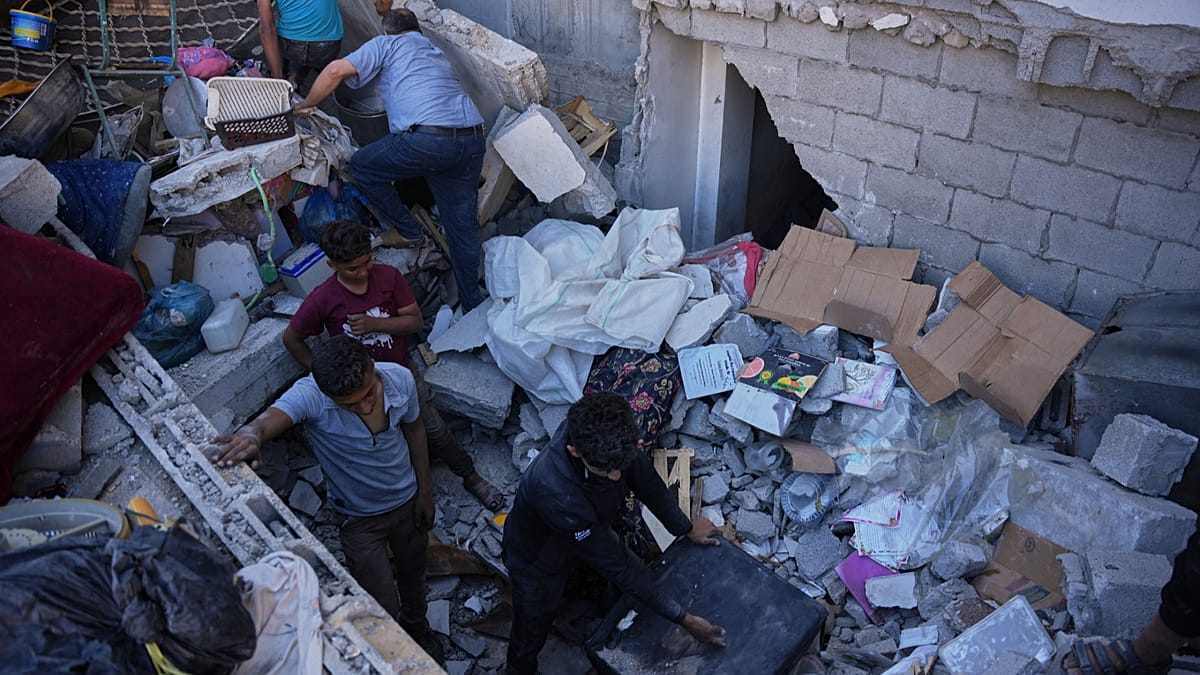
Other emissions are linked to the construction of defensive infrastructure and the "substantial carbon footprint” associated with rebuilding damaged roads, buildings and other essential infrastructure.
The ‘overlooked’ environmental impact of war
“Understanding the environmental impacts of conflict is essential if we are to fully account for the drivers of climate change,” says Dr Frederick Otu-Larbi from Lancaster University and the University of Energy and Natural Resources in Ghana.
“Greater transparency around military emissions will help ensure these impacts are no longer overlooked.”
Calls to include military emissions in a country’s carbon footprint and recognise the climate impact of conflict have become louder in recent years.
Last year, Ukraine demanded Russia pay a staggering €37 billion, in what would be the world’s first case of climate reparations from war, due to the impact its full-scale invasion has had on the global environment.
Climate-fuelled extreme weather in Gaza
However, global warming itself compounds crises like the one in Gaza, as humanitarian experts call for climate adaptation to become an integrated part of aid efforts.
Last summer, a deadly heatwave saw temperatures in Gaza surpass 40°C, increasing the risk of dehydration and spoiling essential food supplies. Gazans were forced to endure the soaring temperatures, with thousands left without protection from intense heat due to forced displacement and limited electricity.
As heat-trapping greenhouse gases continue to bake the planet, the frequency and intensity of heatwaves are only projected to get worse.
There’s a 91 per cent chance that at least one of the next five years will shoot past the 1.5°C threshold and an 86 per cent chance that one of those years will smash the record for Earth’s hottest year set in 2024, according to the World Meteorological Organisation (WMO).
For every 1℃ rise in air temperature, the atmosphere can hold around seven per cent more moisture, which can lead to more intense and heavy rainfall.
In March, heavy rainstorms transformed streets into stagnant lakes, damaging the shelters of more than 3,000 displaced Gazans.
According to UNICEF, at least 11 children, including several newborns, died from hypothermia by early February due to prolonged exposure to cold, wet and windy conditions.
The UN aid coordination office (OCHA) says that around 800,000 people, almost 40 per cent of the Gazan population, now live in sites prone to flooding.
Climate change is worsening public health risks
Rising temperatures, along with water scarcity, overcrowding, sewage overflow and damaged sanitation systems, are creating severe public health risks.
“Humanitarian agencies have repeatedly warned that heat and unsafe water are contributing to the spread of diarrhoeal disease, hepatitis A, skin infections and other communicable illnesses,” Asif Hussain, CEO of UK aid charity SKT Welfare, tells Euronews Earth.
Hussain explains that rodent and insect infestations are also now being reported as a part of the environmental crisis in Gaza.
“When waste accumulates, sewage systems collapse, temperatures rise, and large populations are displaced into overcrowded areas, the conditions for disease transmission escalate rapidly,” he adds.
It’s a problem that isn’t exclusive to Palestine. Hussain notes that in parts of Yemen, Pakistan and other “fragile settings”, climate-driven shifts in rainfall, prolonged drought and rising temperatures are no longer occasional shifts.
“They’re becoming structural conditions that directly affect water access, food production, livelihoods and local economies,” he warns.
“Authorities and humanitarian actors need to stop treating climate adaptation as something separate from emergency response.”
Climate shocks overlap with humanitarian crises
SKT Welfare is urging policymakers to invest in resilient water and sanitation systems, strengthen disease surveillance and expand sustainable energy access through technology like solar.
“Once infrastructure collapses under combined conflict and climate pressures, the public health consequences escalate very quickly,” Hussain warns.
The humanitarian expert worries that crises are becoming increasingly layered and prolonged, as the world edges towards a reality where conflict, food insecurity, displacement, environmental degradation and climate shocks overlap.
“Communities will face repeated emergencies with less time and fewer resources to recover between them,” he adds.
“When healthcare systems are weakened, sanitation infrastructure is damaged, temperatures rise, and populations are displaced into overcrowded environments, outbreaks become far more difficult to contain.
“That’s why climate resilience can no longer be viewed as supplementary to humanitarian response. In many contexts, it’s becoming essential to sustaining the humanitarian response itself.”